


Page 1544 - Williams Hematology ( PDFDrive )
P. 1544
1518  Part XI:  Malignant Lymphoid Diseases                     Chapter 91:  Acute Lymphoblastic Leukemia            1519


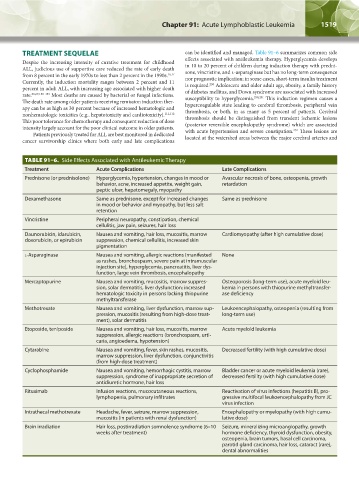
                  TREATMENT SEQUELAE                                    can be identified and managed. Table 91–6 summarizes common side
                  Despite the increasing intensity of curative treatment for childhood   effects associated with antileukemia therapy. Hyperglycemia develops
                  ALL, judicious use of supportive care reduced the rate of early death   in 10 to 20 percent of children during induction therapy with predni-
                  from 8 percent in the early 1970s to less than 2 percent in the 1990s. 16,17    sone, vincristine, and l-asparaginase but has no long-term consequence
                  Currently, the  induction  mortality  ranges  between  2  percent  and  11   nor prognostic implication; in some cases, short-term insulin treatment
                                                                                 250
                  percent in adult ALL, with increasing age associated with higher death   is required.  Adolescent and older adult age, obesity, a family history
                  rate. 66,67,150–153  Most deaths are caused by bacterial or fungal infections.   of diabetes mellitus, and Down syndrome are associated with increased
                                                                                                250,251
                  The death rate among older patients receiving remission induction ther-  susceptibility to hyperglycemia.   This induction regimen causes a
                  apy can be as high as 30 percent because of increased hematologic and   hypercoagulable state leading to cerebral thrombosis, peripheral vein
                  nonhematologic toxicities (e.g., hepatotoxicity and cardiotoxicity). 111,112    thrombosis, or both, in as many as 5 percent of patients. Cerebral
                  This poor tolerance for chemotherapy and consequent reduction of dose   thrombosis should be distinguished from transient ischemic lesions
                  intensity largely account for the poor clinical outcome in older patients.  (posterior reversible encephalopathy syndrome) which are associated
                                                                                                             252
                     Patients previously treated for ALL are best monitored in dedicated   with acute hypertension and severe constipation.  These lesions are
                  cancer survivorship clinics where both early and late complications   located at the watershed areas between the major cerebral arteries and


                   TABLE 91–6.  Side Effects Associated with Antileukemic Therapy
                   Treatment               Acute Complications                       Late Complications
                   Prednisone (or prednisolone)  Hyperglycemia, hypertension, changes in mood or   Avascular necrosis of bone, osteopenia, growth
                                           behavior, acne, increased appetite, weight gain,    retardation
                                           peptic ulcer, hepatomegaly, myopathy
                   Dexamethasone           Same as prednisone, except for increased changes   Same as prednisone
                                           in mood or behavior and myopathy, but less salt
                                           retention
                   Vincristine             Peripheral neuropathy, constipation, chemical
                                           cellulitis, jaw pain, seizures, hair loss
                   Daunorubicin, idarubicin,   Nausea and vomiting, hair loss, mucositis, marrow   Cardiomyopathy (after high cumulative dose)
                   doxorubicin, or epirubicin  suppression, chemical cellulitis, increased skin
                                           pigmentation
                   l-Asparaginase          Nausea and vomiting, allergic reactions (manifested   None
                                           as rashes, bronchospasm, severe pain at intramuscular
                                           injection site), hyperglycemia, pancreatitis, liver dys-
                                           function, large vein thrombosis, encephalopathy
                   Mercaptopurine          Nausea and vomiting, mucositis, marrow suppres-  Osteoporosis (long-term use), acute myeloid leu-
                                           sion, solar dermatitis, liver dysfunction: increased   kemia in persons with thiopurine methyltransfer-
                                           hematologic toxicity in persons lacking thiopurine   ase deficiency
                                           methyltransferase
                   Methotrexate            Nausea and vomiting, liver dysfunction, marrow sup-  Leukoencephalopathy, osteopenia (resulting from
                                           pression, mucositis (resulting from high-dose treat-  long-term use)
                                           ment), solar dermatitis
                   Etoposide, teniposide   Nausea and vomiting, hair loss, mucositis, marrow   Acute myeloid leukemia
                                           suppression, allergic reactions (bronchospasm, urti-
                                           caria, angioedema, hypotension)
                   Cytarabine              Nausea and vomiting, fever, skin rashes, mucositis,   Decreased fertility (with high cumulative dose)
                                           marrow suppression, liver dysfunction, conjunctivitis
                                           (from high-dose treatment)
                   Cyclophosphamide        Nausea and vomiting, hemorrhagic cystitis, marrow   Bladder cancer or acute myeloid leukemia (rare),
                                           suppression, syndrome of inappropriate secretion of   decreased fertility (with high cumulative dose)
                                           antidiuretic hormone, hair loss
                   Rituximab               Infusion reactions, mucocutaneous reactions,   Reactivation of virus infections (hepatitis B), pro-
                                             lymphopenia, pulmonary infiltrates      gressive multifocal leukoencephalopathy from JC
                                                                                     virus infection
                   Intrathecal methotrexate  Headache, fever, seizure, marrow suppression,   Encephalopathy or myelopathy (with high cumu-
                                           mucositis (in patients with renal dysfunction)  lative dose)
                   Brain irradiation       Hair loss, postirradiation somnolence syndrome (6–10  Seizure, mineralizing microangiopathy, growth
                                           weeks after treatment)                    hormone deficiency, thyroid dysfunction, obesity,
                                                                                     osteopenia, brain tumors, basal cell carcinoma,
                                                                                     parotid gland carcinoma, hair loss, cataract (rare),
                                                                                     dental abnormalities


          Kaushansky_chapter 91_p1505-1526.indd   1519                                                                  9/21/15   12:20 PM

