


Page 1546 - Williams Hematology ( PDFDrive )
P. 1546
1520  Part XI:  Malignant Lymphoid Diseases                     Chapter 91:  Acute Lymphoblastic Leukemia            1521


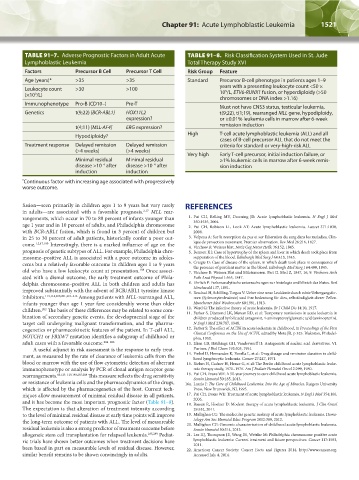
                   TABLE 91–7.  Adverse Prognostic Factors in Adult Acute   TABLE 91–8.  Risk Classification System Used in St. Jude
                   Lymphoblastic Leukemia                                Total Therapy Study XVI
                   Factors          Precursor B Cell  Precursor T Cell   Risk Group  Feature
                   Age (years)*     >35              >35                 Standard   Precursor B-cell phenotype in patients ages 1–9
                   Leukocyte count   >30             >100                           years with a presenting leukocyte count <50 ×
                                                                                      9
                   (×10 /L)                                                         10 /L, ETV6-RUNX1 fusion, or hyperdiploidy (>50
                      9
                                                                                    chromosomes or DNA index >1.16)
                   Immunophenotype  Pro-B (CD10–)    Pre-T
                                                                                    Must not have CNS3 status, testicular leukemia,
                   Genetics         t(9;22) [BCR-ABL1]  HOX11L2                     t(9;22), t(1;19), rearranged MLL gene, hypodiploidy,
                                                     expression?                    or ≥0.01% leukemia cells in marrow after 6-week
                                    t(4;11) [MLL-AF4]  ERG expression?              remission induction
                                    Hypodiploidy?                        High       T-cell acute lymphoblastic leukemia (ALL) and all
                                                                                    cases of B-cell precursor ALL that do not meet the
                   Treatment response  Delayed remission   Delayed remission        criteria for standard or very-high-risk ALL
                                    (>4 weeks)       (>4 weeks)
                                                                         Very high  Early T-cell precursor, initial induction failure, or
                                    Minimal residual   Minimal residual             ≥1% leukemic cells in marrow after 6-week remis-
                                    disease >10  after   disease >10  after         sion induction
                                            –4
                                                             –4
                                    induction        induction
                  * Continuous factor with increasing age associated with progressively
                  worse outcome.

                  fusion—seen primarily in children ages 1 to 9 years but very rarely   REFERENCES
                  in adults—are associated with a favorable prognosis. 2,17   MLL rear-
                  rangements, which occur in 70 to 80 percent of infants younger than     1.  Pui  CH,  Relling  MV,  Downing  JR:  Acute  lymphoblastic  leukemia.  N Engl J Med
                                                                           350:1535, 2004.
                  age 1 year and in 10 percent of adults, and Philadelphia chromosome     2.  Pui CH, Robison LL, Look AT: Acute lymphoblastic leukemia. Lancet 371:1030,
                  with BCR-ABL1 fusion, which is found in 3 percent of children but   2008.
                  in 25 to 30 percent of adult patients, historically confer a poor out-    3.  Velpeau A: Sur la resorption du pus et sur l’alteration du sang dans les maladies, Clin-
                                                                           ique de persection nenemant. Premier observation. Rev Med 26:216, 1827.
                  come. 1,2,17,199  Interestingly, there is a marked influence of age on the     4.  Virchow R: Weisses blut. Notiz Geg Natur Heilk 36:152, 1845.
                  prognosis of genetic subtypes of ALL. For example, Philadelphia chro-    5.  Bennett JH: Case of hypertrophy of the spleen and liver in which death took place from
                  mosome–positive ALL is associated with a poor outcome in adoles-  suppuration of the blood. Edinburgh Med Surg J 64:413, 1845.
                  cents but a relatively favorable outcome in children ages 1 to 9 years     6.  Craigie D: Case of disease of the spleen, in which death took place in consequence of
                                                                           the presence of purulent matter in the blood. Edinburgh Med Surg J 64:400, 1845.
                  old who have a low leukocyte count at presentation.  Once associ-    7.  Virchow R: Weisses Blut und Milztumoren. Part II. Med Z, 1847, 16, 9. Virchows Arch
                                                         198
                  ated with a dismal outcome, the early treatment outcome of Phila-  Path Anat Physiol 1:565, 1847.
                  delphia chromosome–positive ALL in both children and adults has     8.  Ehrlich P: Farbenanalytische untersuchungen zur histologie und klinick des blutes. Berl
                                                                           Hirschwald 137, 1891.
                  improved substantially with the advent of BCR/ABL1 tyrosine kinase     9.  Reschad H, Schilling-Torgau V: Ueber eine neue Leukämie durch echte Uebergangsfor-
                  inhibitors. 113,114,200,201,210–216  Among patients with MLL-rearranged ALL,   men (Splenozytenleuämie) und ihre bedeutung für dies, selbständigkeit dieser Zellen.
                  infants younger than age 1 year fare considerably worse than older   Munchener Med Wochenschr 60:1981, 1913.
                  children.  The basis of these differences may be related to some com-    10.  Ward G: The infective theory of acute leukemia. Br J Child Dis 14:10, 1917.
                        202
                  bination of secondary genetic events, the developmental stage of the     11.  Farber S, Diamond LK, Mercer RD, et al: Temporary remissions in acute leukemia in
                                                                           children produced by folic acid antagonist, 4-aminopteroylglumatic acid (aminopterin).
                  target cell undergoing malignant transformation, and the pharma-  N Engl J Med 238:787, 1948.
                  cogenetics or pharmacokinetic features of the patient. In T-cell ALL,     12.  Farber S: The effect of ACTH in acute leukemia in childhood, in Proceedings of the First
                  NOTCH1 or FBXW7 mutation identifies a subgroup of childhood or   Clinical Conference on the Use of ACTH, edited by Mote JR, p 325. Blakiston, Philadel-
                                                                           phia, 1950.
                  adult cases with a favorable outcome. 284–286           13.  Elion GB, Hitchings GH, Vanderwerff H: Antagonists of nucleic acid derivatives. VI.
                     A useful adjunct in risk assessment is the response to early treat-  Purines. J Biol Chem 192:505, 1951.
                  ment, as measured by the rate of clearance of leukemia cells from the     14.  Pinkel D, Hernandez K, Borella L, et al: Drug dosage and remission duration in child-
                                                                           hood lymphocytic leukemia. Cancer 27:247, 1971.
                  blood or marrow with the use of flow cytometric detection of aberrant     15.  Riehm H, Gadner H, Henze G, et al: The Berlin childhood acute lymphoblastic leuke-
                  immunophenotype or analysis by PCR of clonal antigen receptor gene   mia therapy study, 1970–1976. Am J Pediatr Hematol Oncol 2:299, 1980.
                  rearrangements. 83,123–129,190,287,288  This measure reflects the drug sensitivity     16.  Pui CH, Evans WE: A 50-year journey to cure childhood acute lymphoblastic leukemia.
                                                                           Semin Hematol 50:185, 2013.
                  or resistance of leukemia cells and the pharmacodynamics of the drugs,     16a. Laszlo J: The Cure of Childhood Leukemia: Into the Age of Miracles. Rutgers University
                  which is affected by the pharmacogenetics of the host. Current tech-  Press, New Brunswick, NJ, 1995.
                  niques allow measurement of minimal residual disease in all patients,     17.  Pui CH, Evans WE: Treatment of acute lymphoblastic leukemia. N Engl J Med 354:166,
                                                                           2006.
                  and it has become the most important prognostic factor (Table 91–8).     18.  Bassan R, Hoelzer D: Modern therapy of acute lymphoblastic leukemia. J Clin Oncol
                  The expectation is that alteration of treatment intensity according   29:532, 2011.
                  to the level of minimal residual disease at early time points will improve     19.  Mullighan CG: The molecular genetic makeup of acute lymphoblastic leukemia. Hema-
                  the long-term outcome of patients with ALL. The level of measureable   tology Am Soc Hematol Educ Program 2012:389, 2012.
                  residual leukemia is also a strong predictor of treatment outcome before     20.  Mullighan CG: Genomic characterization of childhood acute lymphoblastic leukemia.
                                                                           Semin Hematol 50:314, 2013.
                  allogeneic stem cell transplantation for relapsed leukemia. 235,289  Pediat-    21.  Lee HJ, Thompson JE, Wang ES, Wetzler M: Philadelphia chromosome-positive acute
                  ric trials have shown better outcomes when treatment decisions have   lymphoblastic leukemia: Current treatment and future perspectives. Cancer 117:1583,
                                                                           2011.
                  been based in part on measurable levels of residual disease. However,     22.  American Cancer Society: Cancer Facts and Figures 2014. http://www.cancer.org.
                  similar benefit remains to be shown convincingly in adults.  Accessed July 4, 2014.


          Kaushansky_chapter 91_p1505-1526.indd   1521                                                                  9/21/15   12:20 PM

