


Page 1582 - Williams Hematology ( PDFDrive )
P. 1582
1556  Part XI:  Malignant Lymphoid Diseases                                Chapter 93:  Hairy Cell Leukemia          1557


                                                                        those seen in splenic  marginal lymphoma with villous lymphocytes.
                                                                        Patients usually have very large spleens, leukopenia, and thrombocy-
                                                                        topenia. The immunophenotypic profile shows strong expression of
                                                                        CD20 and negative staining for CD25, CD11c, CD123, and annexin.
                                                                        This indolent lymphoma has been reported to respond to splenectomy.
                                                                            There are patients with classic appearing HCL who have molecular
                                                                        features suggesting that there may be more than one molecular “variant”
                                                                        of this disease. For example, patients with a classic immunophenotype
                  H&E                       Reticulin                   who are BRAF V600E mutation-negative and use the immunoglobulin
                                                                        VH4–34 have a worse prognosis than those with HCL-c, despite hav-
                                                                        ing identical immunophenotypic markers. 19,35  Patients with unmutated
                                                                        immunoglobulin gene rearrangement and those harboring a p53 muta-
                                                                        tion also have a worse prognosis, indicating that these molecular fea-
                                                                        tures potentially define yet another form of this disease.  Further study
                                                                                                                31
                                                                        of the molecular prognostic features will hopefully identify informa-
                                                                        tion that will enable improvement in selection of appropriate therapy.
                                                                                                                          19
                                                                        Establishing an accurate diagnosis of HCL or one of the clinical entities
                  CD20                      V600E BRAF
                                                                        that mimic this disease by including a complete set of immunopheno-
                                                                        typic and molecular markers is essential in selecting the best therapeutic
                                                                        option for each patient (Table 93–1).

                                                                           THERAPY
                                                                        CRITERIA FOR INITIATION OF TREATMENT
                                                                        Patients with HCL should be treated for symptoms related to the disease
                  Annexin A1                DBA44
                                                                        or for deterioration in blood counts. Patients may have symptoms asso-
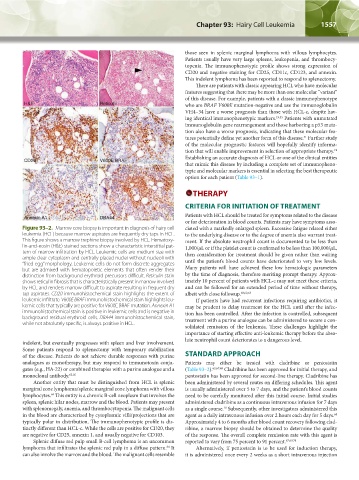
                  Figure 93–2.  Marrow core biopsy is important in diagnosis of hairy cell   ciated with a markedly enlarged spleen. Excessive fatigue related either
                  leukemia (HCL) because marrow aspirates are frequently dry taps in HCL.   to the underlying disease or to the degree of anemia also warrant treat-
                  This figure shows a marrow trephine biopsy involved by HCL. Hematoxy-  ment. If the absolute neutrophil count is documented to be less than
                  lin-and-eosin (H&E) stained sections show a characteristic interstitial pat-  1,000/μL or if the platelet count is confirmed to be less than 100,000/μL,
                  tern of marrow infiltration by HCL. Leukemic cells are medium size with   then consideration for treatment should be given rather than waiting
                  ample clear cytoplasm and centrally placed nuclei without nucleoli with   until the patient’s blood counts have deteriorated to very low levels.
                  “fried egg” morphology. Leukemic cells do not form discrete aggregates
                  but are admixed with hematopoietic elements that often render their   Many patients will  have  achieved these low hematologic parameters
                  distinction from background erythroid precursors difficult. Reticulin stain   by the time of diagnosis, therefore meriting prompt therapy. Approx-
                  shows reticulin fibrosis that is characteristically present in marrow involved   imately 10 percent of patients with HCL-c may not meet these criteria,
                  by HCL and renders marrow difficult to aspirate resulting in frequent dry   and can be followed for an extended period of time without therapy,
                  tap aspirates. CD20 immunohistochemical stain highlights the extent of   albeit with close followup. 60,62,63
                  leukemic infiltrate. V600E BRAF immunohistochemical stain highlights leu-  If patients have had recurrent infections requiring antibiotics, it
                  kemic cells that typically are positive for V600E BRAF mutation. Annexin A1   may be prudent to delay treatment for the HCL until after the infec-
                  immunohistochemical stain is positive in leukemic cells and is negative in   tion has been controlled. After the infection is controlled, subsequent
                  background residual erythroid cells. DBA44 immunohistochemical stain,   treatment with a purine analogue can be administered to secure a con-
                  while not absolutely specific, is always positive in HCL.
                                                                        solidated remission of the leukemia. These challenges highlight the
                                                                        importance of starting effective anti-leukemic therapy before the abso-
                                                                        lute neutrophil count deteriorates to a dangerous level.
                  indolent, but eventually progresses with spleen and liver involvement.
                  Some patients respond to splenectomy with temporary stabilization
                  of the disease. Patients do not achieve durable responses with purine   STANDARD APPROACH
                  analogues as monotherapy, but may respond to immunotoxin conju-  Patients may either be treated with cladribine or pentostatin
                  gates (e.g., HA-22) or combined therapies with a purine analogue and a   (Table 93–2). 62,67,68  Cladribine has been approved for initial therapy, and
                  monoclonal antibody. 65,66                            pentostatin has been approved for second-line therapy. Cladribine has
                     Another entity that must be distinguished from HCL is splenic   been administered by several routes on differing schedules. This agent
                  marginal zone lymphoma/splenic marginal zone lymphoma with villous   is usually administered over 5 to 7 days, and the patient’s blood counts
                  lymphocytes.  This entity is a chronic B-cell neoplasm that involves the   need to be carefully monitored after this initial course. Initial studies
                           64
                  spleen, splenic hilar nodes, marrow and the blood. Patients may present   administered cladribine as a continuous intravenous infusion for 7 days
                  with splenomegaly, anemia, and thrombocytopenia. The malignant cells   as a single course.  Subsequently, other investigators administered this
                                                                                     10
                  in the blood are characterized by cytoplasmic villi/projections that are   agent as a daily intravenous infusion over 2 hours each day for 5 days.
                                                                                                                          68
                  typically polar in distribution. The immunophenotypic profile is dis-  Approximately 4 to 6 months after blood count recovery following clad-
                  tinctly different than HCL-c. While the cells are positive for CD20, they   ribine, a marrow biopsy should be obtained to determine the quality
                  are negative for CD25, annexin 1, and usually negative for CD103.  of the response. The overall complete remission rate with this agent is
                     Splenic diffuse red pulp small B-cell lymphoma is an uncommon   reported to vary from 75 percent to 91 percent. 67,69,70
                                                                  64
                  lymphoma that infiltrates the splenic red pulp in a diffuse pattern.  It   Alternatively, if pentostatin is to be used for induction therapy,
                  can also involve the marrow and the blood. The malignant cells resemble   it is administered once every 2 weeks as a short intravenous injection


          Kaushansky_chapter 93_p1553-1562.indd   1557                                                                  9/18/15   3:47 PM

