


Page 1583 - Williams Hematology ( PDFDrive )
P. 1583
1558           Part XI:  Malignant Lymphoid Diseases                                                                                                                                    Chapter 93:  Hairy Cell Leukemia         1559


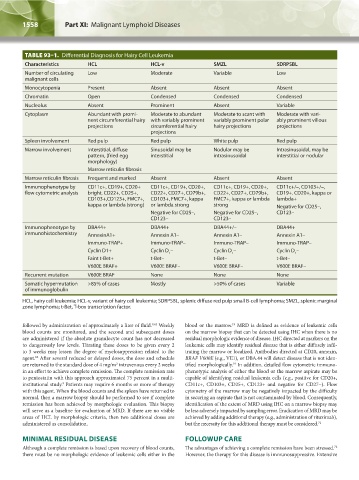
                TABLE 93–1.  Differential Diagnosis for Hairy Cell Leukemia
                Characteristics      HCL                  HCL-v                 SMZL                 SDRPSBL
                Number of circulating   Low               Moderate              Variable             Low
                malignant cells
                Monocytopenia        Present              Absent                Absent               Absent
                Chromatin            Open                 Condensed             Condensed            Condensed
                Nucleolus            Absent               Prominent             Absent               Variable
                Cytoplasm            Abundant with promi-  Moderate to abundant   Moderate to scant with   Moderate with vari-
                                     nent circumferential hairy  with variably prominent   variably prominent polar   ably prominent villous
                                     projections          circumferential hairy   hairy projections  projections
                                                          projections
                Spleen involvement   Red pulp             Red pulp              White pulp           Red pulp
                Marrow involvement   Interstitial, diffuse   Sinusoidal may be   Nodular may be      Intrasinusoidal, may be
                                     pattern, (fried egg   interstitial         intrasinusoidal      interstitial or nodular
                                     morphology)
                                     Marrow reticulin fibrosis
                Marrow reticulin fibrosis  Frequent and marked  Absent          Absent               Absent
                Immunophenotype by   CD11c+, CD19+, CD20+   CD11c+, CD19+, CD20+,   CD11c+, CD19+, CD20+,   CD11c+/–, CD103+/–,
                flow cytometric analysis  bright, CD22+, CD25+,   CD22+, CD27+, CD79b+,   CD22+, CD27+, CD79b+,   CD19+. CD20+, kappa or
                                     CD103+,CD123+, FMC7+,  CD103+, FMC7+, kappa   FMC7+, kappa or lambda   lambda+
                                     kappa or lambda (strong)  or lambda strong  strong              Negative for CD25–,
                                                          Negative for CD25–,   Negative for CD25–,   CD123–
                                                          CD123–                CD123–
                Immunophenotype by   DBA44+               DBA44+                DBA44+/–             DBA44+
                immunohistochemistry  AnnexinA1+          Annexin A1–           Annexin A1–          Annexin A1–
                                     Immuno-TRAP+         Immuno-TRAP–          Immuno-TRAP–         Immuno-TRAP–
                                     Cyclin D1+           Cyclin D –            Cyclin D –           Cyclin D –
                                                                 1                    1                    1
                                     Faint t-Bet+         t-Bet–                t-Bet–               t-Bet–
                                     V600E BRAF+          V600E BRAF–           V600E BRAF–          V600E BRAF–
                Recurrent mutation   V600E BRAF           None                  None                 None
                Somatic hypermutation   >85% of cases     Mostly                >50% of cases        Variable
                of immunoglobulin
               HCL, hairy cell leukemia; HCL-v, variant of hairy cell leukemia; SDRPSBL, splenic diffuse red pulp small B-cell lymphoma; SMZL, splenic marginal
               zone lymphoma; t-Bet, T-box transcription factor.


               followed by administration of approximately a liter of fluid.  Weekly   blood or the marrow.  MRD is defined as evidence of leukemic cells
                                                                                      19
                                                           9,62
               blood counts are monitored, and the second and subsequent doses   on the marrow biopsy that can be detected using IHC when there is no
               are administered if the absolute granulocyte count has not decreased   residual morphologic evidence of disease. IHC directed at markers on the
               to dangerously low levels. Titrating these doses to be given every 2   leukemic cells may identify residual disease that is either diffusely infil-
               to 3 weeks may lessen the degree of myelosuppression related to the   trating the marrow or localized. Antibodies directed at CD20, annexin,
               agent.  After several reduced or delayed doses, the dose and schedule   BRAF V600E (e.g., VE1), or DBA.44 will detect disease that is not iden-
                    62
               are returned to the standard dose of 4 mg/m  intravenous every 2 weeks   tified morphologically.  In addition, detailed flow cytometric immuno-
                                               2
                                                                                      19
               in an effort to achieve complete remission. The complete remission rate   phenotypic analysis of either the blood or the marrow aspirate may be
               to pentostatin with this approach approximated 75 percent in a multi-  capable of identifying residual leukemia cells (e.g., positive for CD20+,
               institutional study.  Patients may require 6 months or more of therapy   CD11c+, CD103+, CD25+, CD123+ and negative for CD27−). Flow
                             9
               with this agent. When the blood counts and the spleen have returned to   cytometry of the marrow may be negatively impacted by the difficulty
               normal, then a marrow biopsy should be performed to see if complete   in securing an aspirate that is not contaminated by blood. Consequently,
               remission has been achieved by morphologic evaluation. This biopsy   identification of the extent of MRD using IHC on a marrow biopsy may
               will serve as a baseline for evaluation of MRD. If there are no visible   be less adversely impacted by sampling error. Eradication of MRD may be
               areas of HCL by morphologic criteria, then two additional doses are   achieved by adding additional therapy (e.g., administration of rituximab),
               administered as consolidation.                         but the necessity for this additional therapy must be considered. 71
               MINIMAL RESIDUAL DISEASE                               FOLLOWUP CARE
                                                                                                                        72
               Although a complete remission is based upon recovery of blood counts,   The advantages of achieving a complete remission have been stressed.
               there must be no morphologic evidence of leukemic cells either in the   However, the therapy for this disease is immunosuppressive. Extensive


          Kaushansky_chapter 93_p1553-1562.indd   1558                                                                  9/18/15   3:47 PM

