


Page 1584 - Williams Hematology ( PDFDrive )
P. 1584
1558  Part XI:  Malignant Lymphoid Diseases                                Chapter 93:  Hairy Cell Leukemia          1559


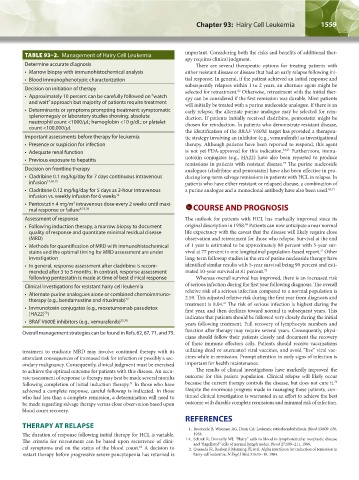
                   TABLE 93–2.  Management of Hairy Cell Leukemia       important. Considering both the risks and benefits of additional ther-
                                                                        apy requires clinical judgment.
                   Determine accurate diagnosis                             There are several therapeutic options for treating patients with
                   •  Marrow biopsy with immunohistochemical analysis   either resistant disease or disease that had an early relapse following ini-
                   •  Blood immunophenotypic characterization           tial response. In general, if the patient achieved an initial response and
                                                                        subsequently relapses within 1 to 2 years, an alternate agent might be
                   Decision on initiation of therapy                    selected for retreatment.  Otherwise, retreatment with the initial ther-
                                                                                          62
                   •   Approximately 10 percent can be carefully followed on “watch   apy can be considered if the first remission was durable. Most patients
                    and wait” approach but majority of patients require treatment  will initially be treated with a purine nucleoside analogue. If there is an
                   •   Determinants or symptoms prompting treatment: symptomatic   early relapse, the alternate purine analogue may be selected for rein-
                    splenomegaly or laboratory studies showing: absolute    duction. If patients initially received cladribine, pentostatin might be
                    neutrophil count <1000/μL; hemoglobin <10 g/dL; or platelet   chosen for reinduction. In patients who demonstrate resistant disease,
                    count <100,000/μL
                                                                        the identification of the BRAF V600E target has provided a therapeu-
                   Important assessments before therapy for leukemia    tic strategy involving an inhibitor (e.g., vemurafenib) as investigational
                   •  Presence or suspicion for infection               therapy. Although patients have been reported to respond, this agent
                   •  Adequate renal function                           is not yet FDA-approved for this indication. 24,25  Furthermore, immu-
                   •  Previous exposure to hepatitis                    notoxin conjugates (e.g., HA22) have also been reported to produce
                                                                        remissions in patients with resistant disease.  The purine nucleoside
                                                                                                         73
                   Decision on frontline therapy                        analogues (cladribine and pentostatin) have also been effective in pro-
                   •   Cladribine 0.1 mg/kg/day for 7 days continuous intravenous   ducing long-term salvage remissions in patients with HCL in relapse. In
                    infusion 12,69,75                                   patients who have either resistant or relapsed disease, a combination of
                   •   Cladribine 0.12 mg/kg/day for 5 days as 2-hour intravenous   a purine analogue and a monoclonal antibody have also been used. 62,71
                    infusion vs. weekly infusion for 6 weeks 14
                   •   Pentostatin 4 mg/m  intravenous dose every 2 weeks until maxi-
                                   2
                    mal response or failure 9,72,76                        COURSE AND PROGNOSIS
                   Assessment of response                               The outlook for patients with HCL has markedly improved since its
                                                                                            68
                   •   Following induction therapy, a marrow biopsy to document   original description in 1958.  Patients can now anticipate a near normal
                    quality of response and quantitate minimal residual disease   life expectancy with the caveat that the disease will likely require close
                    (MRD)                                               observation and retreatment for those who relapse. Survival at the end
                   •   Methods for quantification of MRD with immunohistochemical   of 1 year is estimated to be approximately 88 percent with 5-year sur-
                                                                                                                      21
                    stains and the optimal timing for MRD assessment are under   vival at 77 percent in one longitudinal population-based report.  Other
                    investigation                                       long-term followup studies in the era of purine nucleoside therapy have
                   •   In general, response assessment after cladribine is recom-  identified similar results with 5-year survival being 90 percent and esti-
                    mended after 3 to 5 months. In contrast, response assessment   mated 10-year survival at 81 percent. 72
                    following pentostatin is made at time of best clinical response  Whereas overall survival has improved, there is an increased risk
                   Clinical investigations for resistant hairy cell leukemia  of serious infection during the first year following diagnosis. The overall
                   •   Alternate purine analogues alone or combined chemoimmuno-  relative risk of a serious infection compared to a normal population is
                    therapy (e.g., bendamustine and rituximab) 77       2.59. This adjusted relative risk during the first year from diagnosis and
                                                                                     21
                   •   Immunotoxin conjugates (e.g., moxetumomab pasudotox   treatment is 8.04.  The risk of serious infection is highest during the
                                                                        first year, and then declines toward normal in subsequent years. This
                    [HA22] )                                            indicates that patients should be followed very closely during the initial
                         73
                   •   BRAF V600E inhibitors (e.g., vemurafenib) 25,78  years following treatment. Full recovery of lymphocyte numbers and
                  Overall management strategies can be found in Refs. 62, 67, 71, and 79.  function after therapy may require several years. Consequently, physi-
                                                                        cians should follow their patients closely and document the recovery
                                                                        of these immune effectors cells. Patients should receive vaccinations
                  treatment to eradicate MRD may involve continued therapy with its   utilizing dead or attenuated viral vaccines, and avoid “live” viral vac-
                  attendant consequences of increased risk for infection or possibly a sec-  cines while in remission. Prompt attention to early signs of infection is
                  ondary malignancy. Consequently, clinical judgment must be exercised   important for health maintenance.
                  to achieve the optimal outcome for patients with this disease. An accu-  The results of clinical investigations have markedly improved the
                  rate assessment of response to therapy may best be made several months   outcome for this patient population. Clinical relapse will likely occur
                                                                                                                          74
                  following completion of initial induction therapy.  In those who have   because the current therapy controls the disease, but does not cure it.
                                                      71
                  achieved a complete response, careful followup is indicated. In those   Despite the enormous progress made in managing these patients, con-
                  who had less than a complete remission, a determination will need to   tinued clinical investigation is warranted in an effort to achieve the best
                  be made regarding salvage therapy versus close observation based upon   outcome with durable complete remissions and minimal risk of infection.
                  blood count recovery.
                                                                        REFERENCES
                  THERAPY AT RELAPSE                                      1.  Bouroncle B, Wiseman AG, Doan CA: Leukemic reticuloendotheliosis. Blood 13:609–630,

                  The duration of response following initial therapy for HCL is variable.   1958.
                  The criteria for retreatment can be based upon recurrence of clini-   1A.  Schrek R, Donnelly WJ: “Hairy” cells in blood in lymphoreticular neoplastic disease
                                                                           and “flagellated” cells of normal lymph nodes. Blood 27:199–211, 1966.
                  cal symptoms and on the status of the blood count.  A decision to     2.  Quesada JR, Reuben J, Manning JT, et al: Alpha interferon for induction of remission in
                                                         62
                  restart therapy before progressive severe pancytopenia has returned is   hairy-cell leukemia. N Engl J Med 310:15–18, 1984.


          Kaushansky_chapter 93_p1553-1562.indd   1559                                                                  9/18/15   3:47 PM

