


Page 1652 - Williams Hematology ( PDFDrive )
P. 1652
1626  Part XI:  Malignant Lymphoid Diseases  Chapter 98:  Diffuse Large B-Cell Lymphoma and Related Diseases         1627


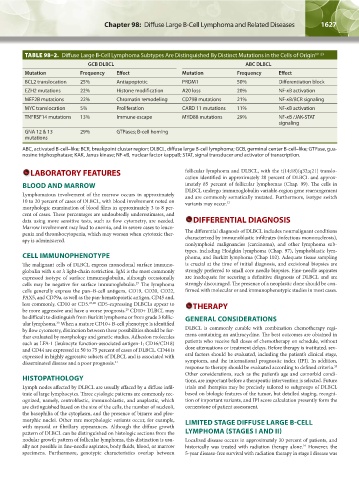
                   TABLE 98–2.  Diffuse Large B-Cell Lymphoma Subtypes Are Distinguished By Distinct Mutations in the Cells of Origin 19–23
                                        GCB DLBCL                                            ABC DLBCL
                   Mutation          Frequency   Effect                Mutation           Frequency     Effect
                   BCL2 translocation  25%       Antiapoptotic         PRDM1              50%           Differentiation block
                   EZH2 mutations    22%         Histone modification  A20 loss           20%           NF-κB activation
                   MEF2B mutations   22%         Chromatin remodeling  CD79B mutations    21%           NF-κB/BCR signaling
                   MYC translocation  5%         Proliferation         CARD 11 mutations  11%           NF-κB activation
                   TNFRSF14 mutations  13%       Immune escape         MYD88 mutations    29%           NF-κB /JAK-STAT
                                                                                                        signaling
                   GNA 12 & 13       29%         GTPases; B-cell homing
                   mutations

                  ABC, activated B-cell–like; BCR, breakpoint cluster region; DLBCL, diffuse large B-cell lymphoma; GCB, germinal center B-cell–like; GTPase, gua-
                  nosine triphosphatase; KAK, Janus kinase; NF-κB, nuclear factor kappaB; STAT, signal transducer and activator of transcription.

                     LABORATORY FEATURES                                follicular lymphoma and DLBCL, with the t(14;18)(q32;q21) translo-
                                                                        cation identified in approximately 20 percent of DLBCL and approx-
                  BLOOD AND MARROW                                      imately 85 percent of follicular lymphomas (Chap. 99). The cells in
                  Lymphomatous involvement of the marrow occurs in approximately     DLBCL undergo immunoglobulin variable-region gene rearrangement
                                                                        and are commonly somatically mutated. Furthermore, isotype switch
                  10 to 20 percent of cases of DLBCL, with blood involvement noted on   variants may occur. 32
                  morphologic examination of blood films in approximately 3 to 8 per-
                  cent of cases. These percentages are undoubtedly underestimates, and
                  data using more  sensitive tests, such as  flow cytometry, are  needed.   DIFFERENTIAL DIAGNOSIS
                  Marrow involvement may lead to anemia, and in severe cases to leuco-
                  penia and thrombocytopenia, which may worsen when cytotoxic ther-  The differential diagnosis of DLBCL includes nonmalignant conditions
                  apy is administered.                                  characterized by immunoblastic infiltrates (infectious mononucleosis),
                                                                        nonlymphoid malignancies (carcinoma), and other lymphoma sub-
                                                                        types, including Hodgkin lymphoma (Chap. 97), lymphoblastic lym-
                  CELL IMMUNOPHENOTYPE                                  phoma, and Burkitt lymphoma (Chap 102). Adequate tissue sampling
                  The malignant cells of DLBCL express monoclonal surface immuno-  is crucial at the time of initial diagnosis, and excisional biopsies are
                  globulin with κ or λ light-chain restriction. IgM is the most commonly   strongly preferred to small core needle biopsies. Fine-needle aspirates
                  expressed isotype of surface immunoglobulin, although occasionally   are inadequate for securing a definitive diagnosis of DLBCL and are
                  cells  may  be  negative  for  surface  immunoglobulin.   The  lymphoma   strongly discouraged. The presence of a neoplastic clone should be con-
                                                        27
                  cells generally express the pan–B-cell antigens, CD19, CD20, CD22,   firmed with molecular or and immunophenotypic studies in most cases.
                  PAX5, and CD79a, as well as the pan-hematopoietic antigen, CD45 and,
                  less commonly, CD10 or CD5. 27,28  CD5-expressing DLBCLs appear to   THERAPY
                  be more aggressive and have a worse prognosis.  CD10+ DLBCL may
                                                    29
                  be difficult to distinguish from Burkitt lymphoma or from grade 3 follic-  GENERAL CONSIDERATIONS
                  ular lymphoma.  When a mature CD10+ B-cell phenotype is identified
                             30
                  by flow cytometry, distinction between these possibilities should be fur-  DLBCL is commonly curable with combination chemotherapy regi-
                  ther evaluated by morphology and genetic studies. Adhesion molecules   mens containing an anthracycline. The best outcomes are obtained in
                  such as LFA-1 (leukocyte function-associated antigen-1; CD16/CD18)   patients who receive full doses of chemotherapy on schedule, without
                  and CD44 are expressed in 50 to 75 percent of cases of DLBCL. CD44 is   dose attenuations or treatment delays. Before therapy is instituted, sev-
                  expressed in highly aggressive subsets of DLBCL and is associated with   eral factors should be evaluated, including the patient’s clinical stage,
                  disseminated disease and a poor prognosis. 31         symptoms, and the international prognostic index (IPI). In addition,
                                                                        response to therapy should be evaluated according to defined criteria.
                                                                                                                          33
                                                                        Other considerations, such as the patient’s age and comorbid condi-
                  HISTOPATHOLOGY                                        tions, are important before a therapeutic intervention is selected. Future
                  Lymph nodes affected by DLBCL are usually effaced by a diffuse infil-  trials and therapies may be precisely tailored to subgroups of DLBCL
                  trate of large lymphocytes. Three cytologic patterns are commonly rec-  based on biologic features of the tumor, but detailed staging, recogni-
                  ognized, namely, centroblastic, immunoblastic, and anaplastic, which   tion of important variants, and IPI score calculation presently form the
                  are distinguished based on the size of the cells, the number of nucleoli,   cornerstone of patient assessment.
                  the basophilia of the cytoplasm, and the presence of bizarre and pleo-
                  morphic nuclei. Other rare morphologic variants occur, for example,   LIMITED STAGE DIFFUSE LARGE B-CELL
                  with myxoid or fibrillary appearances. Although the diffuse growth
                  pattern of DLBCL can be distinguished on histologic sections from the   LYMPHOMA (STAGES I AND II)
                  nodular growth pattern of follicular lymphoma, this distinction is usu-  Localized disease occurs in approximately 30 percent of patients, and
                  ally not possible in fine-needle aspirates, body fluids, blood, or marrow   historically was treated with radiation therapy alone.  However, the
                                                                                                                34
                  specimens. Furthermore, genotypic characteristics overlap between   5-year disease-free survival with radiation therapy in stage I disease was


          Kaushansky_chapter 98_p1625-1640.indd   1627                                                                  9/18/15   11:42 PM

