


Page 1657 - Williams Hematology ( PDFDrive )
P. 1657
1632           Part XI:  Malignant Lymphoid Diseases                                                                                                     Chapter 98:  Diffuse Large B-Cell Lymphoma and Related Diseases         1633


               developed to minimize the toxicity associated with standard high-dose   TABLE 98–5.  International Prognostic Factor Index for
               chemotherapy, achieve sufficient engraftment to prevent graft rejection      93
               and exploit the graft-versus-tumor effect of allo-HSCT. In a prospec-  Non-Hodgkin Lymphoma
               tive study, 31 patients with DLBCL and one patient with Burkitt lym-  Risk factors
               phoma received allo-HSCT following 2 Gy total-body irradiation with     Age older than 60 years
               or without fludarabine.  Twenty-four patients had undergone prior
                                 89
               ASCT. With a median followup of 45 months, 3-year OS and PFS were      Serum lactic dehydrogenase greater than twice normal
               45 percent and 35 percent, respectively. Three-year cumulative inci-    Performance status ≥2
               dences of relapse and nonrelapse mortality were 41 percent and 25     Stage III or IV
               percent, respectively. Cumulative incidences of acute graft-versus-host
               disease (GVHD) grades II to IV, grades III and IV, and chronic GVHD     Extranodal involvement at more than 1 site
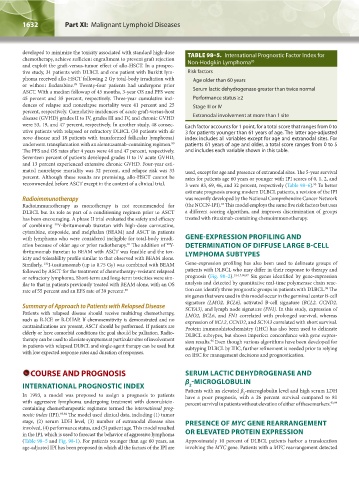
               were 53, 19, and 47 percent, respectively. In another study, 48 consec-  Each factor accounts for 1 point, for a total score that ranges from 0 to
               utive patients with relapsed or refractory DLBCL (30 patients with de   3 for patients younger than 61 years of age. The latter age-adjusted
               novo disease and 18 patients with transformed follicular lymphoma)   index includes all variables except for age and extranodal sites. For
                                                                 90
               underwent transplantation with an alemtuzumab-containing regimen.    patients 61 years of age and older, a total score ranges from 0 to 5
               The PFS and OS rates after 4 years were 48 and 47 percent, respectively.   and includes each variable shown in this table.
               Seventeen percent of patients developed grades II to IV acute GVHD,
               and 13 percent experienced extensive chronic GVHD. Four-year esti-
               mated nonrelapse mortality was 32 percent, and relapse risk was 33   used, except for age and presence of extranodal sites. The 5-year survival
               percent. Although these results are promising, allo-HSCT  cannot be   rates for patients age 60 years or younger with IPI scores of 0, 1, 2, and
               recommended before ASCT except in the context of a clinical trial.  3 were 83, 69, 46, and 32 percent, respectively (Table 98–6).  To better
                                                                                                                 93
                                                                      estimate prognosis among modern DLBCL patients, a revision of the IPI
               Radioimmunotherapy                                     was recently developed by the National Comprehensive Cancer Network
                                                                                  95
               Radioimmunotherapy as monotherapy is not recommended for   (the NCCN-IPI).  This model employs the same five risk factors but uses
               DLBCL but its role as part of a conditioning regimen prior to ASCT   a  different  scoring  algorithm,  and  improves  discrimination  of  groups
               has been encouraging. A phase II trial evaluated the safety and efficacy   treated with rituximab-containing chemoimmunotherapy.
                          90
               of combining  Y-ibritumomab tiuxetan with high-dose carmustine,
               cytarabine, etoposide, and melphalan (BEAM) and ASCT in patients
               with lymphoma who were considered ineligible for total-body irradi-  GENE-EXPRESSION PROFILING AND
                                                                90
               ation because of older age or prior radiotherapy.  The addition of  Y-   DETERMINATION OF DIFFUSE LARGE B-CELL
                                                   91
               ibritumomab tiuxetan to BEAM with ASCT was feasible and the tox-  LYMPHOMA SUBTYPES
               icity and tolerability profile similar to that observed with BEAM alone.
                       131
               Similarly,  I-tositumomab (up to 0.75 Gy) was combined with BEAM   Gene-expression profiling has also been used to delineate groups of
               followed by ASCT for the treatment of chemotherapy-resistant relapsed   patients with DLBCL who may differ in their response to therapy and
               or refractory lymphoma. Short-term and long-term toxicities were sim-  prognosis (Fig. 98–2). 14–17,96,97  Six genes identified by gene-expression
               ilar to that in patients previously treated with BEAM alone, with an OS   analysis and detected by quantitative real-time polymerase chain reac-
                                                                                                                     98
               rate of 55 percent and an EFS rate of 39 percent. 92   tion can identify three prognostic groups in patients with DLBCL.  The
                                                                      six genes that were used in this model occur in the germinal center B-cell
                                                                      signature  (LMO2, BCL6),  activated  B-cell  signature  (BCL2, CCND2,
               Summary of Approach to Patients with Relapsed Disease  SCYA3), and lymph node signature (FN1). In this study, expression of
               Patients with relapsed disease should receive multidrug chemotherapy,   LMO2,  BCL6, and  FN1 correlated with prolonged survival, whereas
               such as R-ICE or R-DHAP. If chemosensitivity is demonstrated and no   expression of BCL2, CCND2, and SCYA3 correlated with short survival.
               contraindications are present, ASCT should be performed. If patients are   Protein immunohistochemistry (IHC) has also been used to delineate
               elderly or have comorbid conditions the goal should be palliation. Radio-  DLBCL subtypes, but shows imperfect concordance with gene expres-
               therapy can be used to alleviate symptoms at particular sites of involvement   sion results.  Even though various algorithms have been developed for
                                                                               96
               in patients with relapsed DLBCL and single-agent therapy can be used but   subtyping DLBCL by IHC, further refinement is needed prior to relying
               with low expected response rates and duration of responses.  on IHC for management decisions and prognostication.

                  COURSE AND PROGNOSIS                                SERUM LACTIC DEHYDROGENASE AND
                                                                      β -MICROGLOBULIN
               INTERNATIONAL PROGNOSTIC INDEX                          2
                                                                                          2
               In  1993,  a  model  was  proposed  to  assign  a  prognosis  to  patients   Patients with an elevated β -microglobulin level and high serum LDH
                                                                      have  a  poor  prognosis,  with  a  26  percent survival  compared  to  81
               with aggressive lymphoma undergoing treatment with doxorubicin-   percent survival in patients without elevation of either of these markers. 93,99
               containing chemotherapeutic regimens termed the international prog-
               nostic index (IPI). 93,94  The model used clinical data, including (1) tumor
               stage, (2) serum LDH level, (3) number of extranodal disease sites   PRESENCE OF MYC GENE REARRANGEMENT
               involved, (4) performance status, and (5) patient age. This model resulted
               in the IPI, which is used to forecast the behavior of aggressive lymphoma   OR ELEVATED PROTEIN EXPRESSION
               (Table 98–5 and Fig. 98-1). For patients younger than age 60 years, an   Approximately 10 percent of DLBCL patients harbor a translocation
               age-adjusted IPI has been proposed in which all the factors of the IPI are   involving the MYC gene. Patients with a MYC rearrangement detected


          Kaushansky_chapter 98_p1625-1640.indd   1632                                                                  9/18/15   11:42 PM

