


Page 1653 - Williams Hematology ( PDFDrive )
P. 1653
1628           Part XI:  Malignant Lymphoid Diseases                                                                                                     Chapter 98:  Diffuse Large B-Cell Lymphoma and Related Diseases         1629


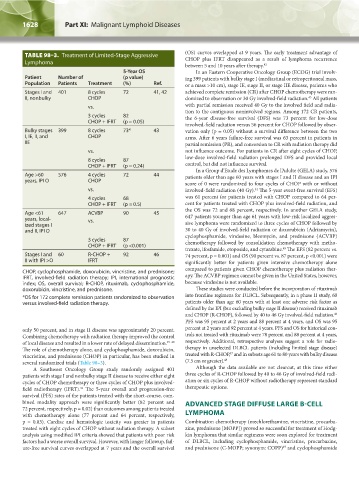
                TABLE 98–3.  Treatment of Limited-Stage Aggressive    (OS) curves overlapped at 9 years. The early treatment advantage of
                                                                      CHOP plus IFRT disappeared as a result of lymphoma recurrence
                Lymphoma
                                                                      between 5 and 10 years after therapy. 42
                                                 5-Year OS                In an Eastern Cooperative Oncology Group (ECOG) trial involv-
                Patient    Number of             (p value)            ing 399 patients with bulky stage I (mediastinal or retroperitoneal mass,
                Population  Patients  Treatment  (%)       Ref.       or a mass >10 cm), stage IE, stage II, or stage IIE disease, patients who
                Stages I and  401    8 cycles    72        41, 42     achieved complete remission (CR) after CHOP chemotherapy were ran-
                II, nonbulky         CHOP                             domized to observation or 30 Gy involved-field radiation.  All patients
                                                                                                               43
                                     vs.                              with partial remission received 40 Gy to the involved field and radia-
                                                                      tion to the contiguous noninvolved regions. Among 172 CR patients,
                                     3 cycles    82                   the 6-year disease-free survival (DFS) was 73 percent for low-dose
                                     CHOP + IFRT  (p = 0.05)
                                                                      involved-field radiation versus 56 percent for CHOP followed by obser-
                Bulky stages  399    8 cycles    73*       43         vation only (p = 0.05) without a survival difference between the two
                I, IE, II, and       CHOP                             arms. After 6 years failure-free survival was 63 percent in patients in
                IIE                                                   partial remission (PR), and conversion to CR with radiation therapy did
                                     vs.                              not influence outcome. For patients in CR after eight cycles of CHOP,
                                     8 cycles    87                   low-dose involved-field radiation prolonged DFS and provided local
                                     CHOP + IFRT  (p = 0.24)          control, but did not influence survival.
                                                                          In a Group d’Etude des Lymphomes de l’Adulte (GELA) study, 576
                Age >60    576       4 cycles    72        44         patients older than age 60 years with stages I and II disease and an IPI
                years, IPI O         CHOP
                                                                      score of 0 were randomized to four cycles of CHOP with or without
                                     vs.                              involved-field radiation (40 Gy).  The 5-year event-free survival (EFS)
                                                                                             44
                                     4 cycles    68                   was 61 percent for patients treated with CHOP compared to 64 per-
                                     CHOP + IFRT  (p = 0.5)           cent for patients treated with CHOP plus involved-field radiation, and
                                                                      the OS was 72 and 68 percent, respectively. In another GELA study,
                Age <61    647       ACVBP       90        45
                years, local-        vs.                              647 patients younger than age 61 years with low-risk localized aggres-
                ized stages I                                         sive lymphoma were randomized to three cycles of CHOP followed by
                and II, IPI O                                         30 to 40 Gy of involved-field radiation or doxorubicin (Adriamycin),
                                                                      cyclophosphamide, vindesine, bleomycin, and prednisone (ACVBP)
                                     3 cycles    87                   chemotherapy followed by consolidation chemotherapy with metho-
                                     CHOP + IFRT  (p <0.001)
                                                                                                       45
                                                                      trexate, ifosfamide, etoposide, and cytarabine.  The EFS (82 percent vs.
                Stages I and  60     R-CHOP +    92        46         74 percent, p = 0.001) and OS (90 percent vs. 87 percent, p <0.001) were
                II with IPI >O       IFRT                             significantly better for patients given intensive chemotherapy alone
               CHOP, cyclophosphamide, doxorubicin, vincristine, and prednisone;   compared to patients given CHOP chemotherapy plus radiation ther-
               IFRT, involved-field radiation therapy; IPI,  international prognostic   apy. The ACVBP regimen cannot be given in the United States, however,
               index; OS, overall survival; R-CHOP,  rituximab, cyclophosphamide,   because vindesine is not available.
               doxorubicin, vincristine, and prednisone.                  These studies were conducted before the incorporation of rituximab
               *OS for 172 complete remission patients randomized to observation   into frontline regimens for DLBCL. Subsequently, in a phase II study, 60
               versus involved-field radiation therapy.               patients older than age 60 years with at least one adverse risk factor as
                                                                      defined by the IPI (but excluding bulky stage II disease) received rituximab
                                                                                                                        46
                                                                      and CHOP (R-CHOP), followed by 40 to 46 Gy involved-field radiation.
                                                                      PFS was 95 percent at 2 years and 88 percent at 4 years, and OS was 95
               only 50 percent, and in stage II disease was approximately 20 percent.   percent at 2 years and 92 percent at 4 years. PFS and OS for historical con-
               Combining chemotherapy with radiation therapy improved the control   trols not treated with rituximab were 78 percent and 88 percent at 4 years,
               of local disease and resulted in a lower rate of delayed dissemination. 35–40    respectively. Additional, retrospective analyses suggest a role for radio-
               The role of chemotherapy alone, and cyclophosphamide, doxorubicin,   therapy in unselected DLBCL patients (including limited stage disease)
                                                                                     47
               vincristine, and prednisone (CHOP) in particular, has been studied in   treated with R-CHOP,  and in subsets age 61 to 80 years with bulky disease
               several randomized trials (Table 98–3).                (7.5 cm or greater). 48
                   A Southwest Oncology Group study randomly assigned 401   Although the data available are not clearcut, at this time either
               patients with stage I and nonbulky stage II disease to receive either eight   three cycles of R-CHOP followed by 40 to 46 Gy of involved-field radi-
               cycles of CHOP chemotherapy or three cycles of CHOP plus involved-  ation or six cycles of R-CHOP without radiotherapy represent standard
               field  radiotherapy (IFRT).  The  5-year overall and  progression-free   therapeutic options.
                                   41
               survival (PFS) rates of the patients treated with the short-course, com-
               bined modality approach were significantly better (82 percent and     ADVANCED STAGE DIFFUSE LARGE B-CELL
               72 percent, respectively, p = 0.02) than outcomes among patients treated
               with chemotherapy alone (77 percent and 64 percent, respectively,     LYMPHOMA
               p = 0.03). Cardiac and hematologic toxicity was greater in patients   Combination chemotherapy (mechlorethamine, vincristine, procarba-
               treated with eight cycles of CHOP without radiation therapy. A subset   zine, prednisone [MOPP]) proved so successful for treatment of Hodg-
               analysis using modified IPI criteria showed that patients with poor risk   kin lymphoma that similar regimens were soon explored for treatment
               factors had a worse overall survival. However, with longer followup, fail-  of  DLBCL,  including  cyclophosphamide,  vincristine, procarbazine,
               ure-free survival curves overlapped at 7 years and the overall survival   and prednisone (C-MOPP; synonym: COPP)  and cyclophosphamide
                                                                                                       49


          Kaushansky_chapter 98_p1625-1640.indd   1628                                                                  9/18/15   11:42 PM

