


Page 1667 - Williams Hematology ( PDFDrive )
P. 1667
1642           Part XI:  Malignant Lymphoid Diseases                                                                                                                                  Chapter 99:  Follicular Lymphoma           1643


                    A                                            B


                    C                         D                                   E

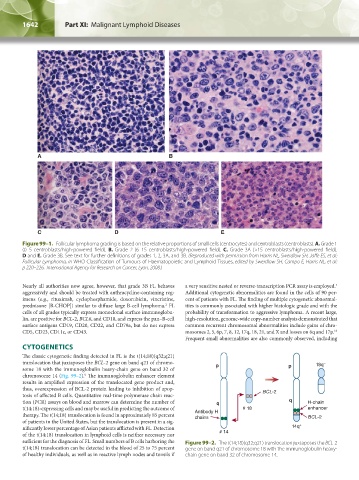
               Figure 99–1.  Follicular lymphoma grading is based on the relative proportions of small cells (centrocytes) and centroblasts (centroblasts). A. Grade 1
               (0–5 centroblasts/high-powered field).  B. Grade 2 (6–15 centroblasts/high-powered field).  C. Grade 3A (>15 centroblasts/high-powered field).
               D and E. Grade 3B. See text for further definitions of grades 1, 2, 3A, and 3B. (Reproduced with permission from Harris NL, Swerdlow SH, Jaffe ES, et al:
               Follicular Lymphoma, in WHO Classification of Tumours of Haematopoietic and Lymphoid Tissues, edited by Swerdlow SH, Campo E, Harris NL, et al:
               p 220–226.  International Agency for Research on Cancer, Lyon, 2008.)

               Nearly all authorities now agree, however, that grade 3B FL behaves   a very sensitive nested or reverse-transcription PCR assay is employed.
                                                                                                                        2
               aggressively and should be treated with anthracycline-containing reg-  Additional cytogenetic abnormalities are found in the cells of 90 per-
               imens (e.g., rituximab, cyclophosphamide, doxorubicin, vincristine,   cent of patients with FL. The finding of multiple cytogenetic abnormal-
               prednisone [R-CHOP]) similar to diffuse large B-cell lymphoma.  FL   ities is commonly associated with higher histologic grade and with the
                                                               2
               cells of all grades typically express monoclonal surface immunoglobu-  probability of transformation to aggressive lymphoma. A recent large,
               lin, are positive for BCL-2, BCL6, and CD10, and express the pan–B-cell   high-resolution, genome-wide copy-number analysis demonstrated that
               surface antigens CD19, CD20, CD22, and CD79a, but do not express   common recurrent chromosomal abnormalities include gains of chro-
               CD5, CD23, CD11c, or CD43.                             mosomes 2, 5, 6p, 7, 8, 12, 17q, 18, 21, and X and losses on 6q and 17p.
                                                                                                                        10
                                                                      Frequent small abnormalities are also commonly observed, including
               CYTOGENETICS
               The classic cytogenetic finding detected in FL is the t(14;18)(q32;q21)
               translocation that juxtaposes the BCL-2 gene on band q21 of chromo-                                18q –
               some 18 with the immunoglobulin heavy-chain gene on band 32 of   p                        p
                                    9
               chromosome 14 (Fig. 99–2).  The immunoglobulin enhancer element
               results in amplified expression of the translocated gene product and,
               thus, overexpression of BCL-2 protein leading to inhibition of apop-
               tosis of affected B cells. Quantitative real-time polymerase chain reac-         BCL-2
               tion (PCR) assays on blood and marrow can determine the number of   q                     q     H-chain
               t(14;18)-expressing cells and may be useful in predicting the outcome of   # 18                 enhancer
               therapy. The t(14;18) translocation is found in approximately 85 percent   Antibody H           BCL-2
                                                                         chains
               of patients in the United States, but the translocation is present in a sig-
               nificantly lower percentage of Asian patients afflicted with FL. Detection                 14q +
               of the t(14;18) translocation in lymphoid cells is neither necessary nor   # 14
               sufficient for the diagnosis of FL. Small numbers of B cells harboring the   Figure 99–2.  The t(14;18)(q32;q21) translocation juxtaposes the BCL-2
               t(14;18) translocation can be detected in the blood of 25 to 75 percent   gene on band q21 of chromosome 18 with the immunoglobulin heavy-
               of healthy individuals, as well as in reactive lymph nodes and tonsils if   chain gene on band 32 of chromosome 14.


          Kaushansky_chapter 99_p1641-1652.indd   1642                                                                  9/18/15   3:57 PM

