


Page 1670 - Williams Hematology ( PDFDrive )
P. 1670
1644  Part XI:  Malignant Lymphoid Diseases                               Chapter 99:  Follicular Lymphoma           1645


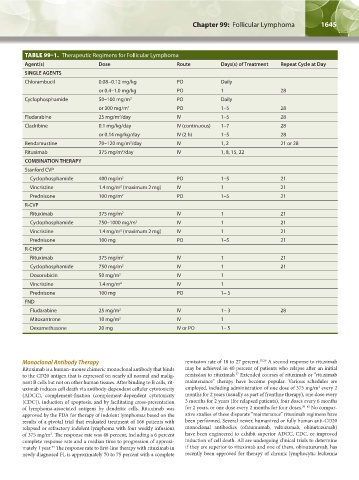
                   TABLE 99–1.  Therapeutic Regimens for Follicular Lymphoma
                   Agent(s)                Dose                       Route         Days(s) of Treatment  Repeat Cycle at Day
                   SINGLE AGENTS
                   Chlorambucil            0.08−0.12 mg/kg            PO            Daily
                                           or 0.4–1.0 mg/kg           PO            1                   28
                   Cyclophosphamide        50–100 mg/m 2              PO            Daily
                                           or 300 mg/m 2              PO            1–5                 28
                   Fludarabine             25 mg/m /day               IV            1–5                 28
                                                  2
                   Cladribine              0.1 mg/kg/day              IV (continuous)  1–7              28
                                           or 0.14 mg/kg/day          IV (2 h)      1–5                 28
                   Bendamustine            70–120 mg/m /day           IV            1, 2                21 or 28
                                                      2
                   Rituximab               375 mg/m /day              IV            1, 8, 15, 22
                                                   2
                   COMBINATION THERAPY
                   Stanford CVP
                     Cyclophosphamide      400 mg/m 2                 PO            1–5                 21
                     Vincristine           1.4 mg/m  (maximum 2 mg)   IV            1                   21
                                                   2
                     Prednisone            100 mg/m 2                 PO            1–5                 21
                   R-CVP
                     Rituximab             375 mg/m 2                 IV            1                   21
                     Cyclophosphamide      750–1000 mg/m 2            IV            1                   21
                     Vincristine           1.4 mg/m  (maximum 2 mg)   IV            1                   21
                                                   2
                     Prednisone            100 mg                     PO            1–5                 21
                   R-CHOP
                     Rituximab             375 mg/m 2                 IV            1                   21
                     Cyclophosphamide      750 mg/m 2                 IV            1                   21
                     Doxorubicin           50 mg/m 2                  IV            1
                     Vincristine           1.4 mg/m 2                 IV            1
                     Prednisone            100 mg                     PO            1– 5
                   FND
                     Fludarabine           25 mg/m 2                  IV            1– 3                28
                     Mitoxantrone          10 mg/m 2                  IV            1
                     Dexamethasone         20 mg                      IV or PO      1– 5


                  Monoclonal Antibody Therapy                           remission rate of 18 to 27 percent. 35,36  A second response to rituximab
                  Rituximab is a human–mouse chimeric monoclonal antibody that binds   may be achieved in 40 percent of patients who relapse after an initial
                                                                                         37
                  to the CD20 antigen that is expressed on nearly all normal and malig-  remission to rituximab.  Extended courses of rituximab or “rituximab
                  nant B cells but not on other human tissues. After binding to B cells, rit-  maintenance” therapy have become popular. Various schedules are
                                                                                                                     2
                  uximab induces cell death via antibody-dependent cellular cytotoxicity   employed, including administration of one dose of 375 mg/m  every 2
                  (ADCC), complement-fixation (complement-dependent cytotoxicity   months for 2 years (usually as part of frontline therapy), one dose every
                  [CDC]), induction of apoptosis, and by facilitating cross-presentation   3 months for 2 years (for relapsed patients), four doses every 6 months
                  of lymphoma-associated antigens by dendritic cells. Rituximab was   for 2 years, or one dose every 2 months for four doses. 38–42  No compar-
                  approved by the FDA for therapy of indolent lymphomas based on the   ative studies of these disparate “maintenance” rituximab regimens have
                  results of a pivotal trial that evaluated treatment of 166 patients with   been performed. Several newer, humanized or fully human anti-CD20
                  relapsed or refractory indolent lymphoma with four weekly infusions   monoclonal antibodies (ofatumumab, veltuzumab, obinutuzumab)
                  of 375 mg/m . The response rate was 48 percent, including a 6 percent   have been engineered to exhibit superior ADCC, CDC, or improved
                           2
                  complete response rate and a median time to progression of approxi-  induction of cell death. All are undergoing clinical trials to determine
                  mately 1 year.  The response rate to first-line therapy with rituximab in   if they are superior to rituximab and one of them, obinutuzumab, has
                            34
                  newly diagnosed FL is approximately 70 to 75 percent with a complete   recently been approved for therapy of chronic lymphocytic leukemia


          Kaushansky_chapter 99_p1641-1652.indd   1645                                                                  9/18/15   3:57 PM

