


Page 1698 - Williams Hematology ( PDFDrive )
P. 1698
1672  Part XI:  Malignant Lymphoid Diseases                                Chapter 102:  Burkitt Lymphoma            1673


                   TABLE 102–1.  Murphy Staging System for Burkitt         LABORATORY FEATURES
                   Lymphoma
                   Stage I: Single nodal or extranodal site excluding mediastinum or   BLOOD AND MARROW
                   abdomen                                              Patients with bulky disease may have Burkitt cells in marrow and blood
                   Stage II: Single extranodal tumor with regional nodal involvement  with accompanying suppression of normal blood counts. Characteristic
                                                                        pathologic features of BL on smear preparation are intermediate-size cells
                    Two extranodal tumors on one side of diaphragm      with round nuclei, multiple nucleoli, strongly basophilic cytoplasm (a
                    Primary gastrointestinal tumor with or without associated   consequence of the abundant polyribosomes), and the presence of lipid-
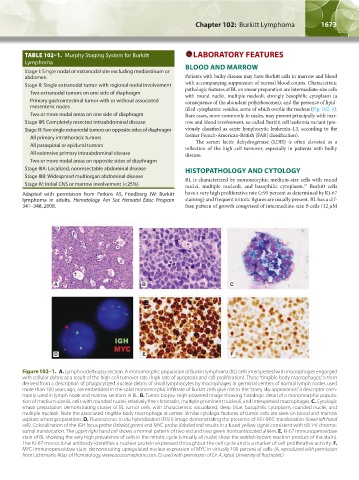
                    mesenteric nodes                                    filled cytoplasmic vesicles, some of which overlie the nucleus (Fig. 102–1).
                    Two or more nodal areas on one side of diaphragm    Rare cases, more commonly in males, may present principally with mar-
                   Stage IIR: Completely resected intraabdominal disease  row and blood involvement, so-called Burkitt cell leukemia variant (pre-
                   Stage III: Two single extranodal tumors on opposite sides of diaphragm  viously classified as acute lymphocytic leukemia–L3, according to the
                    All primary intrathoracic tumors                    former French-American-British [FAB] classification).
                                                                            The serum lactic dehydrogenase (LDH) is often elevated as a
                    All paraspinal or epidural tumors                   reflection  of  the  high  cell  turnover,  especially  in  patients  with  bulky
                    All extensive primary intraabdominal disease        disease.
                    Two or more nodal areas on opposite sides of diaphragm
                   Stage IIIA: Localized, nonresectable abdominal disease  HISTOPATHOLOGY AND CYTOLOGY
                   Stage IIIB: Widespread multiorgan abdominal disease  BL is characterized by monomorphic medium-size cells with round
                   Stage IV: Initial CNS or marrow involvement (<25%)   nuclei, multiple nucleoli, and basophilic cytoplasm.  Burkitt cells
                                                                                                                37
                  Adapted  with  permisison  from  Perkins  AS,  Friedberg  JW:  Burkitt    have a very high proliferative rate (≥95 percent as determined by Ki-67
                  lymphoma in adults.  Hematology  Am Soc Hematol Educ Program     staining) and frequent mitotic figures are usually present. BL has a dif-
                  341–348, 2008.                                        fuse pattern of growth comprised of intermediate-size B cells (12 μM


                            A                             B                            C


                            D                             E                             F

                  Figure 102–1.  A. Lymph node biopsy section. A monomorphic population of Burkitt lymphoma (BL) cells interspersed with macrophages engorged
                  with cellular debris as a result of the high cell turnover rate (high rate of apoptosis and cell proliferation). These “tingible body macrophages,” a term
                  derived from a description of phagocytized nuclear debris of small lymphocytes by macrophages in germinal centers of normal lymph nodes used
                  more than 100 years ago, are embedded in the solid monomorphic infiltrate of Burkitt cells give rise to the “starry sky appearance,” a descriptor com-
                  monly used in lymph node and marrow sections in BL. B. Tumor biopsy. High-powered image showing histologic detail of a monomorphic popula-
                  tion of medium-size BL cells with rounded nuclei, relatively fine chromatin, multiple prominent nucleoli, and interspersed macrophages. C. Cytologic
                  smear preparation demonstrating cluster of BL tumor cells, with characteristic vacuolated, deep-blue, basophilic cytoplasm, rounded nuclei, and
                  multiple nucleoli. Note the associated tingible body macrophage at center. Similar cytologic features of tumor cells are seen on blood and marrow
                  aspirate smear preparations. D. Fluorescence in situ hybridization (FISH) image demonstrating the presence of IGH-MYC translocation (lower left hand
                  cell). Colocalization of the IGH locus probe (labeled green) and MYC probe (labeled red) results in a fused yellow signal consistent with t(8:14) chromo-
                  somal translocation. The upper right hand cell shows a normal pattern of two red and two green nontranslocated alleles. E. Ki-67 immunoperoxidase
                  stain of BL showing the very high prevalence of cells in the mitotic cycle (virtually all nuclei show the reddish-brown reaction product of the stain).
                  The Ki-67 monoclonal antibody identifies a nuclear protein expressed throughout the cell cycle and is a marker of cell proliferative activity. F.
                  MYC immunoperoxidase stain, demonstrating upregulated nuclear expression of MYC in virtually 100 percent of cells. (A, reproduced with permission
                  from Lichtman’s Atlas of Hematology, www.accessmedicine.com. D, used with permission of Dr. A. Iqbal, University of Rochester.)


          Kaushansky_chapter 102_p1671-1678.indd   1673                                                                 17/09/15   3:20 pm

