


Page 1693 - Williams Hematology ( PDFDrive )
P. 1693
1668           Part XI:  Malignant Lymphoid Diseases                                                                                                                     Chapter 101:  Marginal Zone B-cell Lymphomas            1669


                                                                      REFERENCES

                                                                        1.  Swerdlow SH, Campo E, Harris NL, et al. (eds): World Health Organization Classification of
                                                                         Tumours of Haematopoietic and Lymphoid Tissues. IARC Press, Lyon, 2008.
                                                                        2.  Berger F, Felman P, Thieblemont C, et al: Non-MALT marginal zone B-cell lympho-
                                                                         mas: A description of clinical presentation and outcome in 124 patients.  Blood 95:
                                                                         1950–1956, 2000.
                                                                        3.  Arcaini L, Lucioni M, Boveri E, Paulli M: Nodal marginal zone lymphoma: Current
                                                                         knowledge and future directions of an heterogeneous disease.  Eur J Haematol 83:
                                                                         165–174, 2009.
                                                                        4.  Ferreri AJ, Dolcetti R, Magnino S, et al: Chlamydial infection: The link with ocular
                                                                         adnexal lymphomas. Nat Rev Clin Oncol 6:658–669, 2009.
                                                                        5.  Lecuit M, Abachin E, Martin A, et al: Immunoproliferative small intestinal disease
                                                                         associated with Campylobacter jejuni. N Engl J Med 350:239–248, 2004.
                                                                        6.  Zucca  E,  Roggero  E,  Maggi-Solcà  N,  et  al:  Prevalence  of  Helicobacter pylori  and
                                                                         hepatitis C virus infection among non-Hodgkin’s lymphoma patients in southern
                                                                         Switzerland. Haematologica 85:147–153, 2000.
                                                                        7.  Roggero E, Zucca E, Mainetti C, et al: Eradication of Borrelia burgdorferi infection in
                                                                         primary marginal zone B-cell lymphoma of the skin. Hum Pathol 31:263–268, 2000.
                                                                        8.  O’Rourke  JL:  Gene  expression  profiling  in  Helicobacter-induced MALT  lymphoma
                                                                         with reference to antigen drive and protective immunization. J Gastroenterol Hepatol
                                                                         23(Suppl):S151–S156, 2008.
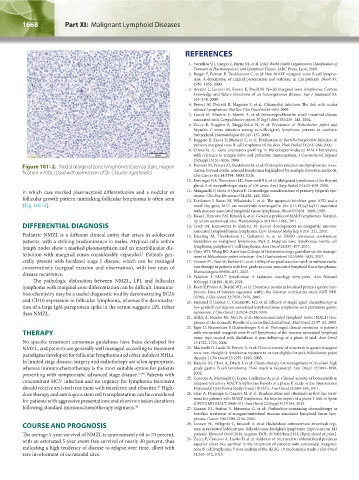
               Figure 101–2.  Nodal marginal zone lymphoma (Giemsa stain, magni-    9.  Ponzoni M, Ferreri AJ, Guidoboni M, et al: Chlamydia infection and lymphomas: Asso-
               fication ×200). (Used with permission of Dr. Claudio Agostinelli.)  ciation beyond ocular adnexal lymphomas highlighted by multiple detection methods.
                                                                         Clin Cancer Res 14:5794–5800, 2008.
                                                                        10.  Derringer GA, Thompson LD, Frommelt RA, et al: Malignant lymphoma of the thyroid
                                                                         gland: A clinicopathologic study of 108 cases. Am J Surg Pathol 24:623–639, 2000.
               in which case marked plasmacytoid differentiation and a nodular or     11.  Manganelli P, Fietta P, Quaini F: Hematologic manifestations of primary Sjögren’s syn-
                                                                         drome. Clin Exp Rheumatol 24:438–448, 2006.
               follicular growth pattern mimicking follicular lymphoma is often seen     12.  Dierlamm J, Baens M, Wlodarska I, et al: The apoptosis inhibitor gene API2 and a
               (Fig. 101–2).                                             novel 18q gene, MLT, are recurrently rearranged in the t(11;18)(q21;q21) associated
                                                                         with mucosa-associated lymphoid tissue lymphoma. Blood 93:3601–3609, 1999.
                                                                        13.  Kwee I, Rancoita PM, Rinaldi A, et al: Genomic profiles of MALT lymphomas: Variabil-
                                                                         ity across anatomical sites. Haematologica 96:1064–1066, 2011.
               DIFFERENTIAL DIAGNOSIS                                   14.  Troch M, Kiesewetter B, Raderer M: Recent developments in nongastric mucosa-
                                                                         associated lymphoid tissue lymphoma. Curr Hematol Malig Rep 6:216–221, 2011.
               Pediatric NMZL is a different clinical entity that arises in adolescent     15.  Dreyling M, Thieblemont C, Gallamini A, et al: ESMO consensus conferences:
               patients, with a striking predominance in males. Atypical cells within   Guidelines on malignant lymphoma. Part 2: Marginal zone lymphoma, mantle cell
               lymph nodes show a marked pleomorphism and an interfollicular dis-  lymphoma, peripheral T-cell lymphoma. Ann Oncol 24:857–877, 2013.
               tribution with marginal zones considerably expanded.  Patients gen-    16.  Chey WD, Wong BC: American College of Gastroenterology guideline on the manage-
                                                        1
                                                                         ment of Helicobacter pylori infection. Am J Gastroenterol 102:1808–1825, 2007.
               erally present with localized stage I disease, which can be managed     17.  Zinzani PL, Tani M, Barbieri E, et al: Utility of surgical resection with or without radia-
               conservatively (surgical excision and observation), with low rates of   tion therapy in patients with low-grade mucosa-associated lymphoid tissue lymphoma.
               disease recurrence.                                       Haematologica 88:830–831, 2003.
                   The pathologic distinction between NMZL, LPL and follicular     18.  Yahalom J: MALT lymphomas: A radiation oncology view-point.  Ann Hematol
                                                                         80(Suppl 3):B100–B105, 2001.
               lymphoma with marginal zone differentiation can be difficult. Immuno-    19.  Koch P, Probst A, Berdel WE, et al: Treatment results in localized primary gastric lym-
               histochemistry may be a useful diagnostic tool by demonstrating BCL6   phoma: Data of patients registered within the German multicenter study (GIT NHL
                                                                         02/96). J Clin Oncol 23:7050–7059, 2005.
               and CD10 expression in follicular lymphoma, whereas the demonstra-    20.  Hammel P, Haioun C, Chaumette MT, et al: Efficacy of single-agent chemotherapy in
               tion of a large IgM paraprotein spike in the serum suggests LPL rather   low-grade B-cell mucosa-associated lymphoid tissue lymphoma with prominent gastric
               than NMZL.                                                expression. J Clin Oncol 13:2524–2529, 1995.
                                                                        21.  Avilés A, Nambo MJ, Neri N, et al: Mucosa-associated lymphoid tissue (MALT) lym-
                                                                         phoma of the stomach: Results of a controlled clinical trial. Med Oncol 22:57–62, 2005.
                                                                        22.  Jäger U, Neumeister P, Quehenberger F, et al: Prolonged clinical remission in patients
               THERAPY                                                   with extranodal marginal zone B-cell lymphoma of the mucosa-associated lymphoid
                                                                         tissue type treated with cladribine: 6 year follow-up of a phase II trial.  Ann Oncol
               No specific treatment consensus guidelines have been developed for   17:1722–1723, 2006.
               NMZL, and patients are generally well managed according to treatment     23.  Martinelli G, Laszlo D, Ferreri A, et al: Clinical activity of rituximab in gastric marginal
               paradigms developed for follicular lymphoma and other indolent NHLs.   zone non-Hodgkin’s lymphoma resistant to or not eligible for anti-Helicobacter pylori
                                                                         therapy. J Clin Oncol 23:1979–1983, 2005.
               In limited stage disease, surgery and radiotherapy are often appropriate,     24.  Raderer M, Chott A, Drach J, et al: Chemotherapy for management of localised high
               whereas immunochemotherapy is the most suitable option for patients   grade  gastric  B-cell  lymphoma:  How  much  is  necessary?  Ann Oncol  13:1094–1098,
               presenting with symptomatic advanced stage disease. 15,46  Patients with   2002.
               concomitant HCV infection and no urgency for lymphoma treatment     25.  Conconi A, Martinelli G, Lopez-Guillermo A, et al: Clinical activity of bortezomib in
                                                                         relapsed/refractory MALT lymphomas: Results of a phase II study of the International
               should receive antiviral treatment with interferon and ribavirin.  High-  Extranodal Lymphoma Study Group (IELSG). Ann Oncol 22:689–695, 2011.
                                                             47
               dose therapy and autologous stem cell transplantation can be considered     26.  Salar A, Domingo E, Canales M, et al: Bendamustine and rituximab as first line treat-
               for patients with aggressive presentations and short remission durations   ment for patients with MALT lymphoma. An interim report of a phase 2 trial in Spain
                                                                         (GELTAMO MALT-2008–01). Ann Oncol 22(Suppl 4):IV184, 2011.
               following standard immunochemotherapy regimens. 46       27.  Zinzani PL, Stefoni V, Musuraca G, et al: Fludarabine-containing chemotherapy as
                                                                         frontline  treatment  of  nongastrointestinal  mucosa-associated  lymphoid  tissue  lym-
                                                                         phoma. Cancer 100:2190–2194, 2004.
               COURSE AND PROGNOSIS                                     28.  Zinzani PL, Pellegrini C, Broccoli A, et al: Fludarabine-mitoxantrone-rituximab regi-
                                                                         men in untreated indolent non-follicular non-Hodgkin’s lymphoma: Experience on 143
               The average 5-year survival of NMZL is approximately 60 to 70 percent,   patients. Hematol Oncol 2014, in press. DOI: 10.1002/hon.2151. [Epub ahead of print]
               with an estimated 5-year event-free survival of nearly 30 percent, thus     29.  Zucca E, Conconi A, Laszlo D, et al: Addition of rituximab to chlorambucil produces
               indicating a high tendency of disease to relapse over time, albeit with   superior event-free survival in the treatment of patients with extranodal marginal-
                                                                         zone B-cell lymphoma: 5-year analysis of the IELSG-19 randomized study. J Clin Oncol
               rare involvement of extranodal sites.                     31:565–572, 2013.


          Kaushansky_chapter 101_p1663-1670.indd   1668                                                                 9/18/15   9:37 AM

