


Page 1700 - Williams Hematology ( PDFDrive )
P. 1700
1674  Part XI:  Malignant Lymphoid Diseases                                Chapter 102:  Burkitt Lymphoma            1675


                    THERAPY                                             Rasburicase acts more quickly than allopurinol and should be used if
                                                                        risk is considered high or if evidence of spontaneous tumor lysis is pres-
                  GENERAL CONSIDERATIONS                                ent initially. 51,52  Continuous venovenous hemofiltration has also been
                  BL is a highly aggressive tumor; however, therapy with multiagent   very useful in allowing concomitant full-dose chemotherapy and pre-
                                                                        venting tumor lysis and renal failure.
                                                                                                   53,54
                  chemotherapeutic  programs  results  in  excellent  long-term  remission
                  rates and long-term survival of up to 85 percent of children. Applying
                  the  same  chemotherapy  regimens  to  adults  has  shown  dramatically
                  improved response rates. 45–47  Risk stratification allows patients with   SPECIFIC REGIMENS
                  limited disease to be treated with less-intensive therapy than more   The specific regimens that have been developed to treat BL have his-
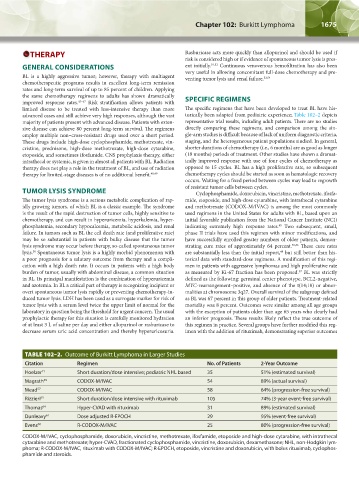
                  advanced cases and still achieve very high responses, although the vast   torically been adapted from pediatric experience; Table 102–2 depicts
                  majority of patients present with advanced disease. Patients with exten-  representative trial results, including adult patients. There are no studies
                  sive disease can achieve 80 percent long-term survival. The regimens   directly comparing these regimens, and comparison among the sin-
                  employ multiple non–cross-resistant drugs used over a short period.   gle-arm studies is difficult because of lack of uniform diagnostic criteria,
                  These drugs include high-dose cyclophosphamide, methotrexate, vin-  staging, and the heterogeneous patient populations studied. In general,
                  cristine, prednisone, high-dose methotrexate, high-dose cytarabine,   shorter durations of chemotherapy (i.e., 6 months) are as good as longer
                  etoposide, and sometimes ifosfamide. CNS prophylaxis therapy, either   (18 months) periods of treatment. Other studies have shown a dramat-
                  intrathecal or systemic, is given in almost all patients with BL. Radiation   ically improved response with use of four cycles of chemotherapy as
                  therapy does not play a role in the treatment of BL, and use of radiation   opposed to 15 cycles. BL has a high proliferative rate, so subsequent
                  therapy for limited-stage diseases is of no additional benefit. 48,49  chemotherapy cycles should be started as soon as hematologic recovery
                                                                        occurs. Waiting for a fixed period between cycles may lead to regrowth
                                                                        of resistant tumor cells between cycles.
                  TUMOR LYSIS SYNDROME                                      Cyclophosphamide, doxorubicin, vincristine, methotrexate, ifosfa-
                  The tumor lysis syndrome is a serious metabolic complication of rap-  mide, etoposide, and high-dose cytarabine, with intrathecal cytarabine
                  idly growing tumors, of which BL is a classic example. The syndrome   and methotrexate (CODOX-M/IVAC) is among the most commonly
                  is the result of the rapid destruction of tumor cells, highly sensitive to   used regimens in the United States for adults with BL, based upon an
                  chemotherapy, and can result in hyperuricemia, hyperkalemia, hyper-  initial favorable publication from the National Cancer Institute (NCI)
                  phosphatemia, secondary hypocalcemia, metabolic acidosis, and renal   indicating extremely high response rates.  Two subsequent, small,
                                                                                                        45
                  failure. In tumors such as BL the cell death rate (and proliferative rate)   phase II trials have used this regimen with minor modifications, and
                  may be so substantial in patients with bulky disease that the tumor   have successfully enrolled greater numbers of older patients, demon-
                  lysis syndrome may occur before therapy, so-called spontaneous tumor   strating cure rates of approximately 64 percent. 55,56  These cure rates
                  lysis.  Spontaneous tumor lysis is a highly morbid phenomenon with   are substantially less than the initial report,  but still better than his-
                                                                                                        49
                     50
                  a poor prognosis for a salutary outcome from therapy and a compli-  torical data with standard-dose regimens. A modification of this regi-
                  cation with a high death rate. It occurs in patients with a high body   men in patients with aggressive lymphomas and high proliferative rate
                  burden of tumor, usually with abdominal disease, a common situation   as measured by Ki-67 fraction has been proposed.  BL was strictly
                                                                                                               57
                  in BL. Its principal manifestation is the combination of hyperuricemia   defined as the following: germinal center phenotype, BCL2-negative,
                  and azotemia. In BL a critical part of therapy is recognizing incipient or   MYC-rearrangement–positive, and absence of the t(14;18) or abnor-
                  overt spontaneous tumor lysis rapidly or preventing chemotherapy-in-  malities at chromosome 3q27. Overall survival of the subgroup defined
                  duced tumor lysis. LDH has been used as a surrogate marker for risk of   as BL was 67 percent in this group of older patients. Treatment-related
                  tumor lysis with a serum level twice the upper limit of normal for the   mortality was 8 percent. Outcomes were similar among all age groups
                  laboratory in question being the threshold for urgent concern. The usual   with the exception of patients older than age 65 years who clearly had
                  prophylactic therapy for this situation is carefully monitored hydration   an inferior prognosis. These results likely reflect the true outcome of
                  of at least 3 L of saline per day and either allopurinol or rasburicase to   this regimen in practice. Several groups have further modified this reg-
                  decrease serum uric acid concentration and thereby hyperuricosuria.   imen with the addition of rituximab, demonstrating superior outcomes


                   TABLE 102–2.  Outcome of Burkitt Lymphoma in Larger Studies
                   Citation         Regimen                                     No. of Patients   2-Year Outcome
                   Hoelzer 71       Short duration/dose intensive; pediatric NHL based  35        51% (estimated survival)
                   Magrath 45       CODOX-M/IVAC                                54                89% (actual survival)
                   Mead 57          CODOX-M/IVAC                                58                64% (progression-free survival)
                   Rizzieri 65      Short duration/dose intensive with rituximab  105             74% (3-year event-free survival)
                   Thomas 64        Hyper-CVAD with rituximab                   31                89% (estimated survival)
                   Dunleavy 61      Dose adjusted R-EPOCH                       29                95% (event-free survival)
                   Evens 60         R-CODOX-M/IVAC                              25                80% (progression-free survival)
                  CODOX-M/IVAC, cyclophosphamide, doxorubicin, vincristine, methotrexate, ifosfamide, etoposide and high-dose cytarabine, with intrathecal
                  cytarabine and methotrexate; hyper-CVAD, fractionated cyclophosphamide, vincristine, doxorubicin, dexamethasone; NHL, non-Hodgkin lym-
                  phoma; R-CODOX-M/IVAC, rituximab with CODOX-M/IVAC; R-EPOCH, etoposide, vincristine and doxorubicin, with bolus rituximab, cyclophos-
                  phamide and steroids.


          Kaushansky_chapter 102_p1671-1678.indd   1675                                                                 17/09/15   3:20 pm

