


Page 1719 - Williams Hematology ( PDFDrive )
P. 1719
1694           Part XI:  Malignant Lymphoid Diseases                                                                                                      Chapter 104:  Mature T-Cell and Natural Killer Cell Lymphomas          1695


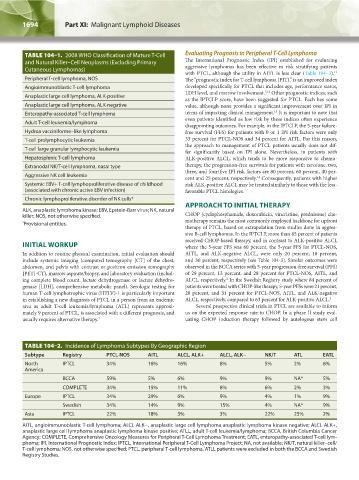
                TABLE 104–1.  2008 WHO Classification of Mature T-Cell   Evaluating Prognosis in Peripheral T-Cell Lymphoma
                and Natural Killer–Cell Neoplasms (Excluding Primary    The International Prognostic Index (IPI) established for evaluating
                                                                      aggressive lymphomas has been effective in risk stratifying patients
                Cutaneous Lymphomas)
                                                                      with PTCL, although the utility in AITL is less clear (Table 104–3).
                                                                                                                        11
                Peripheral T-cell lymphoma, NOS                       The “prognostic index for T-cell lymphoma (PIT),” is an improved index
                Angioimmunoblastic T-cell lymphoma                    developed specifically for PTCL that includes age, performance status,
                                                                      LDH level, and marrow involvement.  Other prognostic indices, such
                                                                                                 7,12
                Anaplastic large cell lymphoma, ALK-positive
                                                                      as the IPTCLP score, have been suggested for PTCL. Each has some
                Anaplastic large cell lymphoma, ALK-negative          value, although none provides a significant improvement over IPI in
                                                                                                    13
                Enteropathy-associated T-cell lymphoma                terms of impacting clinical management.  It is important to note that
                                                                      even patients identified as low risk by these indices often experience
                Adult T-cell leukemia/lymphoma
                                                                      disappointing outcomes. For example, in the IPTCLP, the 5-year failure-
                Hydroa vacciniforme–like lymphoma                     free survival (FFS) for patients with 0 or 1 IPI risk factors were only
                T-cell prolymphocytic leukemia                        33 percent for PTCL-NOS and 34 percent for AITL. For this reason,
                                                                      the approach to management of PTCL patients usually does not dif-
                T-cell large granular lymphocytic leukemia
                                                                      fer significantly based on IPI alone. Nevertheless, in patients with
                Hepatosplenic T-cell lymphoma                         ALK-positive ALCL, which tends to be more responsive to chemo-
                Extranodal NK/T-cell lymphoma, nasal type             therapy, the progression-free survivals for patients with zero/one, two,
                                                                      three, and four/five IPI risk factors are 80 percent, 60 percent, 40 per-
                Aggressive NK cell leukemia                           cent and 25 percent, respectively.  Consequently, patients with higher
                                                                                              14
                Systemic EBV+ T-cell lymphoproliferative disease of childhood   risk ALK-positive ALCL may be treated similarly to those with the less-
                (associated with chronic active EBV infection)        favorable PTCL histologies.
                Chronic lymphoproliferative disorder of NK cells*
                                                                      APPROACH TO INITIAL THERAPY
               ALK, anaplastic lymphoma kinase; EBV, Epstein-Barr virus; NK, natural
               killer; NOS, not otherwise specified.                  CHOP (cyclophosphamide, doxorubicin, vincristine, prednisone) che-
               * Provisional entities.                                motherapy remains the most commonly employed backbone for upfront
                                                                      therapy of PTCL, based on extrapolation from studies done in aggres-
                                                                      sive B-cell lymphomas. In the IPTCLP, more than 85 percent of patients
                                                                      received CHOP-based therapy, and in contrast to ALK-positive ALCL
               INITIAL WORKUP                                         where the 5-year FFS was 60 percent, the 5-year FFS for PTCL-NOS,
               In addition to routine physical examination, initial evaluation should   AITL, and ALK-negative ALCL, were only 20 percent, 18 percent,
               include  systemic imaging (computed tomography [CT] of the  chest,   and 36 percent, respectively (see Table 104-3). Similar outcomes were
               abdomen, and pelvis with contrast or positron emission tomography   observed in the BCCA series with 5-year progression-free survival (PFS)
               [PET]-CT), marrow aspirate/biopsy, and laboratory evaluation (includ-  of 29 percent, 13 percent, and 28 percent for PTCL-NOS, AITL, and
               ing complete blood count, lactate dehydrogenase or lactate dehydro-  ALCL, respectively.  In the Swedish Registry study where 84 percent of
                                                                                    2
               genase [LDH], comprehensive metabolic panel). Serologic testing for   patients were treated with CHOP-like therapy, 5-year PFSs were 21 percent,
               human T-cell lymphotrophic virus (HTLV)-1 is particularly important   20 percent, and 31 percent for PTCL-NOS, AITL, and ALK-negative
               in establishing a new diagnosis of PTCL in a person from an endemic   ALCL, respectively, compared to 63 percent for ALK-positive ALCL. 4
               area as adult T-cell leukemia/lymphoma (ATL) represents approxi-  Several prospective clinical trials in PTCL are available to inform
               mately 9 percent of PTCL, is associated with a different prognosis, and   us on the expected response rate to CHOP. In a phase II study eval-
               usually requires alternative therapy. 3                uating CHOP induction therapy followed by autologous  stem cell


                TABLE 104–2.  Incidence of Lymphoma Subtypes By Geographic Region
                Subtype      Registry       PTCL-NOS      AITL     ALCL, ALK+     ALCL, ALK−     NK/T      ATL      EATL
                North        IPTCL          34%           16%      16%            8%             5%        2%       6%
                America
                             BCCA           59%           5%       6%             9%             9%        NA*      5%
                             COMPLETE       34%           15%      11%            8%             6%        2%       3%
                Europe       IPTCL          34%           29%      6%             9%             4%        1%       9%
                             Swedish        34%           14%      9%             15%            4%        NA*      9%
                Asia         IPTCL          22%           18%      3%             3%             22%       25%      2%

               AITL, angioimmunoblastic T-cell lymphoma; ALCL ALK−, anaplastic large cell lymphoma anaplastic lymphoma kinase negative; ALCL ALK+,
               anaplastic large cell lymphoma anaplastic lymphoma kinase positive; ATLL, adult T-cell leukemia/lymphoma; BCCA, British Columbia Cancer
               Agency; COMPLETE, Comprehensive Oncology Measures for Peripheral T-Cell Lymphoma Treatment; EATL, enteropathy-associated T-cell lym-
               phoma; IPI, International Prognostic Index; IPTCL, International Peripheral T-Cell Lymphoma Project; NA, not available; NK/T, natural killer–cell/
               T-cell lymphoma; NOS, not otherwise specified; PTCL, peripheral T-cell lymphoma. ATLL patients were excluded in both the BCCA and Swedish
                                                                            *
               Registry Studies.


          Kaushansky_chapter 104_p1693-1706.indd   1694                                                                 9/21/15   12:47 PM

