


Page 1721 - Williams Hematology ( PDFDrive )
P. 1721
1696           Part XI:  Malignant Lymphoid Diseases                                                                                                      Chapter 104:  Mature T-Cell and Natural Killer Cell Lymphomas          1697


               subjects younger than age 60 years in a prospective study evaluating   For patients who are transplantation-eligible, allogeneic transplan-
               upfront stem cell transplantation for PTCL.  In this phase II study,   tation should be considered in the relapsed/refractory setting. Once
                                                22
               patients received biweekly CHOEP followed by ASCT for the respond-  a donor is identified, intensive salvage chemotherapy options should
               ers. The ORR to CHOEP was 82 percent with a CR rate of 51 percent.   be considered, including ICE (ifosfamide, carboplatin, etoposide) or
               Although one must be cautious when comparing results from differ-  DHAP (dexamethasone, cytarabine, cisplatinum), as they have a high
               ent study populations, these results appear superior to those reported   potential to induce major remissions that will optimize outcomes after
                                                                                 30
               by Reimer and colleagues for patients treated with CHOP followed by   transplantation.  However, these regimens are generally only tolerated
               ASCT, who achieved CR in only 39 percent of cases. 15  for three to four cycles and should be followed promptly by consoli-
                   There are no randomized trials assessing the controversial   dation with transplantation. Both myeloablative and reduced intensity
               approach of performing ASCT in first remission for PTCL, although   allogeneic stem cell transplantation have demonstrated up to 60 percent
               several prospective studies suggest the benefit of this strategy. The afore-  3-year PFS. 37–39  The role of ASCT in relapsed/refractory PTCL is con-
               mentioned Nordic study enrolled 160 patients with PTCL, including    troversial. Several series suggest that ASCT rarely results in long-term
               39 percent with PTCL-NOS, 19 percent with ALK-negative ALCL, and   disease control of PTCL, with the exception of patients with ALCL. 34,35
               19 percent with AITL, while excluding ALK-positive ALCL.  Patients   Other series, however, including registry data from the Center for Inter-
                                                           22
               were treated with CHOEP for six cycles (etoposide was omitted for   national Blood and Marrow Transplant Research, report more salutary
               patients >60 years of age) and those in CR or partial response (PR) pro-  results for ASCT after relapse. 36
               ceeded to  high-dose therapy with carmustine,  etoposide,  cytarabine,   For patients who are not transplantation-eligible, the goals of treat-
               and melphalan (or cyclophosphamide) and ASCT. By intent-to-treat   ment are palliative, and therapy should be geared toward maintaining
               analysis, 71 percent of patients underwent ASCT and the 5-year OS and   quantity and quality of life. Options for treatment include romidep-
               PFS were 51 percent and 44 percent. Reimer and colleagues conducted   sin, belinostat, pralatrexate, gemcitabine, bendamustine, and alemtu-
               the second largest prospective study evaluating ASCT in first remission   zumab. 26–29,40–42  In addition, brentuximab vedotin should be considered
               following CHOP, enrolling 83 patients.  A 3-year OS rate of 48 per-  as the first choice for relapsed CD30-expressing ALCL patients, who
                                            15
               cent was observed by intent-to-treat analysis. For those who were trans-  have not previously received this agent. 21–33
               planted (66 percent of patients enrolled) outcomes were considerably   In view of the heterogeneity of PTCL, there is an increasing inter-
               more favorable with a 3-year OS of 71 percent. In a retrospective anal-  est in individualizing therapy based on histology and other factors.
               ysis performed at Memorial Sloan Kettering Cancer Center to evaluate   For example, brentuximab vedotin, a CD30 antibody–drug conjugate,
               patients treated with the intent to transplant in first remission, interim   induced responses in patient with relapsed or refractory ALCL as well
               PET imaging was found to be the most powerful predictor of outcome.   as those with CD30-positive AITL and PTCL-NOS. 32,33  Similarly, cri-
               Of the 53 percent of patients who had a negative interim PET scan after   zotinib, an ALK inhibitor, demonstrated significant activity in a small
               four cycles, 59 percent were progression free after 5 years, including     number of patients with relapsed ALK-positive ALCL and is being fur-
               53 percent of those with IPI of 3 or greater. 23       ther investigated. 43–45  The histone deacetylase (HDAC) inhibitors, such
                                                                      as belinostat and romidepsin, appear to have preferential activity and
               APPROACH TO RELAPSED OR REFRACTORY                     duration of response in patients with AITL (see Table  104–4). 27,29
                                                                          Gene-expression profiling has identified molecular classifiers that
               THERAPY                                                improve classification and prognostication in ALK-negative ALCL,
               There are no randomized data or standard of care to guide treatment   AITL, and PTCL-NOS. 46–49  Furthermore, additional translocations
               of patients with relapsed or refractory PTCL.  In the largest series of   and recurrent mutations have been identified that may help better
                                                 24
               patients with PTCL-NOS, AITL, and ALCL treated from 1976 to 2010,   classify PTCLs and identify potential treatment targets. Next-genera-
               those with relapsed or refractory disease who did not proceed to hemato-  tion sequencing has identified a novel translocation within ALK-neg-
               poietic stem cell transplant demonstrated a median OS of 5.5 months.    ative ALCL, t(6;7),  which potentially identifies a unique entity within
                                                                 26
                                                                                   50
               However, the outlook for this patient population may improve as several   ALK-negative ALCL associated with a better prognosis.  This muta-
                                                                                                               51
               new agents have been approved for this setting, including romidepsin,   tion typically leads to reduced expression of the DUSP22 gene, which
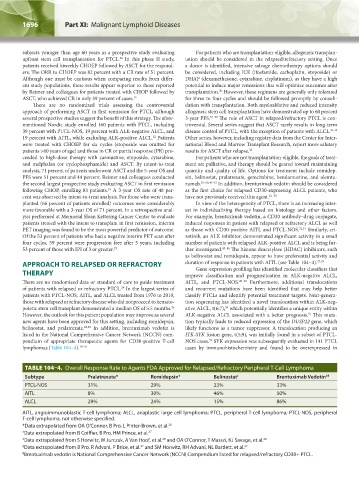
               belinostat,  and  pralatrexate. 28,29   In  addition,  brentuximab  vedotin  is   likely functions as a tumor suppressor. A translocation producing an
               listed in the National Comprehensive Cancer Network (NCCN) com-  ITK-SYK fusion gene, t(5;9), was initially found in a subset of PTCL-
               pendium of appropriate therapeutic agents for CD30-positive T-cell   NOS cases.  SYK expression was subsequently evaluated in 141 PTCL
                                                                              52
               lymphomas (Table 104–4). 30–33                         cases by immunohistochemistry and found to be overexpressed in
                TABLE 104–4.  Overall Response Rate to Agents FDA Approved for Relapsed/Refractory Peripheral T-Cell Lymphoma
                Subtype              Pralatrexate*        Romidepsin †          Belinostat ‡         Brentuximab Vedotin §¶
                PTCL-NOS             31%                  29%                   23%                  33%
                AITL                 8%                   30%                   46%                  50%
                ALCL                 29%                  24%                   15%                  86%
               AITL, angioimmunoblastic T-cell lymphoma; ALCL, anaplastic large cell lymphoma; PTCL, peripheral T-cell lymphoma; PTCL-NOS, peripheral
               T-cell lymphoma, not otherwise specified.
                                                                26
               *Data extrapolated from OA O’Connor, B Pro, L Pinter-Brown, et al.
               † Data extrapolated from B Coiffier, B Pro, HM Prince, et al.
                                                          27
                                                                                                28
               ‡ Data extrapolated from S Horwitz, W Jurczak, A Van Hoof, et al.  and OA O’Connor, T Masszi, KJ Savage, et al.
                                                              29
                                                                                          32
               § Data extrapolated from B Pro, R Advani, P Brice, et al.  and SM Horwitz, RH Advani, NL Bartlett, et al.
                                                       32
               ¶ Brentuximab vedotin is National Comprehensive Cancer Network (NCCN) Compendium listed for relapsed/refractory CD30+ PTCL.


          Kaushansky_chapter 104_p1693-1706.indd   1696                                                                 9/21/15   12:47 PM

