


Page 1720 - Williams Hematology ( PDFDrive )
P. 1720
1694  Part XI:  Malignant Lymphoid Diseases   Chapter 104:  Mature T-Cell and Natural Killer Cell Lymphomas          1695


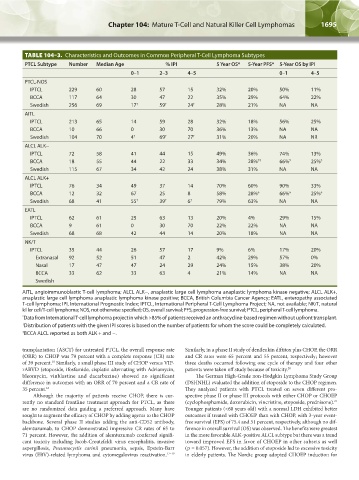
                   TABLE 104–3.  Characteristics and Outcomes in Common Peripheral T-Cell Lymphoma Subtypes
                   PTCL Subtype  Number    Median Age             % IPI            5 Year OS*  5-Year PFS* 5-Year OS by IPI
                                                      0–1       2–3      4–5                            0–1        4–5
                   PTCL-NOS
                     IPTCL       229       60         28        57       15        32%       20%        50%        11%
                     BCCA        117       64         30        47       22        35%       29%        64%        22%
                     Swedish     256       69         17 †      59 †     24 †      28%       21%        NA         NA
                   AITL
                     IPTCL       213       65         14        59       28        32%       18%        56%        25%
                     BCCA        10        66         0         30       70        36%       13%        NA         NA
                     Swedish     104       70         4 †       69 †     27 †      31%       20%        NA         NR
                   ALCL ALK−
                     IPTCL       72        58         41        44       15        49%       36%        74%        13%
                     BCCA        18        55         44        22       33        34%       28% ‡‡     66% ‡      25% ‡
                     Swedish     115       67         34        42       24        38%       31%        NA         NA
                   ALCL ALK+
                     IPTCL       76        34         49        37       14        70%       60%        90%        33%
                     BCCA        12        32         67        25       8         58%       28% ‡      66% ‡      25% ‡
                     Swedish     68        41         55 †      39 †     6 †       79%       63%        NA         NA
                   EATL
                     IPTCL       62        61         25        63       13        20%       4%         29%        15%
                     BCCA        9         61         0         30       70        22%       22%        NA         NA
                     Swedish     68        68         42        44       14        20%       18%        NA         NA
                   NK/T
                     IPTCL       35        44         26        57       17        9%        6%         17%        20%
                      Extranasal  92       52         51        47       2         42%       29%        57%        0%
                      Nasal      17        47         47        24       29        24%       15%        38%        20%
                      BCCA       33        62         33        63       4         21%       14%        NA         NA
                      Swedish

                  AITL, angioimmunoblastic T-cell lymphoma; ALCL ALK−, anaplastic large cell lymphoma anaplastic lymphoma kinase negative; ALCL ALK+,
                  anaplastic large cell lymphoma anaplastic lymphoma kinase positive; BCCA, British Columbia Cancer Agency; EATL, enteropathy associated
                  T-cell lymphoma; IPI, International Prognostic Index; IPTCL, International Peripheral T-Cell Lymphoma Project; NA, not available; NK/T, natural
                  killer cell/T-cell lymphoma; NOS, not otherwise specified; OS, overall survival; PFS, progression-free survival; PTCL, peripheral T-cell lymphoma.
                  * Data from International T-cell lymphoma project in which >85% of patients received an anthracycline-based regimen without upfront transplant.
                  † Distribution of patients with the given IPI scores is based on the number of patients for whom the score could be completely calculated.
                  ‡ BCCA ALCL reported as both ALK + and −.


                  transplantation (ASCT) for untreated PTCL, the overall response rate   Similarly, in a phase II study of denileukin diftitox plus CHOP, the ORR
                  (ORR) to CHOP was 79 percent with a complete response (CR) rate   and CR rates were 65 percent and 55 percent, respectively; however
                  of 39 percent.  Similarly, a small phase III study of CHOP versus VIP-  three deaths occurred following one cycle of therapy and four other
                            15
                  rABVD (etoposide, ifosfamide, cisplatin alternating with Adriamycin,   patients were taken off study because of toxicity. 20
                  bleomycin, vinblastine and dacarbazine) showed no significant   The German High-Grade non-Hodgkin Lymphoma Study Group
                  difference in outcomes with an ORR of 70 percent and a CR rate of   (DSHNHL) evaluated the addition of etoposide to the CHOP regimen.
                  35 percent. 16                                        They analyzed patients with PTCL treated on seven different pro-
                     Although the majority of patients receive CHOP, there is cur-  spective phase II or phase III protocols with either CHOP or CHOEP
                  rently no standard frontline treatment approach for PTCL, as there   (cyclophosphamide, doxorubicin, vincristine, etoposide, prednisone).
                                                                                                                          21
                  are no randomized data guiding a preferred approach. Many have   Younger patients (<60 years old) with a normal LDH exhibited better
                  sought to augment the efficacy of CHOP by adding agents to the CHOP   outcomes if treated with CHOEP than with CHOP, with 3-year event-
                  backbone. Several phase II studies adding the anti-CD52 antibody,   free survival (EFS) of 75.4 and 51 percent, respectively, although no dif-
                  alemtuzumab, to CHOP demonstrated impressive CR rates of 65 to     ference in overall survival (OS) was observed. The benefits were greatest
                  71 percent. However, the addition of alemtuzumab conferred signifi-  in the more favorable ALK-positive ALCL subtype but there was a trend
                  cant  toxicity  including  Jacob-Creutzfeldt  virus  encephalitis,  invasive   toward improved EFS in favor of CHOEP in other subsets as well
                  aspergillosis,  Pneumocystis  carinii pneumonia, sepsis, Epstein-Barr   (p = 0.057). However, the addition of etoposide led to excessive toxicity
                  virus (EBV)-related lymphoma and cytomegalovirus reactivation. 17–19    in elderly patients. The Nordic group adopted CHOEP induction for


          Kaushansky_chapter 104_p1693-1706.indd   1695                                                                 9/21/15   12:47 PM

