


Page 1821 - Williams Hematology ( PDFDrive )
P. 1821
1796           Part XI:  Malignant Lymphoid Diseases                                                                                                                                  Chapter 109:  Macroglobulinemia            1797


               discontinuation of everolimus led to rapid increases in serum IgM lev-    RESPONSE CRITERIA IN WALDENSTRÖM
               els, and symptomatic hyperviscosity. Grade 2 or higher hematologic
               and nonhematologic toxicities in this study that were related to everoli-  MACROGLOBULINEMIA
               mus were predominately hematologic, including anemia (40 percent),
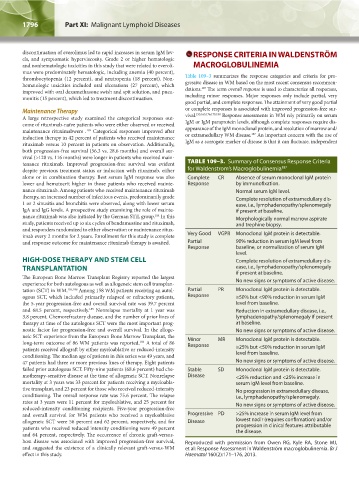
               thrombocytopenia (12 percent), and neutropenia (18 percent). Non-  Table 109–3 summarizes the response categories and criteria for pro-
               hematologic toxicities included oral ulcerations (27 percent), which   gressive disease in WM based on the most recent consensus recommen-
                                                                           187
               improved with oral dexamethasone swish and spit solution, and pneu-  dations.  The term overall response is used to characterize all responses,
               monitis (15 percent), which led to treatment discontinuation.  including minor responses. Major responses only include partial, very
                                                                      good partial, and complete responses. The attainment of very good partial
               Maintenance Therapy                                    or complete responses is associated with improved progression-free sur-
                                                                          155,165,176,179,188
               A large retrospective study examined the categorical responses out-  vival.   Response assessments in WM rely primarily on serum
               come of rituximab-naïve patients who were either observed or received   IgM or IgM paraprotein levels, although complete responses require dis-
                                     183
               maintenance rituximabwere .  Categorical responses improved after   appearance of the IgM monoclonal protein, and resolution of marrow and/
                                                                                            187
               induction therapy in 42 percent of patients who received maintenance   or extramedullary WM disease.  An important concern with the use of
               rituximab versus 10 percent in patients on observation. Additionally,   IgM as a surrogate marker of disease is that it can fluctuate, independent
               both progression-free survival (56.3 vs. 28.6 months) and overall sur-
               vival (>120 vs. 116 months) were longer in patients who received main-
               tenance rituximab. Improved progression-free survival was evident   TABLE 109–3.  Summary of Consensus Response Criteria
               despite previous treatment status or induction with rituximab, either   for Waldenstrom’s Macroglobulinemia 187
               alone or in combination therapy. Best serum IgM response was also   Complete   CR  Absence of serum monoclonal IgM protein
               lower and hematocrit higher in those patients who received mainte-  Response  by immunofixation.
               nance rituximab. Among patients who received maintenance rituximab      Normal serum IgM level.
               therapy, an increased number of infectious events, predominantly grade   Complete resolution of extramedullary dis-
               1 or 2 sinusitis and bronchitis were observed, along with lower serum   ease, i.e., lymphadenopathy/splenomegaly
               IgA and IgG levels. A prospective study examining the role of mainte-   if present at baseline.
               nance rituximab was also initiated by the German STiL group.  In this   Morphologically normal marrow aspirate
                                                            184
               study, patients received up to six cycles of bendamustine and rituximab,   and trephine biopsy.
               and responders randomized to either observation or maintenance ritux-
               imab every 2 months for 2 years. Enrollment for this study is complete   Very Good  VGPR  Monoclonal IgM protein is detectable.
               and response outcome for maintenance rituximab therapy is awaited.  Partial   90% reduction in serum IgM level from
                                                                       Response        baseline, or normalization of serum IgM
                                                                                       level.
               HIGH-DOSE THERAPY AND STEM CELL                                         Complete resolution of extramedullary dis-
               TRANSPLANTATION                                                         ease, i.e., lymphadenopathy/splenomegaly
                                                                                       if present at baseline.
               The European Bone Marrow Transplant Registry reported the largest       No new signs or symptoms of active disease.
               experience for both autologous as well as allogeneic stem cell transplan-
               tation (SCT) in WM. 185,186  Among 158 WM patients receiving an autol-  Partial   PR  Monoclonal IgM protein is detectable.
               ogous SCT, which included primarily relapsed or refractory patients,   Response  ≥50% but <90% reduction in serum IgM
               the 5-year progression-free and overall survival rate was 39.7 percent   level from baseline.
                                      185
               and 68.5 percent, respectively.  Nonrelapse mortality at 1 year was     Reduction in extramedullary disease, i.e.,
               3.8 percent. Chemorefractory disease, and the number of prior lines of   lymphadenopathy/splenomegaly if present
               therapy at time of the autologous SCT were the most important prog-     at baseline.
               nostic factor for progression-free and overall survival. In the alloge-  No new signs or symptoms of active disease.
               neic SCT experience from the European Bone Marrow Transplant, the   Minor   MR  Monoclonal IgM protein is detectable.
               long-term outcome of 86 WM patients was reported.  A total of 86   Response
                                                       186
               patients received allograft by either myeloablative or reduced-intensity   ≥25% but <50% reduction in serum IgM
               conditioning. The median age of patients in this series was 49 years, and   level from baseline.
               47 patients had three or more previous lines of therapy. Eight patients   No new signs or symptoms of active disease.
               failed prior autologous SCT. Fifty-nine patients (68.6 percent) had che-  Stable   SD  Monoclonal IgM protein is detectable.
               motherapy-sensitive disease at the time of allogeneic SCT. Nonrelapse   Disease  <25% reduction and <25% increase in
               mortality at 3 years was 33 percent for patients receiving a myeloabla-  serum IgM level from baseline.
               tive transplant, and 23 percent for those who received reduced-intensity   No progression in extramedullary disease,
               conditioning. The overall response rate was 75.6 percent. The relapse   i.e., lymphadenopathy/splenomegaly.
               rates at 3 years were 11 percent for myeloablative, and 25 percent for   No new signs or symptoms of active disease.
               reduced-intensity conditioning recipients. Five-year progression-free
               and overall survival for WM patients who received a myeloablative   Progressive PD  >25% increase in serum IgM level from
               allogeneic SCT were 56 percent and 62 percent, respectively, and for   Disease  lowest nadir (requires confirmation) and/or
               patients who received reduced intensity conditioning were 49 percent    progression in clinical features attributable
                                                                                       the disease.
               and 64 percent, respectively. The occurrence of chronic graft-versus-
               host disease was associated with improved progression-free survival,   Reproduced with permission from Owen RG, Kyle RA, Stone MJ,
               and suggested the existence of a clinically relevant graft-versus-WM   et al: Response Assessment in Waldenström macroglobulinemia. Br J
               effect in this study.                                  Haematol 160(2):171–176, 2013.


          Kaushansky_chapter 109_p1785-1802.indd   1796                                                                 9/21/15   12:31 PM

