


Page 1817 - Williams Hematology ( PDFDrive )
P. 1817
1792           Part XI:  Malignant Lymphoid Diseases                                                                                                                                  Chapter 109:  Macroglobulinemia            1793


                        A                                            B
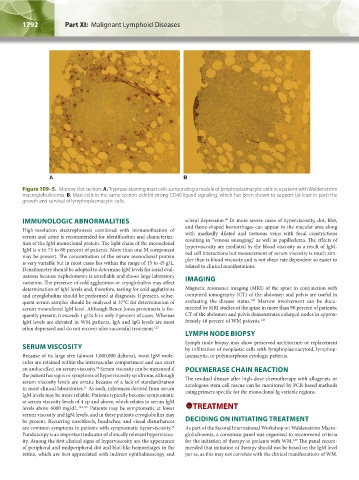
               Figure 109–5.  Marrow clot section. A. Tryptase-staining mast cells surrounding a nodule of lymphoplasmacytic cells in a patient with Waldenström
               macroglobulinemia. B. Mast cells in the same section exhibit strong CD40 ligand signaling, which has been shown to support (at least in part) the
               growth and survival of lymphoplasmacytic cells.


               IMMUNOLOGIC ABNORMALITIES                              scleral depression.  In more severe cases of hyperviscosity, dot, blot,
                                                                                   68
                                                                      and flame-shaped hemorrhages can appear in the macular area along
               High-resolution electrophoresis combined with immunofixation of   with markedly dilated and tortuous veins with focal constrictions
               serum and urine is recommended for identification and characteriza-  resulting in “venous sausaging,” as well as papilledema. The effects of
               tion of the IgM monoclonal protein. The light chain of the monoclonal   hyperviscosity are mediated by the blood viscosity as a result of IgM-
               IgM is κ in 75 to 80 percent of patients. More than one M component   red cell interactions but measurement of serum viscosity is much sim-
               may be present. The concentration of the serum monoclonal protein   pler than is blood viscosity and is not shear rate dependent so easier to
               is very variable but in most cases lies within the range of 15 to 45 g/L.   related to clinical manifestations.
               Densitometry should be adopted to determine IgM levels for serial eval-
               uations because nephelometry is unreliable and shows large laboratory   IMAGING
               variation. The presence of cold agglutinins or cryoglobulins may affect
               determination of IgM levels and, therefore, testing for cold agglutinins   Magnetic resonance imaging (MRI) of the spine in conjunction with
               and cryoglobulins should be performed at diagnosis. If present, subse-  computed tomography (CT) of the abdomen and pelvis are useful in
                                                                                            126
               quent serum samples should be analyzed at 37°C for determination of   evaluating the disease status.  Marrow involvement can be docu-
               serum monoclonal IgM level. Although Bence Jones proteinuria is fre-  mented by MRI studies of the spine in more than 90 percent of patients;
               quently present, it exceeds 1 g/24 h in only 3 percent of cases. Whereas   CT of the abdomen and pelvis demonstrates enlarged nodes in approx-
               IgM levels are elevated in WM patients, IgA and IgG levels are most   imately 40 percent of WM patients. 126
               often depressed and do not recover after successful treatment. 123
                                                                      LYMPH NODE BIOPSY
                                                                      Lymph node biopsy may show preserved architecture or replacement
               SERUM VISCOSITY                                        by infiltration of neoplastic cells with lymphoplasmacytoid, lymphop-
               Because of its large size (almost 1,000,000 daltons), most IgM mole-  lasmacytic, or polymorphous cytologic patterns.
               cules are retained within the intravascular compartment and can exert
               an undue effect on serum viscosity.  Serum viscosity can be measured if   POLYMERASE CHAIN REACTION
                                        64
               the patient has signs or symptoms of hyperviscosity syndrome, although
               serum viscosity levels are erratic because of a lack of standardization   The residual disease after high-dose chemotherapy with allogeneic or
               in most clinical laboratories.  As such, inferences derived from serum   autologous stem-cell rescue can be monitored by PCR-based methods
                                    16
               IgM levels may be more reliable. Patients typically become symptomatic   using primers specific for the monoclonal Ig variable regions.
               at serum viscosity levels of 4 cp and above, which relates to serum IgM
               levels above 6000 mg/dL. 124,125  Patients may be symptomatic at lower   TREATMENT
               serum viscosity and IgM levels, and in these patients cryoglobulins may
               be present. Recurring nosebleeds, headaches, and visual disturbances   DECIDING ON INITIATING TREATMENT
               are common symptoms in patients with symptomatic hyperviscosity.    As part of the Second International Workshop on Waldenström Macro-
                                                                 16
               Funduscopy is an important indicator of clinically relevant hyperviscos-  globulinemia, a consensus panel was organized to recommend criteria
               ity. Among the first clinical signs of hyperviscosity are the appearance   for the initiation of therapy in patients with WM.  The panel recom-
                                                                                                          127
               of peripheral and midperipheral dot and blot-like hemorrhages in the   mended that initiation of therapy should not be based on the IgM level
               retina, which are best appreciated with indirect ophthalmoscopy and   per se, as this may not correlate with the clinical manifestations of WM.


          Kaushansky_chapter 109_p1785-1802.indd   1792                                                                 9/21/15   12:30 PM

