


Page 1829 - Williams Hematology ( PDFDrive )
P. 1829
1804           Part XI:  Malignant Lymphoid Diseases                                                                                                                                 Chapter 110:  Heavy-Chain Disease           1805


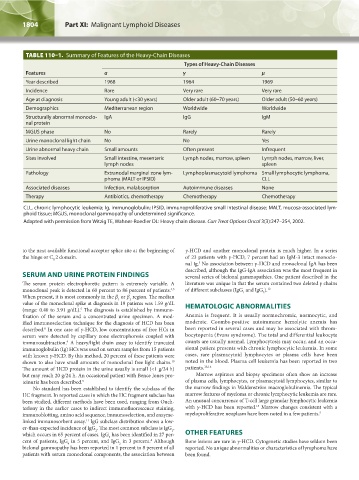
                 TABLE 110–1.  Summary of Features of the Heavy-Chain Diseases
                                                                      Types of Heavy-Chain Diseases
                 Features                  α                         γ                          μ
                 Year described            1968                      1964                       1969
                 Incidence                 Rare                      Very rare                  Very rare
                 Age at diagnosis          Young adult (<30 years)   Older adult (60–70 years)  Older adult (50–60 years)
                 Demographics              Mediterranean region      Worldwide                  Worldwide
                 Structurally abnormal monoclo-  IgA                 IgG                        IgM
                 nal protein
                 MGUS phase                No                        Rarely                     Rarely
                 Urine monoclonal light chain  No                    No                         Yes
                 Urine abnormal heavy chain  Small amounts           Often present              Infrequent
                 Sites involved            Small intestine, mesenteric   Lymph nodes, marrow, spleen  Lymph nodes, marrow, liver,
                                           lymph nodes                                          spleen
                 Pathology                 Extranodal marginal zone lym-  Lymphoplasmacytoid lymphoma Small lymphocytic lymphoma,
                                           phoma (MALT or IPSID)                                CLL
                 Associated diseases       Infection, malabsorption  Autoimmune diseases        None
                 Therapy                   Antibiotics, chemotherapy  Chemotherapy              Chemotherapy
                CLL, chronic lymphocytic leukemia; Ig, immunoglobulin; IPSID, immunoproliferative small intestinal disease; MALT, mucosa-associated lym-
                phoid tissue; MGUS, monoclonal gammopathy of undetermined significance.
                Adapted with permission from Witzig TE, Wahner-Roedler DL: Heavy chain disease. Curr Treat Options Oncol 3(3):247–254, 2002.


               to the next available functional acceptor splice site at the beginning of   γ-HCD and another monoclonal protein is much higher. In a series
               the hinge or C 2 domain.                               of 23 patients with γ-HCD, 7 percent had an IgM-λ intact monoclo-
                          H
                                                                           5
                                                                      nal Ig.  No association between γ-HCD and monoclonal IgA has been
                                                                      described, although the IgG-IgA association was the most frequent in
               SERUM AND URINE PROTEIN FINDINGS                       several series of biclonal gammopathies. One patient described in the
               The serum protein electrophoretic pattern is extremely variable. A   literature was unique in that the serum contained two deleted γ chains
               monoclonal peak is detected in 60 percent to 86 percent of patients.    of different subclasses (IgG  and IgG ). 12
                                                                 4,5
                                                                                                2
                                                                                         1
               When present, it is most commonly in the β  or β  region. The median
                                                   2
                                               1
               value of the monoclonal spike at diagnosis in 19 patients was 1.59 g/dL    HEMATOLOGIC ABNORMALITIES
               (range: 0.40 to 3.91 g/dL).  The diagnosis is established by immuno-
                                   5
               fixation of the serum and a concentrated urine specimen. A mod-  Anemia is frequent. It is usually normochromic, normocytic, and
               ified immunoselection technique for the diagnosis of HCD has been   moderate. Coombs-positive autoimmune hemolytic anemia has
               described.  In one case of γ-HCD, low concentrations of free HCs in   been reported in several cases and may be associated with throm-
                       8
               serum  were  detected  by  capillary  zone  electrophoresis  coupled  with   bocytopenia (Evans syndrome). The total and differential leukocyte
               immunosubtraction.  A heavy/light chain assay to identify truncated   counts are usually normal. Lymphocytosis may occur, and an occa-
                              9
               immunoglobulin (Ig) HCs was used on serum samples from 15 patients   sional patient presents with chronic lymphocytic leukemia. In some
               with known γ-HCD. By this method, 20 percent of these patients were   cases, rare plasmacytoid lymphocytes or plasma cells have been
               shown to also have small amounts of monoclonal free light chains.    noted in the blood. Plasma cell leukemia has been reported in two
                                                                 10
               The amount of HCD protein in the urine usually is small (<1 g/24 h)   patients. 13,14
               but may reach 20 g/24 h. An occasional patient with Bence Jones pro-  Marrow aspirates and biopsy specimens often show an increase
               teinuria has been described. 5                         of plasma cells, lymphocytes, or plasmacytoid lymphocytes, similar to
                   No standard has been established to identify the subclass of the   the marrow findings in Waldenström macroglobulinemia. The typical
               HC fragment. In reported cases in which the HC fragment subclass has   marrow features of myeloma or chronic lymphocytic leukemia are rare.
               been studied, different methods have been used, ranging from Ouch-  An unusual concurrence of T-cell large granular lymphocytic leukemia
                                                                                              15
               terlony in the earlier cases to indirect immunofluorescence staining,   with  γ-HCD has been reported.  Marrow changes consistent with a
               immunoblotting, amino acid sequence, immunoselection, and enzyme-  myeloproliferative neoplasm have been noted in a few patients. 5
               linked immunosorbent assay.  IgG subclass distribution shows a low-
                                     11
               er-than-expected incidence of IgG . The most common subclass is IgG ,
                                        2
                                                                 1
               which occurs in 65 percent of cases. IgG  has been identified in 27 per-  OTHER FEATURES
                                            3
               cent of patients, IgG  in 5 percent, and IgG  in 3 percent.  Although   Bone lesions are rare in γ-HCD. Cytogenetic studies have seldom been
                                                          4
                               4
                                                2
               biclonal gammopathy has been reported in 1 percent to 8 percent of all   reported. No unique abnormalities or characteristics of lymphoma have
               patients with serum monoclonal components, the association between   been found.
          Kaushansky_chapter 110_p1803-1812.indd   1804                                                                 9/18/15   9:57 AM

