


Page 1841 - Williams Hematology ( PDFDrive )
P. 1841
1816           Part XII:  Hemostasis and Thrombosis                                                                                                                Chapter 111:  Megakaryopoiesis and Thrombopoiesis             1817


                TABLE 111–1.  Maturation Stages of Megakaryocytes     not appear to be required for the GPIb-V-IX complex to function as a
                                                                      von Willebrand factor receptor. Rather, GPV is a target of thrombin,
                Term             Size (μM)  Morphology                potentially playing a role in platelet activation. 15
                Megakaryoblast   >10       Lobed nucleus, basophilic
                (stage I)                  cytoplasm                  Demarcation Membranes
                Basophilic       >20       Horseshoe-shaped nucleus,   Another feature of the megakaryoblast is the initial development of
                megakaryocyte              basophilic cytoplasm,      demarcation membranes, which begin as invaginations of the plasma
                (stage II)                 azurophilic granules around   membrane and ultimately develop into a highly branched intercon-
                                           centrosome                 nected system of channels that course through the cytoplasm. The
                                                                      demarcation membrane system is in open communication with the
                Granular megakary-  >25–50  Large multilobed nucleus, aci-                                           16
                ocyte (stage III)          dophilic cytoplasm, numer-  extracellular space, based on studies using electron dense tracers.  Bio-
                                           ous azurophilic granules   chemical analysis indicates the composition of these membranes is very
                                                                      similar to the plasma membrane at each stage of megakaryocyte devel-
                Mature megakaryo-  >25–50  Pyknotic nucleus, groups of   opment. Over the 72 hours required for stage III/IV cells to develop
                cyte (stage IV)            10–12 azurophilic granules
                                                                      from megakaryoblasts, the demarcation membrane system grows sub-
                                                                      stantially. The demarcation membrane system provides the material
                                                                      necessary for development of proplatelet processes, structures that form
               second most abundant megakaryocyte-specific protein. Glycoprotein V   in stage IV megakaryocytes and give rise upon fragmentation to mature
                                                                 12
               also is expressed in complex with GPIb and GPIX, in a ratio of 1:2:2.    platelets. 8,17
               However, the genetic elimination of GPV has little effect on platelet
                      13
               adhesion,  and unlike GPIb and GPIX, no mutations of GPV are asso-  Endomitosis
               ciated with Bernard-Soulier disease (Chap. 120).  Therefore, GPV does   One of the most characteristic features of megakaryocyte development
                                                  14
                                                                      is endomitosis, a unique form of mitosis in which the DNA is repeat-
                                                                      edly replicated in the absence of nuclear or cytoplasmic division. The
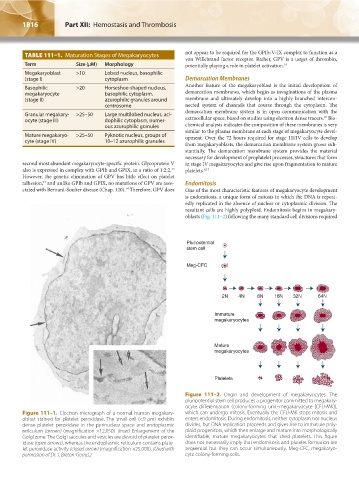
                                                                      resultant cells are highly polyploid. Endomitosis begins in megakary-
                                                                      oblasts (Fig. 111–2) following the many standard cell divisions required


                                                                      Pluripotential
                                                                      stem cell

                                                                      Meg-CFC


                                                                                  2N    4N    8N    16N   32N      64N


                                                                                Immature
                                                                                megakaryocytes


                                                                                Mature
                                                                                megakaryocytes


                                                                                Platelets

                                                                      Figure 111–2.  Origin and development of megakaryocytes.  The
                                                                      pluripotential stem cell produces a progenitor committed to megakary-
                                                                      ocyte differentiation (colony-forming unit–megakaryocyte [CFU-MK]),
               Figure 111–1.  Electron micrograph of a normal human megakary-  which can undergo mitosis. Eventually the CFU-MK stops mitosis and
               oblast stained for platelet peroxidase. The small cell (<9 μm) exhibits   enters endomitosis. During endomitosis, neither cytoplasm nor nucleus
               dense  platelet  peroxidase  in  the  perinuclear  space  and  endoplasmic   divides, but DNA replication proceeds and gives rise to immature poly-
               reticulum (arrows) (magnification ×12,150). (Inset) Enlargement of the   ploid progenitors, which then enlarge and mature into morphologically
               Golgi zone. The Golgi saccules and vesicles are devoid of platelet perox-  identifiable, mature megakaryocytes that shed platelets.  This figure
               idase (open arrows), whereas the endoplasmic reticulum contains plate-  does not necessarily imply that endomitosis and platelet formation are
               let peroxidase activity (closed arrow) (magnification ×25,000). (Used with   sequential but they can occur simultaneously. Meg-CFC, megakaryo-
               permission of Dr. J. Breton-Gorius.)                   cyte colony-forming cells.


          Kaushansky_chapter 111_p1813-1828.indd   1816                                                                 9/21/15   4:11 PM

