


Page 1845 - Williams Hematology ( PDFDrive )
P. 1845
1820           Part XII:  Hemostasis and Thrombosis                                                                                                                Chapter 111:  Megakaryopoiesis and Thrombopoiesis             1821


                         A                             B                            C
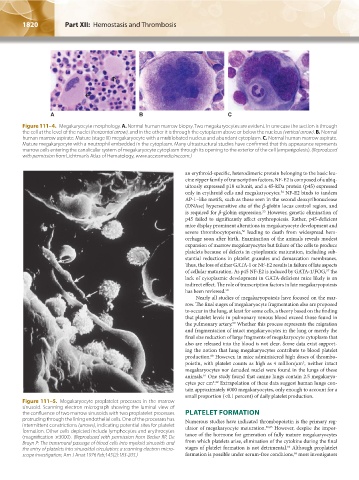
               Figure 111–4.  Megakaryocyte morphology. A. Normal human marrow biopsy. Two megakaryocytes are evident. In one case the section is through
               the cell at the level of the nuclei (horizontal arrow), and in the other it is through the cytoplasm above or below the nucleus (vertical arrow). B. Normal
               human marrow aspirate. Mature (stage III) megakaryocyte with a multilobated nucleus and abundant cytoplasm. C. Normal human marrow aspirate.
               Mature megakaryocyte with a neutrophil embedded in the cytoplasm. Many ultrastructural studies have confirmed that this appearance represents
               marrow cells entering the canalicular system of megakaryocyte cytoplasm through its opening to the exterior of the cell (emperipolesis). (Reproduced
               with permission from Lichtman’s Atlas of Hematology, www.accessmedicine.com.)


                                                                      an erythroid-specific, heterodimeric protein belonging to the basic leu-
                                                                      cine zipper family of transcription factors, NF-E2 is composed of a ubiq-
                                                                      uitously expressed p18 subunit, and a 45-kDa protein (p45) expressed
                                                                      only in erythroid cells and megakaryocytes.  NF-E2 binds to tandem
                                                                                                      54
                                                                      AP-1–like motifs, such as those seen in the second deoxyribonuclease
                                                                      (DNAse) hypersensitive site of the β-globin locus control region, and
                                                                      is required for β-globin expression.  However, genetic elimination of
                                                                                                55
                                                                      p45 failed to significantly affect erythropoiesis. Rather, p45-deficient
                                                                      mice display prominent alterations in megakaryocyte development and
                                                                      severe thrombocytopenia,  leading to death from widespread hem-
                                                                                         56
                                                                      orrhage soon after birth. Examination of the animals reveals modest
                                                                      expansion of marrow megakaryocytes but failure of the cells to produce
                                                                      platelets because of defects in cytoplasmic maturation, including sub-
                                                                      stantial reductions in platelet granules and demarcation membranes.
                                                                      Thus, the loss of either GATA-1 or NF-E2 results in failure of late aspects
                                                                      of cellular maturation. As p45 NF-E2 is induced by GATA-1/FOG,  the
                                                                                                                     57
                                                                      lack of cytoplasmic development in GATA-deficient mice likely is an
                                                                      indirect effect. The role of transcription factors in late megakaryopoiesis
                                                                      has been reviewed. 58
                                                                          Nearly all studies of megakaryopoiesis have focused on the mar-
                                                                      row. The final stages of megakaryocyte fragmentation also are proposed
                                                                      to occur in the lung, at least for some cells, a theory based on the finding
                                                                      that platelet levels in pulmonary venous blood exceed those found in
                                                                      the pulmonary artery.  Whether this process represents the migration
                                                                                      59
                                                                      and fragmentation of intact megakaryocytes in the lung or merely the
                                                                      final size reduction of large fragments of megakaryocyte cytoplasm that
                                                                      also are released into the blood is not clear. Some data exist support-
                                                                      ing the notion that lung megakaryocytes contribute to blood platelet
                                                                      production.  However, in mice administered high doses of thrombo-
                                                                              60
                                                                      poietin,  with  platelet  counts  as  high  as  4  million/μm ,  neither  intact
                                                                                                             3
                                                                      megakaryocytes nor denuded nuclei were found in the lungs of these
                                                                      animals.  One study found that canine lungs contain 2.5 megakaryo-
                                                                            61
                                                                      cytes per cm .  Extrapolation of these data suggest human lungs con-
                                                                               2 62
                                                                      tain approximately 6000 megakaryocytes, only enough to account for a
                                                                      small proportion (<0.1 percent) of daily platelet production.
               Figure 111–5.  Megakaryocyte proplatelet processes in the marrow
               sinusoid. Scanning electron micrograph showing the luminal view of
               the confluence of two marrow sinusoids with two proplatelet processes   PLATELET FORMATION
               protruding through the lining endothelial cells. One of the processes has   Numerous studies have indicated thrombopoietin is the primary reg-
               intermittent constrictions (arrows), indicating potential sites for platelet   ulator of megakaryocyte maturation. 36,63  However, despite the impor-
               formation. Other cells depicted include lymphocytes and erythrocytes   tance of the hormone for generation of fully mature megakaryocytes
               (magnification ×3000).  (Reproduced with permission from Becker RP, De   from which platelets arise, elimination of the cytokine during the final
               Bruyn P: The transmural passage of blood cells into myeloid sinusoids and                64
               the entry of platelets into sinusoidal circulation; a scanning electron micro-  stages of platelet formation is not detrimental.  Although proplatelet
                                                                                                           65
               scope investigation, Am J Anat 1976 Feb;145(2):183-205.)  formation is possible under serum-free conditions,  most investigators


          Kaushansky_chapter 111_p1813-1828.indd   1820                                                                 9/21/15   4:11 PM

