


Page 1844 - Williams Hematology ( PDFDrive )
P. 1844
1818  Part XII:  Hemostasis and Thrombosis            Chapter 111:  Megakaryopoiesis and Thrombopoiesis              1819


                                            Mi            ER


                                                                                 B              D


                                  Gly

                                                                   Mt


                                                                                 C              E


                                                    DM


                                                                     ER
                              A                                   F
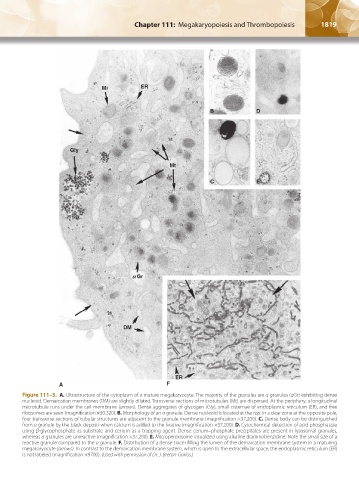
                  Figure 111–3.  A. Ultrastructure of the cytoplasm of a mature megakaryocyte. The majority of the granules are α granules (αGr) exhibiting dense
                  nucleoid. Demarcation membranes (DM) are slightly dilated. Transverse sections of microtubules (Mt) are dispersed. At the periphery, a longitudinal
                  microtubule runs under the cell membrane (arrows). Dense aggregates of glycogen (Gly), small cisternae of endoplasmic reticulum (ER), and free
                  ribosomes are seen (magnification ×30,320). B. Morphology of an α granule. Dense nucleoid is located at the top. In a clear zone at the opposite pole,
                  four transverse sections of tubular structures are adjacent to the granule membrane (magnification ×37,200). C. Dense body can be distinguished
                  from α granule by the black deposit when calcium is added to the fixative (magnification ×37,200). D. Cytochemical detection of acid phosphatase
                  using β-glycophosphate as substrate and cerium as a trapping agent. Dense cerium–phosphate precipitates are present in lysosomal granules,
                  whereas α granules are unreactive (magnification ×37,200). E. Microperoxisome visualized using alkaline diaminobenzidine. Note the small size of a
                  reactive granule compared to the α granule. F. Distribution of a dense tracer filling the lumen of the demarcation membrane system in a maturing
                  megakaryocyte (arrows). In contrast to the demarcation membrane system, which is open to the extracellular space, the endoplasmic reticulum (ER)
                  is not labeled (magnification ×9700). (Used with permission of Dr. J. Breton-Gorius.)


          Kaushansky_chapter 111_p1813-1828.indd   1819                                                                 9/21/15   4:11 PM

