


Page 1875 - Williams Hematology ( PDFDrive )
P. 1875
1850           Part XII:  Hemostasis and Thrombosis                                                                                                      Chapter 112:  Platelet Morphology, Biochemistry, and Function           1851


               function can be used as diagnostic criteria, but they have been reported   However, there were inconsistent and conflicting results in these candi-
               as symptoms. 545                                       date studies.

                    PLATELET GENOMICS, THE PLATELET                   Genome-Wide Associations Studies
                                                                      No unbiased GWAS has been performed using documented arterial
                  TRANSCRIPTOME, AND PLATELET                         thrombosis as the clinical phenotype, but many have been performed
                  PROTEOMICS                                          with coronary artery disease (CAD). Multiple studies have demon-
                                                                      strated that the Chr9p21.3 locus is associated with both myocardial
                                                                      infarction (MI) and CAD. A meta-analysis of all CAD GWAS studies
               PLATELET GENOMICS                                      that included 63,746 patients with acute and chronic CAD and 130,681
               The Homo sapiens genome is comprised of approximately 3.2 billion   controls identified 46 loci meeting genome-wide significance.  These
                                                                                                                   548
               base pairs and has approximately 3.5 million single nucleotide poly-  loci explain less than 11 percent of CAD heritability and although a
               morphisms (SNPs) that occur at frequencies of 1 percent or greater,   substantial proportion of the identified genes regulate lipid metabolism
               but continued sequencing of more genomes indicates there are at least   and inflammation, most loci are not located in previously well-known
               an additional 43 million rare or “private” SNPs. dbSNP (www.ncbi.nlm   or well-characterized platelet genes. Few of these loci have been tested
               .nih.gov/projects/SNP) maintains information about sequence varia-  for functional effects in platelets. There are numerous possible explana-
               tion, allele frequencies, differences in frequencies between populations   tions for the non-association with well-studied platelet candidate genes,
               of different ethnicity and their functional consequences. New technol-  including small platelet gene effect sizes in under-powered heteroge-
               ogies, such as next-generation sequencing, and new analytic method-  neous clinical phenotypes. 549
               ologies have driven and continue to drive expansion of genomics at a
               very rapid pace. Both epidemiologic and experimental approaches have   Whole-Exome Sequencing
               been and are used to assess significance and functionality of platelet   Whole exome-sequencing is well-suited to identify variants in protein-
               gene variants and gene expression, including genetic epidemiology, bio-  coding genes and was used to identify NBEAL2 as the causative gene in
               chemistry, cell biology, physiology, and animal studies.  the gray platelet syndrome. 550,551

               GENE VARIANTS ASSOCIATED WITH DISEASE                  Pharmacogenetics
                                                                      The CYP2C19*2 allele (681G>A; rs4244285) causes a loss of function
               Candidate Genes                                        of the CYP2C19 enzyme and reduced platelet inhibition by clopido-
               Because platelets play a central role in acute ischemic syndromes, anti-  grel as a result of decreased conversion to the active metabolite.  It
                                                                                                                      552
               platelet therapy is a mainstay of therapy. Platelets may also contribute   could account for approximately 12 percent of the variation in plate-
               to the pathophysiology of the chronic process of atherosclerosis,    let inhibition in response to clopidogrel.  Several large meta-analyses
                                                                 546
                                                                                                   553
               although the data are less consistent than with thrombosis. The earli-  have shown the loss-of-function CYP2C19*2 allele is associated with
               est platelet genetic association studies considered associations between   both stent thrombosis and cardiovascular ischemic events or death in
               atherothrombotic disease outcomes and candidate platelet gene vari-  patients undergoing percutaneous coronary interventions. 554,555
               ants that altered amino acids in platelet membrane adhesion receptors.
               Numerous studies reported associations between myocardial infarction   GENE VARIANTS ASSOCIATED WITH PLATELET
               and stroke with SNPs in integrin β  (ITGB3), integrin α  (ITGA2), and
                                                        2
                                         3
                                         547
               GPIbα (GP1BA) and GPVI (GP6).  In these relatively small studies,   TRAITS
               positive associations were more likely to be observed in patients with   Many cellular pathways in multiple tissues contribute to the patho-
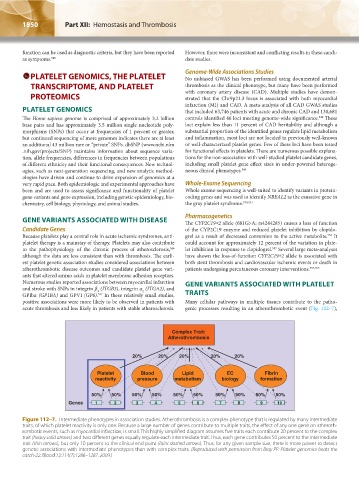
               acute thrombosis and less likely in patients with stable atherosclerosis.   genic processes resulting in an atherothrombotic event (Fig. 112–7),

                                                                  Complex Trait:
                                                                Atherothrombosis


                                                    20%      20%    20%        20%     20%


                                        Platelet       Blood         Lipid          EC           Fibrin
                                        reactivity    pressure    metabolism      biology      formation

                                       50%   50%    50%    50%    50%    50%    50%    50%    50%   50%
                               Genes    1     2      3      4       5     6      7      8      9     10

               Figure 112–7.  Intermediate phenotypes in association studies. Atherothrombosis is a complex phenotype that is regulated by many intermediate
               traits, of which platelet reactivity is only one. Because a large number of genes contribute to multiple traits, the effect of any one gene on atheroth-
               rombotic events, such as myocardial infarction, is small. This highly simplified diagram assumes five traits each contribute 20 percent to the complex
               trait (heavy solid arrows) and two different genes equally regulate each intermediate trait. Thus, each gene contributes 50 percent to the intermediate
               trait (thin arrows), but only 10 percent to the clinical end point (faint dashed arrows). Thus, for any given sample size, there is more power to detect
               genetic associations with intermediate phenotypes than with complex traits. (Reproduced with permission from Bray PF: Platelet genomics beats the
               catch-22. Blood 13;114(7):1286–1287, 2009.)


          Kaushansky_chapter 112_p1829-1914.indd   1850                                                                 17/09/15   3:27 pm

