


Page 1880 - Williams Hematology ( PDFDrive )
P. 1880
1854  Part XII:  Hemostasis and Thrombosis   Chapter 112:  Platelet Morphology, Biochemistry, and Function           1855


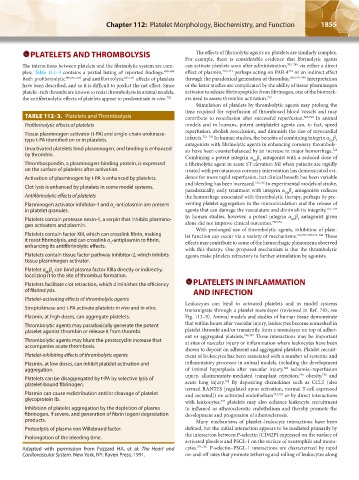
                     PLATELETS AND THROMBOLYSIS                             The effects of fibrinolytic agents on platelets are similarly complex.
                                                                        For example, there is considerable evidence that fibrinolytic agents
                  The interactions between platelets and the fibrinolytic system are com-  can activate platelets soon after administration, 703–709  via either a direct
                                                                                                           714
                  plex;  Table 112–3 contains  a partial  listing of reported findings. 680–684    effect of plasmin, 710–713  perhaps acting on PAR-4  or an indirect effect
                  Both profibrinolytic 398,685–692  and antifibrinolytic 693–701  effects of platelets   through the paradoxical generation of thrombin. 683,715–718  Interpretation
                  have been described, and so it is difficult to predict the net effect. Since   of the latter studies are complicated by the ability of tissue plasminogen
                  platelet-rich thrombi are known to resist thrombolysis in animal models,   activator to release fibrinopeptides from fibrinogen, one of the biomark-
                  the antifibrinolytic effects of platelets appear to predominate in vivo. 702  ers used to assess thrombin activation. 719
                                                                            Stimulation of platelets by thrombolytic agents may prolong the
                                                                        time required for reperfusion of thrombosed blood vessels and may
                   TABLE 112–3.  Platelets and Thrombolysis             contribute to reocclusion after successful reperfusion. 680,720  In animal
                   Profibrinolytic effects of platelets                 models and in humans, potent antiplatelet agents can, in fact, speed
                   Tissue plasminogen activator (t-PA) and single-chain urokinase-  reperfusion, abolish reocclusion, and diminish the size of myocardial
                   type t-PA identified on or in platelets.             infarcts. 721–723  In human studies, the benefits of combining integrin α β
                                                                                                                         IIb 3
                                                                        antagonists with fibrinolytic agents in enhancing coronary thromboly-
                   Unactivated platelets bind plasminogen, and binding is enhanced   sis have been counterbalanced by an increase in major hemorrhage.
                                                                                                                          724
                   by thrombin.
                                                                        Combining a potent integrin α β  antagonist with a reduced dose of
                                                                                               IIb 3
                   Thrombospondin, a plasminogen-binding protein, is expressed   a fibrinolytic agent in acute ST-elevation MI when patients are rapidly
                   on the surface of platelets after activation.        treated with percutaneous coronary intervention has demonstrated evi-
                   Activation of plasminogen by t-PA is enhanced by platelets.  dence for more rapid reperfusion, but clinical benefit has been variable
                                                                        and bleeding has been increased. 725,726  In experimental models of stroke,
                   Clot lysis is enhanced by platelets in some model systems.
                                                                        paradoxically, early treatment with integrin α β  antagonists reduces
                                                                                                          IIb 3
                   Antifibrinolytic effects of platelets                the hemorrhage associated with thrombolytic therapy, perhaps by pre-
                   Plasminogen activator inhibitor-1 and α -antiplasmin are present   venting platelet aggregation in the microcirculation and the release of
                                                2
                   in platelet granules.                                agents that can damage the vasculature and diminish its integrity. 727–729
                                                                        In human studies, however, a potent integrin  α β  antagonist given
                   Platelets contain protease nexin-1, a serpin that inhibits plasmino-               730,731  IIb 3
                   gen activators and plasmin.                          alone did not improve clinical outcomes.
                                                                            With prolonged use of thrombolytic agents, inhibition of plate-
                   Platelets contain factor XIII, which can crosslink fibrin, making   let function can occur via a variety of mechanisms. 102,707,708,732–744  These
                   it resist fibrinolysis, and can crosslink α -antiplasmin to fibrin,   effects may contribute to some of the hemorrhagic phenomena observed
                                               2
                   enhancing its antifibrinolytic effects.
                                                                        with this therapy. One proposed mechanism is that the thrombolytic
                   Platelets contain tissue factor pathway inhibitor-2, which inhibits   agents make platelets refractory to further stimulation by agonists.
                   tissue plasminogen activator.
                   Platelet α β  can bind plasma factor XIIIa directly or indirectly,
                          IIb 3
                   localizing it to the site of thrombus formation.
                   Platelets facilitate clot retraction, which diminishes the efficiency     PLATELETS IN INFLAMMATION
                   of fibrinolysis.                                        AND INFECTION
                   Platelet-activating effects of thrombolytic agents
                                                                        Leukocytes can bind to activated platelets and in model systems
                   Streptokinase and t-PA activate platelets in vivo and in vitro.  transmigrate through a platelet monolayer (reviewed in Ref. 745; see
                   Plasmin, at high doses, can aggregate platelets.     Fig. 112–9). Animal models and studies of human tissue demonstrate
                   Thrombolytic agents may paradoxically generate the potent   that within hours after vascular injury, leukocytes become enmeshed in
                   platelet agonist thrombin or release it from thrombi.  platelet thrombi and/or transiently form a monolayer on top of adher-
                                                                        ent or aggregated platelets. 746,747  These interactions may be important
                   Thrombolytic agents may blunt the prostacyclin increase that   at sites of vascular injury or inflammation where leukocytes have been
                   accompanies acute thrombosis.
                                                                        shown to deposit on adherent and aggregated platelets. Platelet recruit-
                   Platelet-inhibiting effects of thrombolytic agents   ment of leukocytes has been associated with a number of systemic and
                   Plasmin, at low doses, can inhibit platelet activation and   inflammatory processes in animal models, including the development
                                                                                                         748
                   aggregation.                                         of intimal hyperplasia after vascular injury,  ischemia–reperfusion
                                                                        injury, alloimmunity-mediated transplant rejection,  obesity,  and
                                                                                                               749
                                                                                                                      750
                   Platelets can be disaggregated by t-PA by selective lysis of       751
                   platelet-bound fibrinogen.                           acute lung injury.  By depositing chemokines such as CCL5 (also
                                                                        termed RANTES [regulated upon activation, normal T-cell expressed
                   Plasmin can cause redistribution and/or cleavage of platelet    and secreted]) on activated endothelium 752,753  or by direct interactions
                   glycoprotein Ib.
                                                                        with leukocytes,  platelets may also enhance leukocyte recruitment
                                                                                    754
                   Inhibition of platelet aggregation by the depletion of plasma   to inflamed or atherosclerotic endothelium and thereby promote the
                   fibrinogen, if severe, and generation of fibrin (ogen) degradation   development and progression of atherosclerosis.
                   products.                                                Many mechanisms of platelet–leukocyte interactions have been
                   Proteolysis of plasma von Willebrand factor.         defined, but the initial interaction appears to be mediated primarily by
                                                                        the interaction between P-selectin (CD62P) expressed on the surface of
                   Prolongation of the bleeding time.
                                                                        activated platelets and PSGL-1 on the surface of neutrophils and mono-
                  Adapted with permission from Fozzard HA, et al:  The Heart and    cytes. 755–761  P-selectin–PSGL-1 interactions are characterized by rapid
                  Cardiovascular System. New York, NY: Raven Press; 1991.  on-and-off rates that promote tethering and rolling of leukocytes along


          Kaushansky_chapter 112_p1829-1914.indd   1855                                                                 17/09/15   3:28 pm

