


Page 1892 - Williams Hematology ( PDFDrive )
P. 1892
1866  Part XII:  Hemostasis and Thrombosis   Chapter 112:  Platelet Morphology, Biochemistry, and Function           1867


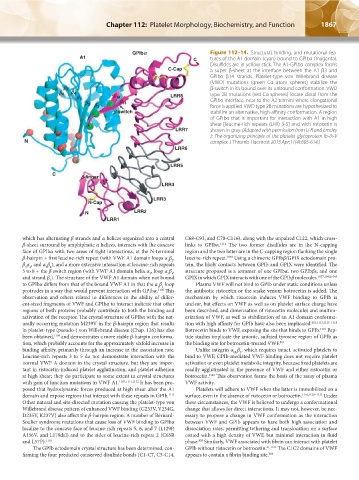
                                                       GPlb`                     Figure 112–14.  Structural, binding, and mutational fea-
                                     A1                                    C     tures of the A1 domain (cyan) bound to GPIbα (magenta).
                                                                                 Disulfides are in yellow stick. The A1-GPIbα complex forms
                                                                   C-Cap         a super β-sheet at the interface between the A1 β3 and
                                                                                 GPIbα  β14  strands.  Platelet-type  von  Willebrand  disease
                                                                                 (VWD) mutations (green Cα atom spheres) stabilize the
                                a 5                                              β-switch in its bound over its unbound conformation. VWD
                              a 6  a 4                                           type 2B mutations (red Cα spheres) locate distal from the
                                    a 1         a 14               LRR8          GPIbα interface, near to the A2 termini where elongational
                                       a 2  a 3   a 13                           force is applied. VWD type 2B mutations are hypothesized to
                                                a-switch                         stabilize an alternative, high-affinity conformation. A region
                                                                                 of GPIbα that is important for interaction with A1 in high
                                                                                 shear [leucine-rich repeats (LRR) 3-5] and with ristocetin is
                                                                     LRR7        shown in gray. (Adapted with permission from Li R and Emsley
                                                                                 J: The organizing principle of the platelet glycoprotein Ib-IX-V
                   N                                                             complex, J Thromb Haemost 2013 Apr;11(4):605-614.)
                                                                     LRR6

                                                                   LRR5
                            C
                                     a-finger
                                                                 LRR4

                                                              LRR3
                                        N-Cap
                                       N               LRR2
                                              LRR1

                  which has alternating β strands and α helices organized into a central   C68-C93, and C70-C116), along with the unpaired C122, which cross-
                  β-sheet surround by amphiphatic α helices, interacts with the concave   links to GPIbα. 1114  The two former disulfides are in the N-capping
                  face of GPIbα with two areas of tight interactions, at the N-terminal   region and the two latter are in the C-capping region flanking the single
                  β-hairpin + first leucine-rich repeat (with VWF A1 domain loops α β ,   leucine-rich repeat. 1040  Using a chimeric GPIbβ/GPIX ectodomain pro-
                                                                  1 2
                  β α , and α β ), and a more extensive interaction at leucine-rich repeats   tein, the likely contacts between GPIb and GPIX were identified. The
                          3 4
                   3 2
                  5 to 8 + the β switch region (with VWF A1 domain helix α , loop α β ,   structure proposed is a tetramer of one GPIbα, two GPIbβs, and one
                                                                  3 4
                                                            3
                  and strand β ). The structure of the VWF A1 domain when not bound   GPIX in which GPIX interacts with one of the GPIbβ molecules. 1037,1040,1043
                           3
                  to GPIbα differs from that of the bound VWF A1 in that the α β  loop   Plasma VWF will not bind to GPIb under static conditions unless
                                                               1 2
                  protrudes in a way that would prevent interaction with GPIbα. 1108  This   the antibiotic ristocetin or the snake venom botrocetin is added. The
                  observation  and  others  related  to  differences  in  the  ability  of  differ-  mechanism by which ristocetin induces VWF binding to GPIb is
                  ent-sized fragments of VWF and GPIbα to interact indicate that other   unclear, but effects on VWF as well as on platelet surface charge have
                  regions of both proteins probably contribute to both the binding and   been described, and dimerization of ristocetin molecules and multim-
                  activation of the receptor. The crystal structure of GPIbα with the nat-  erization of VWF, as well as stabilization of an A1 domain conforma-
                  urally occurring mutation M239V in the β-hairpin region that results   tion with high affinity for GPIb have also been implicated. 801,1113,1115–1118
                  in platelet-type (pseudo-) von Willebrand disease (Chap. 126) has also   Botrocetin binds to VWF, exposing the site that binds to GPIb. 1119  Pep-
                  been obtained, 1109  and demonstrates a more stable β-hairpin conforma-  tide studies implicate the anionic, sulfated tyrosine region of GPIb as
                  tion, which probably accounts for the approximately sixfold increase in   the binding site for botrocetin-treated VWF. 801
                  binding affinity, primarily through an increase in the association rate.   Unlike integrin α β , which requires intact, activated platelets to
                                                                                         IIb 3
                  Leucine-rich repeats 3 to 5 do not demonstrate interaction with the   bind to VWF, GPIb-mediated VWF binding does not require platelet
                  normal VWF A domain in the crystal structure, but they are impor-  activation or even platelet metabolic integrity, because fixed platelets are
                  tant in ristocetin-induced platelet agglutination, and platelet adhesion   readily agglutinated in the presence of VWF and either ristocetin or
                  at high shear; they do participate to some extent in crystal structures   botrocetin. 1116  This observation forms the basis of the assay of plasma
                  with gain of function mutations in VWF A1. 1107,1111,1112  It has been pro-  VWF activity.
                  posed that hydrodynamic forces produced at high shear alter the A1   Platelets will adhere to VWF when the latter is immobilized on a
                  domain and expose regions that interact with these repeats in GPIb. 1113    surface, even in the absence of ristocetin or botrocetin. 1116,1120–1122  Under
                  Other natural and site-directed mutation causing the platelet-type von   these circumstances, the VWF is believed to undergo a conformational
                  Willebrand disease pattern of enhanced VWF binding (G233V, V234G,   change that allows for direct interactions. It may not, however, be nec-
                  D235V, K237V) also affect the β-hairpin region. A number of Bernard-  essary to propose a change in VWF conformation as the interaction
                  Soulier syndrome mutations that cause loss of VWF binding to GPIbα   between VWF and GPIb appears to have both high association and
                  localize to the concave face of leucine-rich repeats 5, 6, and 7 (L129P,   dissociation rates, permitting tethering and translocation on a surface
                  A156V, and L179del) and to the sides of leucine-rich repeat 2 (C65R   coated with a high density of VWF, but minimal interaction in fluid
                  and L57P). 1110                                       phase.  Similarly, VWF associated with fibrin can interact with platelet
                                                                             809
                     The GPIb ectodomain crystal structure has been determined, con-  GPIb without ristocetin or botrocetin. 61,1123  The C1C2 domains of VWF
                  firming the four predicted conserved disulfide bonds (C1-C7, C5-C14,   appears to contain a fibrin binding site. 304


          Kaushansky_chapter 112_p1829-1914.indd   1867                                                                 17/09/15   3:29 pm

