


Page 1891 - Williams Hematology ( PDFDrive )
P. 1891
1866           Part XII:  Hemostasis and Thrombosis                                                                                                      Chapter 112:  Platelet Morphology, Biochemistry, and Function           1867


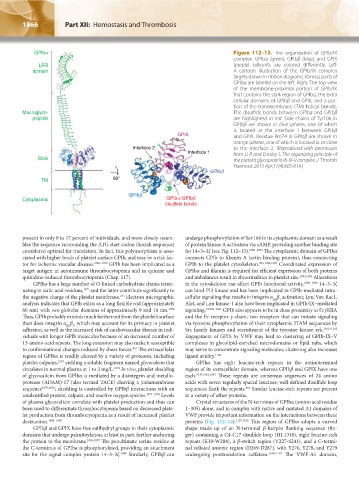
                   GPIba                                                              Figure 112–13.  The organization of GPIb/IX
                                                                                      complex.  GPIbα  (green), GPIbβ  (blue), and GPIX
                     LRR                                                              (purple) subunits are colored differently.  Left:
                   domain                                                             A cartoon illustration of the GPIb/IX complex
                                                                                      largely drawn in ribbon diagrams. Various parts of
                                                                                      GPIbα are labeled on the left. Right: The top view
                                                                                      of the membrane-proximal portion of GPIb/IX
                                                                                      that contains the stalk region of GPIbα, the extra
                                                                                      cellular domains of GPIbβ and GPIX, and a por-
                                                                                      tion of the transmembrane (TM) helical bundle.
               Macroglyco-                                                            The disulfide bonds between GPIbα and GPIbβ
                   peptide                                                            are highlighted in red. Side chains of Tyr106 in
                                                                                      GPIbβ are shown in blue spheres, one of which
                                                                                      is located at the interface 1 between GPIbβ
                                                                   GPIX               and GPIX. Residue Pro74 in GPIbβ are shown in
                                                                                      orange spheres, one of which is located at or close
                                                    Interface 2                       to the interface 2.  (Reproduced with permission
                                                                       Interface 1    from Li R and Emsley J: The organizing principle of
                    Stalk                                                             the platelet glycoprotein Ib-IX-V complex, J  Thromb
                                                                                      Haemost 2013 Apr;11(4):605-614.)
                                                                              GPIbb
                      TM                      90°

                                                   GPIbb
               Cytoplasmic                                      GPIba-GPIbb
                                                               disulfide bonds


               present in only 8 to 17 percent of individuals, and more closely resem-  undergo phosphorylation of Ser 166 in its cytoplasmic domain as a result
               bles the sequence surrounding the ATG start codon (Kozak sequence)   of protein kinase A activation via cAMP, providing another binding site
               considered optimal for translation. In fact, this polymorphism is asso-  for 14–3–3ζ (see Fig. 112–13). 1089–1091  The cytoplasmic domain of GPIbα
               ciated with higher levels of platelet surface GPIb, and may be a risk fac-  connects GPIb to filamin A (actin-binding protein), thus connecting
               tor for ischemic vascular disease. 1062–1070  GPIb has been implicated as a   GPIb to the platelet cytoskeleton. 993,1092,1093  Coordinated expression of
               target antigen in autoimmune thrombocytopenia and in quinine and   GPIbα and filamin is required for efficient expression of both proteins
               quinidine-induced thrombocytopenia (Chap. 117).        and imbalances result in abnormalities in platelet size. 1094,1095  Alterations
                   GPIbα has a large number of O-linked carbohydrate chains termi-  in the cytoskeleton can affect GPIb functional activity. 1096–1098  14–3–3ζ
               nating in sialic acid residues, 1071  and the latter contribute significantly to   can bind PI3 kinase and has been implicated in GPIb-mediated intra-
               the negative charge of the platelet membrane.  Electron micrographic   cellular signaling that results in integrin α β  activation; Lyn; Vav, Rac1,
                                                215
                                                                                                   IIb 3
               analysis indicates that GPIb exists as a long flexible rod (approximately   Alet, and Lim kinase-1 also have been implicated in GPIb/IX–mediated
               60 nm) with two globular domains of approximately 9 and 16 nm. 1072    signaling. 9,1099–1101  GPIb also appears to be in close proximity to FcγRIIA
               Thus, GPIb probably extends much further out from the platelet’s surface   and the Fc receptor γ-chain, two receptors that can initiate signaling
               than does integrin α β , which may account for its primacy in platelet   via tyrosine phosphorylation of their cytoplasmic ITAM sequences by
                              IIb 3
               adhesion, as well as the increased risk of cardiovascular disease in indi-  Src family kinases and recruitment of the tyrosine kinase syk. 1102–1105
               viduals with longer GPIb molecules because of an increased number of   Engagement of GPIb by VWF may lead to clustering of GPIb-IX–V
               13-amino-acid repeats. The long extension may also make it susceptible   complexes in glycolipid-enriched microdomains or lipid rafts, which
                                                    801
               to conformational changes induced by shear forces.  The extracellular   may serve to concentrate signaling molecules; clustering also increases
               region of GPIbα is readily cleaved by a variety of proteases, including   ligand avidity. 1106
               platelet calpains, 1073  yielding a soluble fragment named glycocalicin that   GPIbα has eight leucine-rich repeats in the aminoterminal
               circulates in normal plasma at 1 to 3 mg/L. 1074  In vivo, platelet shedding   region of its extracellular domain, whereas GPIbβ and GPIX have one
               of glycocalicin from GPIbα is mediated by a disintegrin and metallo-  each. 1039,1042,1045  These repeats are consensus  sequences of 24 amino
               protease (ADAM)-17 (also termed TACE) cleaving a juxtamembrane   acids with seven regularly spaced leucines; well-defined disulfide loop
                                                                                          801
               sequence 1075,1076 ; shedding is controlled by GPIbβ interactions with an   sequences flank the repeats.  Similar leucine-rich repeats are present
               unidentified protein, calpain, and reactive oxygen species. 1077–1079  Levels   in a variety of other proteins.
               of plasma glycocalicin correlate with platelet production and thus can   Crystal structures of the N-terminus of GPIbα (amino acid residue
               been used to differentiate thrombocytopenia based on decreased plate-  1–305) alone, and in complex with native and mutated A1 domains of
               let production from thrombocytopenia as a result of increased platelet   VWF provide important information on the interactions between these
               destruction. 1080–1085                                 proteins (Fig. 112–14). 1107,1108  This region of GPIbα adopts a curved
                   GPIbβ and GPIX have free sulfhydryl groups in their cytoplasmic   shape made up of an N-terminal  β-hairpin flanking sequence (fin-
               domains that undergo palmitoylation, at least in part, further anchoring   ger) containing a C4-C17 disulfide loop (H1-D18), eight leucine-rich
               the protein to the membrane. 1086,1087  The penultimate serine residue at   repeats (K19-W204), a β-switch region (V227-S241), and a C-termi-
               the C-terminus of GPIbα is phosphorylated, providing an attachment   nal sulfated anionic region (D269-D287), with Y276, Y278, and Y279
               site for the signal-complex protein 14–3–3ζ. 1088  Similarly, GPIbβ can   undergoing posttranslation sulfation. 1108–1110  The VWF-A1 domain,


          Kaushansky_chapter 112_p1829-1914.indd   1866                                                                 17/09/15   3:29 pm

