


Page 1900 - Williams Hematology ( PDFDrive )
P. 1900
1874  Part XII:  Hemostasis and Thrombosis   Chapter 112:  Platelet Morphology, Biochemistry, and Function           1875


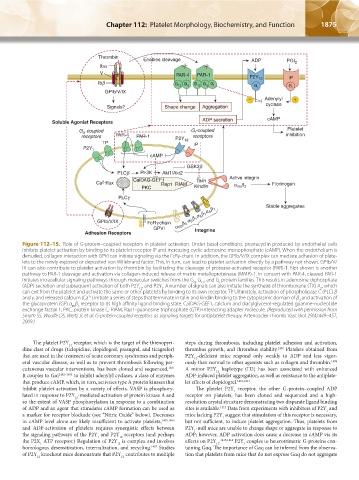
                  Figure 112–15.  Role of G-protein–coupled receptors in platelet activation. Under basal conditions, prostacyclin produced by endothelial cells
                  inhibits platelet activation by binding to its platelet receptor IP and increasing cyclic adenosine monophosphate (cAMP). When the endothelium is
                  denuded, collagen interaction with GPVI can initiate signaling via the FcRγ-chain. In addition, the GPIb/V/IX complex can mediate adhesion of plate-
                  lets to the newly exposed or deposited von Willebrand factor. This, in turn, can lead to platelet activation directly by a pathway not shown. GPIb/V/
                  IX can also contribute to platelet activation by thrombin by facilitating the cleavage of protease-activated receptor (PAR)-1. Not shown is another
                  pathway to PAR-1 cleavage and activation via collagen-induced release of matrix metalloproteinase (MMP)-1. In concert with PAR-4, cleaved PAR-1
                  initiates intracellular signaling pathways through molecular switches from the G , G , and G protein families. This results in adenosine diphosphate
                                                                           q
                                                                              12
                                                                                    i
                  (ADP) secretion and subsequent activation of both P2Y , and P2Y . A number of signals can also initiate the synthesis of thromboxane (TX) A , which
                                                         12
                                                                                                                      2
                                                                 1
                  can exit from the platelet and activate the same or other platelets by binding to its own receptor, TP. Ultimately, activation of phospholipase C (PLC) β
                  and γ, and released calcium (Ca ) initiate a series of steps that terminate in talin and kindlin binding to the cytoplasmic domain of β  and activation of
                                        2+
                                                                                                               3
                  the glycoprotein (GP) α β  receptor to its high affinity ligand binding state. CalDAG-GEF1, calcium and diacylglycerol-regulated guanine-nucleotide
                                  IIb 3
                  exchange factor 1; PKC, protein kinase C; RIAM, Rap1-guanosine triphosphate (GTP)-interacting adapter molecule. (Reproduced with permission from
                  Smyth SS, Woulfe DS, Weitz JI, et al: G-protein-coupled receptors as signaling targets for antiplatelet therapy. Arterioscler Thromb Vasc Biol 29(4):449–457,
                  2009.)
                     The platelet P2Y  receptor, which is the target of the thienopyri-  steps during thrombosis, including platelet adhesion and activation,
                                 12
                  dine class of drugs (ticlopidine, clopidogrel, prasugrel, and ticagrelor)   thrombus growth, and thrombus stability. 1408  Platelets obtained from
                  that are used in the treatment of acute coronary syndromes and periph-  P2Y -deficient  mice  respond  only  weakly  to  ADP  and  less  vigor-
                                                                           12
                  eral vascular disease, as well as to prevent thrombosis following per-  ously than normal to other agonists such as collagen and thrombin. 1409
                  cutaneous vascular interventions, has been cloned and sequenced. 1401    A minor P2Y  haplotype (H2) has been associated with enhanced
                                                                                   12
                  It couples to Gαi 1402–1404  to inhibit adenylyl cyclases, a class of enzymes   ADP-induced platelet aggregation, as well as resistance to the antiplate-
                  that produce cAMP, which, in turn, activates type A protein kinases that   let effects of clopidogrel. 1410,1411
                  inhibit platelet activation by a variety of effects. VASP is phosphory-  The platelet P2Y  receptor, the other G-protein–coupled ADP
                                                                                         1
                  lated in response to P2Y -mediated activation of protein kinase A and   receptor  on  platelets,  has  been  cloned  and  sequenced  and  a  high-
                                   12
                  so the extent of VASP phosphorylation in response to a combination   resolution crystal structure demonstrating two disparate ligand binding
                  of ADP and an agent that stimulates cAMP formation can be used as   sites is available. 1412  Data from experiments with inhibitors of P2Y  and
                                                                                                                        1
                  a marker for receptor blockade (see “Nitric Oxide” below). Decreases   mice lacking P2Y  suggest that stimulation of this receptor is necessary,
                                                                                     1
                  in cAMP level alone are likely insufficient to activate platelets, 1405,1406    but not sufficient, to induce platelet aggregation. Thus, platelets from
                  and ADP-activation of platelets requires synergistic effects between   P2Y -null mice are unable to change shape or aggregate in response to
                                                                           1
                  the signaling pathways of the P2Y  and P2Y  receptors (and perhaps   ADP; however, ADP activation does cause a decrease in cAMP via its
                                           1
                                                  12
                  the P2X  ATP receptor.) Regulation of P2Y  is complex and involves   effects on P2Y . 1413,1414  P2Y  couples to heterotrimeric G-proteins con-
                                                                                            1
                                                  12
                        1
                                                                                   12
                  homologous desensitization, internalization, and recycling. 1407  Studies   taining Gαq. The importance of Gαq can be inferred from the observa-
                  of P2Y  knockout mice demonstrate that P2Y  contributes to multiple   tion that platelets from mice that do not express Gαq do not aggregate
                       12                          12
          Kaushansky_chapter 112_p1829-1914.indd   1875                                                                 17/09/15   3:30 pm

