


Page 1902 - Williams Hematology ( PDFDrive )
P. 1902
1876  Part XII:  Hemostasis and Thrombosis   Chapter 112:  Platelet Morphology, Biochemistry, and Function           1877


                  contribute to shape change and aggregation. 1469–1471  It is unclear whether   Inactive PAR-1  Active PAR-1
                  TP directly couples to GαI 1472  or activates this pathway indirectly via   N
                  released ADP. 1467,1470  A significant portion of PGH /TXA -induced
                                                              2
                                                         2
                  platelet aggregation is actually mediated by secreted ADP, because ADP   S
                  scavenger systems inhibit aggregation induced by a stable PGH /TXA    F L  Thrombin
                                                                    2
                                                                2
                  analogue either partially (30 percent) 1473  or totally. 1472   R L                       Extracellular
                     AA can also be converted to LTs and lipoxins by the sequential   N              N RL L F S
                  actions of LOX and other enzymes. Platelets from most animal species
                  lack 5-LOX, but possess 12-LOX. Consequently, AA liberated by cyto-
                  solic PLA α can be oxygenated by 12-LOX to generate 12-HPETE, an
                         2
                  unstable intermediate that is reduced by glutathione peroxidase or other
                  mechanisms to generate HETE. The generation of 12-HPETE in platelets         C               C
                  is slower and more sustained than the generation of TXA. 1474  Platelets   Intracellular
                  from mice deficient in the platelet-type 12-LOX are hypersensitive to
                  stimulation by ADP, suggesting an inhibitory role for this pathway in      Gi
                  platelet activation by ADP. 1475  12-LOX activity in platelets can be regu-
                  lated by signaling through the GPVI collagen receptor. 1476  Because they           G 12/13   G q
                  lack 5-LOX, platelets do not generate LTB , nor do they appear to possess
                                               4
                  LTB  receptors. 1477  However, they participate in LT and lipoxin (LX) gen-
                     4
                  eration through transcellular metabolism involving leukocytes. Leuko-  Figure  112–16.  Protease-activated receptor (PAR)-1 activation by
                  cyte metabolism of AA, some of which may be derived from platelets, by   thrombin. Thrombin cleaves PAR-1 N-terminus and exposes a new N-
                  5-LOX generates LTA , which is then released and can be transformed by   terminal peptide SFLLRN, which can bind to and activate the transmem-
                                                                        brane core of PAR-1. PAR-1 can activate several G proteins, including
                                 4
                  glutathione-S-transferase in platelets to LTC . 1478  The generation of LTC    G, G  , and G . (Reproduced with permission from Zhang C, Srinivasan
                                                 4
                                                                    4
                                                                          i
                                                                            12/13
                                                                                    q
                  by platelets requires P-selectin–mediated adhesion to leukocytes. 1479    Y, Arlow DH, et al: High-resolution crystal structure of human protease-
                  Leukocyte-derived LTA  can also be converted by platelets to the anti-  activated receptor 1. Nature  492(7429):387–392, 2012.)
                                   4
                  inflammatory metabolite LXA  by the actions of 12-LOX in platelets. 1480
                                       4
                                                                        as a cofactor for the cleavage and activation of PAR-4 by thrombin. 1495
                  Thrombin                                              Deficiency of either PAR-4 or PAR-3 results in a bleeding defect and
                  Thrombin is derived from the inactive zymogen, prothrombin, which   protection from experimental thrombosis in mice. 1494,1496
                  circulates in plasma. When acted upon by the prothrombinase complex   When platelets are exposed to a subaggregating concentration of
                            2+
                  (FXa, FVa, Ca ) assembled on the membrane of activated platelets and   thrombin, they become relatively insensitive to subsequent stimula-
                  other cells, prothrombin is cleaved into thrombin 1481  (Chap. 113), one of   tion with an aggregating concentration of thrombin, a process termed
                  the most potent platelet agonists. The proteolytic activity of thrombin is   homologous desensitization. This involves rapid receptor internaliza-
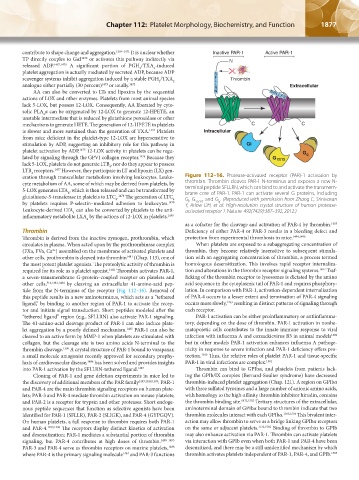
                  required for its role as a platelet agonist. 1482  Thrombin activates PAR-1,   tion and alterations in the thrombin receptor signaling systems. 1497  Traf-
                  a seven-transmembrane G-protein–coupled receptor on platelets and   ficking of the thrombin receptor to lysosomes is dictated by the amino
                  other cells, 514,1483,1484  by cleaving an extracellular 41-amino-acid pep-  acid sequence in the cytoplasmic tail of PAR-1 and requires phosphory-
                  tide from the N-terminus of the receptor (Fig. 112–16). Removal of   lation. In comparison with PAR-1, activation-dependent internalization
                  this peptide results in a new aminoterminus, which acts as a “tethered   of PAR-4 occurs to a lesser extent and termination of PAR-4 signaling
                  ligand,” by binding to another region of PAR-1 to activate the recep-  occurs more slowly, 1493  resulting in distinct patterns of signaling through
                  tor and initiate signal transduction. Short peptides modeled after the   each receptor.
                  “tethered ligand” region (e.g., SFLLRN) also activate PAR-1 signaling.   PAR-1 activation can be either proinflammatory or antiinflamma-
                  The 41-amino-acid cleavage product of PAR-1 can also induce plate-  tory, depending on the dose of thrombin. PAR-1 activation in nonhe-
                  let aggregation by a poorly defined mechanism. 1485  PAR-1 can also be   matopoietic cells contributes to the innate immune response to viral
                  cleaved to an active form by MMP-1 when platelets are stimulated with   infection with influenza A and coxsackievirus B3 in animal models 1499
                  collagen, but the cleavage site is two amino acids N-terminal to the   but in other models PAR-1 activation enhances influenza A pathoge-
                  thrombin cleavage. 1390  A crystal structure of PAR-1 bound to vorapaxar,   nicity in response to severe infection and PAR-1 deficiency offers pro-
                  a small molecule antagonist recently approved for secondary prophy-  tection. 1500  Thus, the relative roles of platelet PAR-1 and tissue-specific
                  laxis of cardiovascular disease, 1486  has been solved and provides insights   PAR-1 in viral infections are complex. 1501
                  into PAR-1 activation by the SFLLRN-tethered ligand. 1487  Thrombin can bind to GPIbα, and platelets from patients lack-
                     Cloning of PAR-1 and gene deletion experiments in mice led to   ing the GPIb/IX complex (Bernard-Soulier syndrome) have decreased
                  the discovery of additional members of the PAR family 1483,1488,1489 : PAR-1   thrombin-induced platelet aggregation (Chap. 121). A region on GPIbα
                  and PAR-4 are the main thrombin signaling receptors on human plate-  with three sulfated tyrosines and a large number of anionic amino acids,
                  lets; PAR-3 and PAR-4 mediate thrombin activation on mouse platelets;   with homology to the high-affinity thrombin inhibitor hirudin, contains
                  and PAR-2 is a receptor for trypsin and other proteases. Short endoge-  the thrombin binding site. 1132,1502  Tertiary structures of the extracellular,
                  nous peptide sequences that function as selective agonists have been   aminoterminal domain of GPIbα bound to thrombin indicate that two
                  identified for PAR-1 (SFLLR), PAR-2 (SLIGK), and PAR-4 (GYPGQV).   thrombin molecules interact with each GPIbα. 1503,1504  This bivalent inter-
                  On human platelets, a full response to thrombin requires both PAR-1   action may allow thrombin to serve as a bridge linking GPIbα receptors
                  and PAR-4. 1489,1490  The receptors display distinct kinetics of activation   on the same or adjacent platelets. 1132,1502  Binding of thrombin to GPIb
                  and desensitization; PAR-1 mediates a substantial portion of thrombin   may also enhance activation via PAR-1. Thrombin can activate platelets
                  signaling, but PAR-4 contributes at high doses of thrombin. 1490–1493    via interaction with GPIb even when both PAR-1 and PAR-4 have been
                  PAR-3 and PAR-4 serve as thrombin receptors on murine platelets, 1488    desensitized, and there may be a still unidentified mechanism by which
                  where PAR-4 is the primary signaling molecule 1494  and PAR-3 functions   thrombin activates platelets independent of PAR-1, PAR-4, and GPIb. 1505


          Kaushansky_chapter 112_p1829-1914.indd   1877                                                                 17/09/15   3:30 pm

