


Page 1905 - Williams Hematology ( PDFDrive )
P. 1905
1880           Part XII:  Hemostasis and Thrombosis                                                                                                      Chapter 112:  Platelet Morphology, Biochemistry, and Function           1881


                                              Pro-
                                             MMP-1            MMP-1                 PAR-1


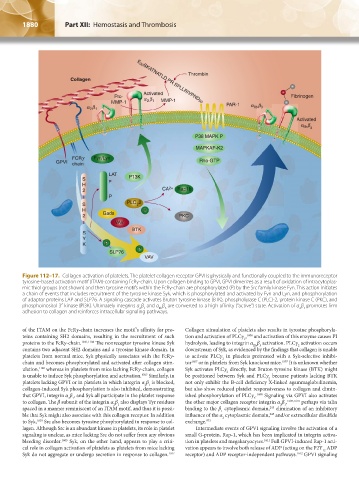
               Figure 112–17.  Collagen activation of platelets. The platelet collagen receptor GPVI is physically and functionally coupled to the immunoreceptor
               tyrosine-based activation motif (ITAM)-containing FcRγ-chain. Upon collagen binding to GPVI, GPVI dimerizes as a result of oxidation of intracytoplas-
               mic thiol groups (not shown) and then tyrosine motifs within the FcRγ-chain are phosphorylated (P) by the Src family kinase Fyn. This action initiates
               a chain of events that includes recruitment of the tyrosine kinase Syk, which is phosphorylated and activated by Fyn and Lyn, and phosphorylation
               of adaptor proteins LAP and SLP76. A signaling cascade activates Bruton tyrosine kinase (BTK), phospholipase C (PLC)-2, protein kinase C (PKC), and
               phosphoinositol 3′-kinase (PI3K). Ultimately integrins α β  and α β  are converted to a high-affinity (“active”) state. Activation of α β  promotes firm
                                                       2 1
                                                                                                            2 1
                                                             IIb 3
               adhesion to collagen and reinforces intracellular signaling pathways.
               of the ITAM on the FcRγ-chain increases the motif’s affinity for pro-  Collagen stimulation of platelets also results in tyrosine phosphoryla-
               teins containing SH2 domains, resulting in the recruitment of such   tion and activation of PLCγ , 2  1606  and activation of this enzyme causes PI
               proteins to the FcRγ-chain. 1041,1104  The nonreceptor tyrosine kinase Syk     hydrolysis, leading to integrin α β  activation. PLCγ  activation occurs
                                                                                             IIb 3
                                                                                                            2
               contains two adjacent SH2 domains and a tyrosine kinase domain. In   downstream of Syk, as evidenced by the findings that collagen is unable
               platelets from normal mice, Syk physically associates with the FcRγ-  to activate PLCγ  in platelets pretreated with a Syk-selective inhibi-
                                                                                  2
               chain and becomes phosphorylated and activated after collagen stim-  tor 1607  or in platelets from Syk knockout mice. 1597  It is unknown whether
               ulation, 1180  whereas in platelets from mice lacking FcRγ-chain, collagen   Syk activates PLCγ  directly, but Bruton tyrosine kinase (BTK) might
                                                                                    2
               is unable to induce Syk phosphorylation and activation. 1597  Similarly, in   be positioned between Syk and PLCγ  because patients lacking BTK
                                                                                                  2
               platelets lacking GPVI or in platelets in which integrin α β  is blocked,   not only exhibit the B-cell deficiency X-linked agammaglobulinemia,
                                                        2 1
               collagen-induced Syk phosphorylation is also inhibited, demonstrating   but also show reduced platelet responsiveness to collagen and dimin-
               that GPVI, integrin α β , and Syk all participate in the platelet response   ished phosphorylation of PLCγ . 1608  Signaling via GPVI also activates
                                                                                             2
                               2 1
               to collagen. The β subunit of the integrin α β  also displays Tyr residues   the other major collagen receptor integrin α β , 1609,1610  perhaps via talin
                                                                                                      2 1
                                              2 1
               spaced in a manner reminiscent of an ITAM motif, and thus it is possi-  binding to the β  cytoplasmic domain,  elimination of an inhibitory
                                                                                                  245
                                                                                  1
                                                                                                  245
               ble that Syk might also associate with this collagen receptor. In addition   influence of the α  cytoplasmic domain,  and/or extracellular disulfide
                                                                                  2
               to Syk, 1603  Src also becomes tyrosine phosphorylated in response to col-  exchange. 973
               lagen. Although Src is an abundant kinase in platelets, its role in platelet   Intermediate events of GPVI signaling involve the activation of a
               signaling is unclear, as mice lacking Src do not suffer from any obvious   small G-protein, Rap-1, which has been implicated in integrin activa-
               bleeding disorder. 1605  Syk, on the other hand, appears to play a criti-  tion in platelets and megakaryocytes. 1611  Full GPVI-induced Rap-1 acti-
               cal role in collagen activation of platelets as platelets from mice lacking   vation appears to involve both release of ADP (acting on the P2Y  ADP
                                                                                                                    12
               Syk do not aggregate or undergo secretion in response to collagen. 1597    receptor) and ADP receptor-independent pathways. 1612  GPVI signaling
          Kaushansky_chapter 112_p1829-1914.indd   1880                                                                 17/09/15   3:30 pm

