


Page 1975 - Williams Hematology ( PDFDrive )
P. 1975
1950           Part XII:  Hemostasis and Thrombosis                                                                                                                      Chapter 114:  Control of Coagulation Reactions          1951


                                                                                      Inactivation
                 Blood coagulation pathways     Protein C pathway                   of fV  and fVIII
                                                                                               a
                                                                                        a
                      XI     XIIa
                         XIa      IXa                                                            fV  and fVIII   i
                                                                                                   i
                     VIII           VIIIa             VIII i                           APC
                                         GLcCer
                          TF-VIIa  Xa   PhosLipid  Protein S/HDL                              Protein
                              V     Va                V i                                    cofactors
                                       V              V                                 Lipid
                                            Heparin    i
                Fibrinogen                                 APC                        cofactors
                                THROMBIN                (Activated
                  Fibrin                                protein C)                          Membrane


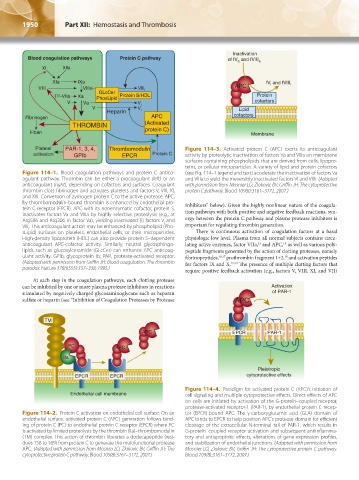
                    Platelet  PAR-1, 3, 4,  Thrombomodulin            Figure  114–3.  Activated protein C (APC) exerts its anticoagulant
                   activation    GPIb            EPCR      Protein C  activity by proteolytic inactivation of factors Va and VIIIa on membrane
                                                                      surfaces containing phospholipids that are derived from cells, lipopro-
                                                                      teins, or cellular microparticles. A variety of lipid and protein cofactors
               Figure 114–1.  Blood coagulation pathways and protein C antico-  (see Fig. 114–1 legend and text) accelerate the inactivation of factors Va
               agulant pathway. Thrombin can be either a procoagulant  (left) or an   and VIIIa to yield the irreversibly inactivated factors Vi and VIIIi. (Adapted
               anticoagulant (right), depending on cofactors and surfaces. Coagulant   with permission from Mosnier LO, Zlokovic BV, Griffin JH: The cytoprotective
               thrombin clots fibrinogen and activates platelets and factors V, VIII, XI,   protein C pathway. Blood 109(8):3161–3172, 2007.)
               and XIII. Conversion of zymogen protein C to the active protease, APC,
               by thrombomodulin-bound thrombin is enhanced by endothelial pro-  Inhibitors” below). Given the highly nonlinear nature of the coagula-
               tein C receptor (EPCR). APC with its nonenzymatic cofactor, protein S,   tion pathways with both positive and negative feedback reactions, syn-
               inactivates factors Va and VIIIa by highly selective proteolysis (e.g., at
               Arg506 and Arg306 in factor Va), yielding inactivated (i) factors V and   ergy between the protein C pathway and plasma protease inhibitors is
                                                               i
               VIII. This anticoagulant action may be enhanced by phospholipid (Pho-  important for regulating thrombin generation.
                 i
               sLipid) surfaces on platelets, endothelial cells, or their microparticles.   There  is  continuous activation of  coagulation factors  at  a  basal
               High-density lipoprotein (HDL) can also provide protein S–dependent   physiologic low level. Plasma from all normal subjects contains circu-
               anticoagulant APC-cofactor activity. Similarly, neutral glycosphingo-  lating active enzymes, factor VIIa,  and APC,  as well as various poly-
                                                                                                       15
                                                                                              14
               lipids such as glucosylceramide (GLcCer) can enhance APC anticoag-  peptide fragments generated by the action of clotting proteases, namely
               ulant activity. GPIb, glycoprotein Ib; PAR, protease-activated receptor.   fibrinopeptides, 16,17  prothrombin fragment 1+2,  and activation peptides
                                                                                                       18
               (Adapted with permission from Griffin JH: Blood coagulation. The thrombin   for factors IX and X. 19,20  The presence of multiple clotting factors that
               paradox. Nature 378(6555):337–338, 1995.)
                                                                      require positive feedback activation (e.g., factors V, VIII, XI, and VII)
                   At each step in the coagulation pathways, each clotting protease
               can be inhibited by one or more plasma protease inhibitors in reactions             Activation
               stimulated by negatively charged glycosaminoglycans such as heparan                 of PAR-1
               sulfate or heparin (see “Inhibition of Coagulation Proteases by Protease   APC

                       TM
                                                        APC                           EPCR        PAR-1

                               PC              APC
                             IIa

                                                                                              Pleiotropic
                                 EPCR        EPCR                                          cytoprotective effects

                                                                      Figure 114–4.  Paradigm for activated protein C (APC)’s initiation of
                               Endothelial cell membrane              cell signaling and multiple cytoprotective effects. Direct effects of APC
                                                                      on cells are initiated by activation of the G-protein–coupled receptor,
                                                                      protease-activated receptor-1 (PAR-1), by endothelial protein C recep-
               Figure 114–2.  Protein C activation on endothelial cell surface. On an   tor (EPCR)-bound APC. The  γ-carboxyglutamic acid  (GLA) domain  of
               endothelial surface, activated protein C (APC) generation follows bind-  APC binds to EPCR to help position APC’s protease domain for efficient
               ing of protein C (PC) to endothelial protein C receptor (EPCR) where PC   cleavage of the extracellular N-terminal tail of PAR-1, which results in
               is activated by limited proteolysis by the thrombin (IIa)–thrombomodulin   G-protein–coupled receptor activation and subsequent antiinflamma-
               (TM) complex. This action of thrombin liberates a dodecapeptide (resi-  tory and antiapoptotic effects, alterations of gene expression profiles,
               dues 158 to 169) from protein C to generate the multifunctional protease   and stabilization of endothelial junctions. (Adapted with permission from
               APC. (Adapted with permission from Mosnier LO, Zlokovic BV, Griffin JH: The   Mosnier LO, Zlokovic BV, Griffin JH: The cytoprotective protein C pathway.
               cytoprotective protein C pathway. Blood 109(8):3161–3172, 2007.)  Blood 109(8):3161–3172, 2007.)


          Kaushansky_chapter 114_p1949-1966.indd   1950                                                                 9/18/15   10:05 AM

