


Page 1976 - Williams Hematology ( PDFDrive )
P. 1976
1950  Part XII:  Hemostasis and Thrombosis                   Chapter 114:  Control of Coagulation Reactions          1951


                  imparts special threshold properties to the blood coagulation pathways,   the molecular weight, normal plasma concentration, chromosomal
                  making the coagulant response nonlinearly responsive to stimuli. The-  location, and gene structures of these factors are given in Table 114–1.
                  oretical analysis of blood coagulation as a threshold system suggests   Factors Va and VIIIa, as substrates of APC, are also participants in the
                  there can be an all-or-none response to various levels of stimulation,   reactions of the anticoagulant protein C pathway. Moreover, factor V,
                  depending on the ensemble of activating and inhibitory reactions that   but not factor V Leiden, appears to act as an APC cofactor for the inac-
                  defines upregulation and downregulation of thrombin generation. 21,22    tivation of factor VIIIa (see “Factor V as Activated Protein C Cofactor”
                  The coagulation system is active, but idling, and is poised for extensive   below). 23
                  and explosive generation of thrombin. Because of synergy among var-
                  ious  cellular  and  humoral  anticoagulant  mechanisms  that  establish  a   PROTEIN C
                  threshold system, the presence of multiple coagulation inhibitors with
                  complementary modes of action prevents massive thrombin generation   In 1976, Stenflo designated a bovine plasma vitamin K–dependent pro-
                  in the absence of a substantial procoagulant stimulus.  tein that eluted in the third peak (peak C) from an anion exchange col-
                                                                        umn as bovine “protein C.”  Protein C, actually previously described
                                                                                             24
                                                                        as the anticoagulant factor autoprothrombin II-A,  is a plasma serine
                                                                                                             25
                       HEREDITARY DEFICIENCIES                          protease zymogen that can be converted to an active serine protease by
                     ASSOCIATED WITH THROMBOTIC                         the action of thrombin.
                                                                            Protein C is synthesized in the liver as a polypeptide precursor of
                     DISEASE                                            461 residues, with a prepropeptide of 42 amino acids that contains the
                                                                        signal for carboxylation of Glu residues by a carboxylase that forms nine
                  Evidence for the physiologic importance of specific factors for control-  γ-carboxyglutamic acid (GLA) residues and secretion of the mature
                  ling coagulation reactions comes from clinical observations and animal   protein. 26–28  The mature glycoprotein of Mr 62,000 contains 419 residues
                  model studies. Major identified genetic risk factors for venous throm-  (see Chap. 113, Fig. 113–1 and Fig. 114–5) and N-linked carbohydrate,
                  bosis involve protein structural defects in factor V, protein C, protein   and the majority of the secreted protein C molecules are cleaved by a
                  S, and antithrombin (Chap. 130). There are also gene regulatory defects   furin-like endoprotease that releases Lys156-Arg157 and generates a
                  associated with thrombotic disease, such as the G20210A polymorphism   two-chain zymogen that circulates in plasma at 65 nM (4 mcg/mL).
                                                                                                                          29
                  in the prothrombin gene that causes elevated levels of prothrombin, and   The heavy and light chains of plasma protein C are covalently linked by
                  defects in protein C gene regulatory elements that decrease the expres-  a disulfide bond that keeps the serine protease globular domain (resi-
                  sion of protein C. Deficiencies of thrombomodulin might also be associ-  dues 170 to 419) covalently tethered to the N-terminal string of three
                  ated with increased risk of arterial thrombosis. Association of hereditary   domains, the GLA domain and the epidermal growth factor (EGF)-like
                  abnormalities of EPCR with increased risks of thrombosis has been sug-  domains EGF1 and EGF2. 26–30
                  gested, but this remains somewhat controversial.          The GLA domain of protein C (residues 1 to 42) and APC is impor-
                                                                        tant for a number of functions, including binding to phospholipid-
                     PROTEIN C PATHWAY COMPONENTS                       containing membranes (see Chap. 113, Fig. 113–3), thrombomodulin,
                                                                        and EPCR; thus, incomplete carboxylation impairs the functional anti-
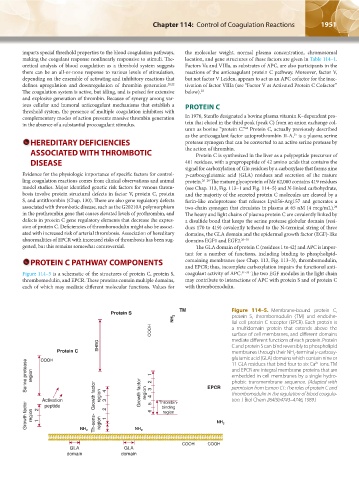
                  Figure 114–5 is a schematic of the structures of protein C, protein S,   coagulant activity of APC. 31–33  The two EGF modules in the light chain
                  thrombomodulin, and EPCR. These proteins contain multiple domains,   may contribute to interactions of APC with protein S and of protein C
                  each of which may mediate different molecular functions. Values for   with thrombomodulin.


                                                                      TM                Figure 114–5.  Membrane-bound protein C,
                                               Protein S                                protein S, thrombomodulin (TM) and endothe-
                                                                    NH 2                lial cell protein C receptor (EPCR). Each protein is
                                                             COOH                       a multidomain protein that extends above the
                                                                                        surface of cell membranes, and different domains
                                           SHBG                                         mediate different functions of each protein. Protein
                                                                                        C and protein S can bind reversibly to phospholipid
                             Protein C                                                  membranes through their NH -terminal γ-carboxy-
                                                                                                             2
                                                                                        glutamic acid (GLA) domains which contain nine or
                        COOH
                   Serine protease  region                   1  2               EPCR    and EPCR are integral membrane proteins that are
                                                                                        11 GLA residues that bind four to six Ca  ions. TM
                                                                                                                    2+
                                                                                        embedded in cell membranes by a single hydro-
                                                                                        phobic transmembrane sequence.  (Adapted  with
                                                                                        permission from Esmon CT: The roles of protein C and
                                                                                        tion. J Biol Chem 264(9):4743–4746, 1989.)
                        Activation        Growth factor  region  4  3  Growth factor  region  43  5  Thrombin-  thrombomodulin in the regulation of blood coagula-
                   Growth factor  region  2  1  NH  Th-sens-  region  2  1  NH  6  region  NH 2
                         peptide
                                                                 binding

                                       2
                                                          2
                                                                       COOH     COOH
                                  GLA               GLA
                                 domain            domain


          Kaushansky_chapter 114_p1949-1966.indd   1951                                                                 9/18/15   10:05 AM

