


Page 1977 - Williams Hematology ( PDFDrive )
P. 1977
1952           Part XII:  Hemostasis and Thrombosis                                                                                                                      Chapter 114:  Control of Coagulation Reactions          1953


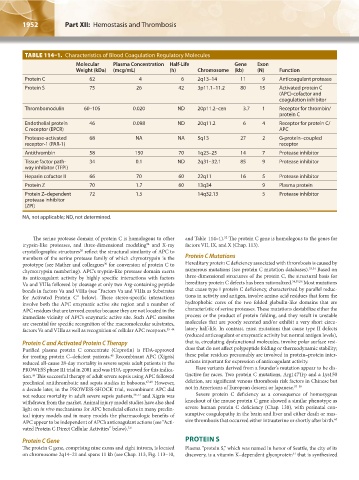
                TABLE 114–1.  Characteristics of Blood Coagulation Regulatory Molecules
                                 Molecular    Plasma Concentration   Half-Life         Gene   Exon
                                 Weight (kDa)  (mcg/mL)          (h)      Chromosome   (kb)   (N)     Function
                Protein C             62                4             6   2q13–14        11     9     Anticoagulant protease
                Protein S             75              26            42    3p11.1–11.2    80    15     Activated protein C
                                                                                                      (APC)-cofactor and
                                                                                                      coagulation inhibitor
                Thrombomodulin      60–105          0.020          ND     20p11.2–cen    3.7    1     Receptor for thrombin/
                                                                                                      protein C
                Endothelial protein   46            0.098          ND     20q11.2        6      4     Receptor for protein C/
                C receptor (EPCR)                                                                     APC
                Protease-activated    68             NA             NA    5q13           27     2     G-protein–coupled
                receptor-1 (PAR-1)                                                                    receptor
                Antithrombin          58             150            70    1q23–25        14     7     Protease inhibitor
                Tissue factor path-   34             0.1           ND     2q31–32.1      85     9     Protease inhibitor
                way inhibitor (TFPI)
                Heparin cofactor II   66              70            60    22q11          16     5     Protease inhibitor
                Protein Z             70             1.7            60    13q34                 9     Plasma protein
                Protein Z–dependent    72            1.5                  14q32.13              5     Protease inhibitor
                protease inhibitor
                (ZPI)
               NA, not applicable; ND, not determined.


                                                                                   52
                   The serine protease domain of protein C is homologous to other   and Table  114–1).  The protein C gene is homologous to the genes for
                                                         34
               trypsin-like proteases, and three-dimensional modeling  and X-ray   factors VII, IX, and X (Chap. 113).
                                   30
               crystallographic structures  reflect the structural similarity of APC to
               members of the serine protease family of which chymotrypsin is the   Protein C Mutations
                                           30
               prototype (see Mather and colleagues  for conversion of protein C to   Hereditary protein C deficiency associated with thrombosis is caused by
               chymotrypsin numbering). APC’s trypsin-like protease domain exerts   numerous mutations (see protein C mutation databases). 53,54  Based on
               its anticoagulant activity by highly specific interactions with factors   three-dimensional structures of the protein C, the structural basis for
               Va and VIIIa followed by cleavage at only two Arg-containing peptide   hereditary protein C defects has been rationalized. 34,55,56  Most mutations
               bonds in factors Va and VIIIa (see “Factors Va and VIIIa as Substrates   that cause type I protein C deficiency, characterized by parallel reduc-
               for Activated Protein C” below). These stereo-specific interactions   tions in activity and antigen, involve amino acid residues that form the
               involve both the APC enzymatic active site region and a number of   hydrophobic cores of the two folded globulin-like domains that are
               APC residues that are termed exosites because they are not located in the   characteristic of serine proteases. These mutations destabilize either the
               immediate vicinity of APC’s enzymatic active site. Such APC exosites   process or the product of protein folding, and they result in unstable
               are essential for specific recognition of the macromolecular substrates,   molecules that are poorly secreted and/or exhibit a very short circu-
               factors Va and VIIIa as well as recognition of cellular APC receptors. 35–44  latory half-life. In contrast, most mutations that cause type II defects
                                                                      (reduced anticoagulant or enzymatic activity but normal antigen levels),
               Protein C and Activated Protein C Therapy              that is, circulating dysfunctional molecules, involve polar surface resi-
               Purified plasma protein C concentrate (Ceprotin) is FDA-approved   dues that do not affect polypeptide folding or thermodynamic stability;
                                             45
               for treating protein C–deficient patients.  Recombinant APC (Xigris)   these polar residues presumably are involved in protein–protein inter-
               reduced all-cause 28-day mortality in severe sepsis adult patients in the   actions important for expression of anticoagulant activity.
               PROWESS phase III trial in 2001 and was FDA-approved for this indica-  Rare variants derived from a founder’s mutation appear to be dis-
                   46
               tion.  This successful therapy of adult severe sepsis using APC followed   tinctive for races. Two protein C mutations, Arg147Trp and a Lys150
               preclinical antithrombotic and sepsis studies in baboons. 47,48  However,   deletion, are significant venous thrombosis risk factors in Chinese but
               a decade later, in the PROWESS-SHOCK trial, recombinant APC did   not in Americans of European descent or Japanese. 57–59
               not reduce mortality in adult severe sepsis patients, 49–51  and Xigris was   Severe protein C deficiency as a consequence of homozygous
               withdrawn from the market. Animal injury model studies have also shed   knockout of the mouse protein C gene showed a similar phenotype as
               light on in vivo mechanisms for APC beneficial effects in many preclin-  severe human protein C deficiency (Chap. 130), with perinatal con-
               ical injury models and in many models the pharmacologic benefits of   sumptive coagulopathy in the brain and liver and either death or mas-
               APC appear to be independent of APC’s anticoagulant actions (see “Acti-  sive thrombosis that occurred either intrauterine or shortly after birth. 60
               vated Protein C Direct Cellular Activities” below). 7,8

               Protein C Gene                                         PROTEIN S
               The protein C gene, comprising nine exons and eight introns, is located   Plasma “protein S,” which was named in honor of Seattle, the city of its
               on chromosome 2q14–21 and spans 11 kb (see Chap. 113, Fig. 113–10,   discovery, is a vitamin K–dependent glycoprotein  that is synthesized
                                                                                                          61


          Kaushansky_chapter 114_p1949-1966.indd   1952                                                                 9/18/15   10:05 AM

