


Page 2027 - Williams Hematology ( PDFDrive )
P. 2027
2002           Part XII:  Hemostasis and Thrombosis                                                                                                                                    Chapter 117:  Thrombocytopenia            2003


                                                                                                                   9
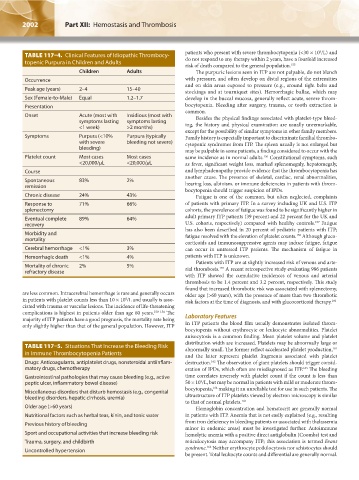
                TABLE 117–4.  Clinical Features of Idiopathic Thrombocy-  patients who present with severe thrombocytopenia (<30 × 10 /L) and
                                                                      do not respond to any therapy within 2 years, have a fourfold increased
                topenic Purpura in Children and Adults
                                                                      risk of death compared to the general population. 155
                                  Children        Adults                  The purpuric lesions seen in ITP are not palpable, do not blanch
                Occurrence                                            with pressure, and often develop on distal regions of the extremities
                                                                      and on skin areas exposed to pressure (e.g., around tight belts and
                Peak age (years)  2–4             15–40
                                                                      stockings and at tourniquet sites). Hemorrhagic bullae, which may
                Sex (Female-to-Male)  Equal       1.2–1.7             develop in the buccal mucosa, generally reflect acute, severe throm-
                Presentation                                          bocytopenia. Bleeding after surgery, trauma, or tooth extraction is
                                                                      common.
                Onset             Acute (most with   Insidious (most with   Besides the physical findings associated with platelet-type bleed-
                                  symptoms lasting   symptoms lasting
                                  <1 week)        >2 months)          ing, the history and physical examination are usually unremarkable,
                                                                      except for the possibility of similar symptoms in other family members.
                Symptoms          Purpura (<10%   Purpura (typically   Family history is especially important to discriminate familial thrombo-
                                  with severe     bleeding not severe)  cytopenic syndromes from ITP. The spleen usually is not enlarged but
                                  bleeding)
                                                                      may be palpable in some patients, a finding considered to occur with the
                Platelet count    Most cases      Most cases          same incidence as in normal adults.  Constitutional symptoms, such
                                                                                                156
                                  <20,000/μL      <20,000/μL          as fever, significant weight loss, marked splenomegaly, hepatomegaly,
                Course                                                and lymphadenopathy provide evidence that the thrombocytopenia has
                                                                      another cause. The presence of skeletal, cardiac, renal abnormalities,
                Spontaneous       83%             2%
                remission                                             hearing loss, albinism. or immune deficiencies in patients with throm-
                                                                      bocytopenia should trigger suspicion of IPDs.
                Chronic disease   24%             43%                     Fatigue  is  one  of  the  common,  but  often  neglected,  complaints
                Response to       71%             66%                 of patients with primary ITP. In a survey including UK and U.S. ITP
                splenectomy                                           cohorts, the prevalence of fatigue was found to be significantly higher in
                Eventual complete   89%           64%                 adult primary ITP patients (39 percent and 22 percent for the UK and
                                                                                                                  157
                recovery                                              U.S. cohorts, respectively) compared with healthy controls.  Fatigue
                                                                      has also been described in 20 percent of pediatric patients with ITP;
                Morbidity and                                         fatigue resolved with the elevation of platelet counts.  Although gluco-
                                                                                                           158
                mortality
                                                                      corticoids and immunosuppressive agents may induce fatigue, fatigue
                Cerebral hemorrhage  <1%          3%                  can occur in  untreated ITP patients. The  mechanism  of fatigue  in
                Hemorrhagic death  <1%            4%                  patients with ITP is unknown.
                                                                          Patients with ITP are at slightly increased risk of venous and arte-
                Mortality of chronic   2%         5%                  rial thrombosis.  A recent retrospective study evaluating 986 patients
                                                                                 159
                refractory disease
                                                                      with ITP showed the cumulative incidences of venous and arterial
                                                                      thrombosis to be 1.4 percent and 3.2 percent, respectively. This study
                                                                      found that increased thrombotic risk was associated with splenectomy,
               are less common. Intracerebral hemorrhage is rare and generally occurs   older age (>60 years), with the presence of more than two thrombotic
               in patients with platelet counts less than 10 × 10 /L and usually is asso-  risk factors at the time of diagnosis, and with glucocorticoid therapy. 160
                                                  9
               ciated with trauma or vascular lesions. The incidence of life-threatening
               complications is highest in patients older than age 60 years. 150–154  The
               majority of ITP patients have a good prognosis, the mortality rate being   Laboratory Features
               only slightly higher than that of the general population. However, ITP   In ITP patients the blood film usually demonstrates isolated throm-
                                                                      bocytopenia without erythrocyte or leukocyte abnormalities. Platelet
                                                                      anisocytosis is a common finding. Mean platelet volume and platelet
                                                                      distribution width are increased. Platelets may be abnormally large or
                TABLE 117–5.  Situations That Increase the Bleeding Risk   abnormally small. The former reflect accelerated platelet production,
                                                                                                                       161
                in Immune Thrombocytopenia Patients
                                                                      and the latter represent platelet fragments associated with platelet
                Drugs: Anticoagulants, antiplatelet drugs, nonsteroidal antiinflam-  destruction.  The observation of giant platelets should trigger consid-
                                                                               162
                matory drugs, chemotherapy                            eration of IPDs, which often are misdiagnosed as ITP.  The bleeding
                                                                                                              163
                Gastrointestinal pathologies that may cause bleeding (e.g., active   time correlates inversely with platelet count if the count is less than
                                                                           9
                peptic ulcer, inflammatory bowel disease)             50 × 10 /L, but may be normal in patients with mild or moderate throm-
                                                                               164
                                                                      bocytopenia,  making it an unreliable test for use in such patients. The
                Miscellaneous disorders that disturb hemostasis (e.g., congenital
                bleeding disorders, hepatic cirrhosis, uremia)        ultrastructure of ITP platelets viewed by electron microscopy is similar
                                                                      to that of normal platelets. 165
                Older age (>60 years)                                     Hemoglobin concentration and hematocrit are generally normal
                Nutritional factors such as herbal teas, kinin, and tonic water  in patients with ITP. Anemia that is not easily explained (e.g., resulting
                Previous history of bleeding                          from iron deficiency in bleeding patients or associated with thalassemia
                                                                      minor in endemic areas) must be investigated further. Autoimmune
                Sport and occupational activities that increase bleeding risk  hemolytic anemia with a positive direct antiglobulin (Coombs) test and
                Trauma, surgery, and childbirth                       reticulocytosis may accompany ITP; this association is termed Evans
                                                                             166
                Uncontrolled hypertension                             syndrome.  Neither erythrocyte poikilocytosis nor schistocytes should
                                                                      be present. Total leukocyte counts and differential are generally normal.


          Kaushansky_chapter 117_p1993-2024.indd   2002                                                                 9/21/15   2:32 PM

