


Page 2078 - Williams Hematology ( PDFDrive )
P. 2078
2052  Part XII:  Hemostasis and Thrombosis           Chapter 120:  Hereditary Qualitative Platelet Disorders         2053


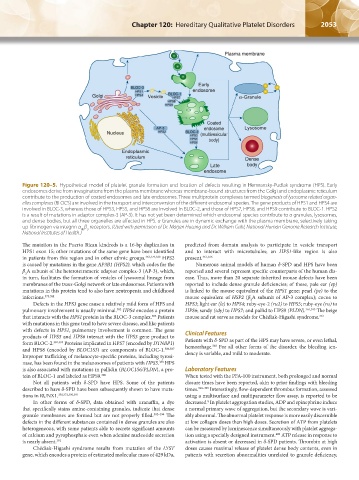
                  Figure 120–5.  Hypothetical model of platelet granule formation and location of defects resulting in Hermansky-Pudlak syndrome (HPS). Early
                  endosomes derive from invaginations from the plasma membrane whereas membrane-bound structures from the Golgi and endoplasmic reticulum
                  contribute to the production of coated endosomes and late endosomes. Three multiprotein complexes termed biogenesis of lysosome related organ-
                  elles complexes (BLOCS) are involved in the transport and interconversion of the different endosomal species. The gene products of HPS1 and HPS4 are
                  involved in BLOC-3, whereas those of HPS3, HPS5, and HPS6 are involved in BLOC-2, and those of HPS7, HPS8, and HPS9 contribute to BLOC-1. HPS2
                  is a result of mutations in adaptor complex-3 (AP-3). It has not yet been determined which endosomal species contribute to α granules, lysosomes,
                  and dense bodies, but all three organelles are affected in HPS. α Granules are in dynamic exchange with the plasma membrane, selectively taking
                  up fibrinogen via integrin α β  receptors. (Used with permission of Dr. Marjan Huizing and Dr. William Gahl, National Human Genome Research Institute,
                                     IIb 3
                  National Institutes of Health.)
                  The mutation in the Puerto Rican kindreds is a 16-bp duplication in   predicted from domain analysis to participate in vesicle transport
                  HPS1 exon 15; other mutations of the same gene have been identified   and to interact with microtubules; an  HPS1-like region is also
                  in patients from this region and in other ethnic groups. 363,379,380  HPS2   present. 361,366
                  is caused by mutations in the gene AP3B1 (HPS2), which codes for the   Numerous animal models of human δ-SPD and HPS have been
                  β A subunit of the heterotetrameric adaptor complex-3 (AP-3), which,   reported and several represent specific counterparts of the human dis-
                   3
                  in turn, facilitates the formation of vesicles of lysosomal lineage from   ease. Thus, more than 20 separate inherited mouse defects have been
                  membranes of the trans-Golgi network or late endosomes. Patients with   reported to include dense granule deficiencies; of these, pale ear (ep)
                  mutations in this protein tend to also have neutropenia and childhood   is linked to the mouse equivalent of the HPS1 gene; pearl (pe) to the
                  infections. 373,381                                   mouse equivalent of HSP2 (β A subunit of AP-3 complex); cocoa to
                                                                                              3
                     Defects in the HPS3 gene cause a relatively mild form of HPS and   HPS3; light ear (le) to HPS4; ruby-eye-2 (ru2) to HPS5; ruby-eye (ru) to
                  pulmonary involvement is usually minimal.  HPS4 encodes a protein   HPS6; sandy (sdy) to HPS7; and pallid to HPS9 (PLDN). 361,395  The beige
                                                 382
                  that interacts with the HPS1 protein in the BLOC-3 complex.  Patients   mouse and rat serve as models for Chédiak-Higashi syndrome. 361
                                                             383
                  with mutations in this gene tend to have severe disease, and like patients
                  with defects in HPS1, pulmonary involvement is common. The gene
                  products of HPS5 and HPS6 interact with the HPS3 gene product to   Clinical Features
                  form BLOC-2. 384,385  Proteins implicated in HPS7 (encoded by DTNBP1)   Patients with δ-SPD as part of the HPS may have severe, or even lethal,
                                                                                  363
                  and  HPS8  (encoded  by  BLOC1S3)  are  components  of  BLOC-1. 386,387    hemorrhage.  For all other forms of the disorder, the bleeding ten-
                  Improper trafficking of melanocyte-specific proteins, including tyrosi-  dency is variable, and mild to moderate.
                  nase, has been found in the melanosomes of patients with HPS5.  HPS
                                                                388
                  is also associated with mutations in pallidin (BLOC1S6/PLDN), a pro-  Laboratory Features
                  tein of BLOC-1 and labeled as HPS9. 389               When tested with the PFA-100 instrument, both prolonged and normal
                     Not all patients with δ-SPD have HPS. Some of the patients   closure times have been reported, akin to prior findings with bleeding
                  described to have δ-SPD have been subsequently shown to have muta-  times. 396–399  Interestingly, flow-dependent thrombus formation, assessed
                  tions in RUNX1. 358,372,390,391                       using a multisurface and multiparameter flow assay, is reported to be
                     In other forms of  δ-SPD, data obtained with uranaffin, a dye   decreased.  In platelet aggregation studies, ADP and epinephrine induce
                                                                                8
                  that specifically stains amine-containing granules, indicate that dense   a normal primary wave of aggregation, but the secondary wave is vari-
                  granule membranes are formed but are not properly filled. 392–394  The   ably abnormal. The abnormal platelet response is more easily discernible
                  defects in the different substances contained in dense granules are also    at low collagen doses than high doses. Secretion of ATP from platelets
                  heterogeneous, with some patients able to secrete significant amounts   can be measured by luminescence simultaneously with platelet aggrega-
                  of calcium and pyrophosphate even when adenine nucleotide secretion   tion using a specially designed instrument.  ATP release in response to
                                                                                                       400
                  is nearly absent. 392                                 activation is absent or decreased in δ-SPD patients. Thrombin at high
                     Chédiak-Higashi syndrome results from mutation of the  LYST   doses causes maximal release of platelet dense body contents, even in
                  gene, which encodes a protein of estimated molecular mass of 429 kDa,   patients with secretion abnormalities unrelated to granule deficiency,


          Kaushansky_chapter 120_p2039-2072.indd   2053                                                                 9/21/15   2:20 PM

