


Page 2159 - Williams Hematology ( PDFDrive )
P. 2159
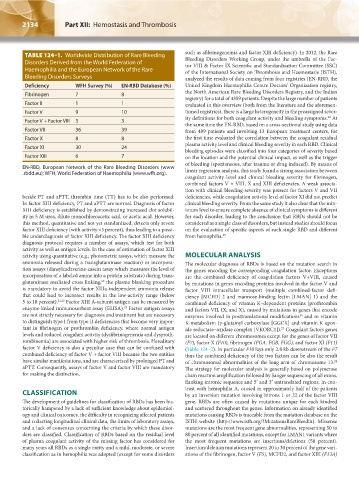
2134           Part XII:  Hemostasis and Thrombosis                                                                               Chapter 124:  Inherited Deficiencies of Coagulation Factors II, V, V+VIII, VII, X, XI, and XIII  2135


                TABLE 124–1.  Worldwide Distribution of Rare Bleeding   such as afibrinogenemia and factor XIII deficiency). In 2012, the Rare
                                                                      Bleeding Disorders Working Group, under the umbrella of the Fac-
                Disorders Derived from the World Federation of        tor VIII & Factor IX Scientific and Standardisation Committee (SSC)
                Haemophilia and the European Network of the Rare      of the International Society on Thrombosis and Haemostasis (ISTH),
                Bleeding Disorders Surveys                            analyzed the results of data coming from four registries (EN-RBD, the
                Deficiency       WFH Survey (%)  EN-RBD Database (%)  United Kingdom Haemophilia Centre Doctors’ Organization registry,
                Fibrinogen       7               8                    the North American Rare Bleeding Disorders Registry, and the Indian
                                                                      registry) for a total of 4359 patients. Despite the large number of patients
                Factor II        1               1                    evaluated in this overview (both from the literature and the aforemen-
                Factor V         9               10                   tioned registries), there is a large heterogeneity in the preassigned sever-
                                                                      ity definitions for both coagulant activity and bleeding symptoms.  At
                                                                                                                      24
                Factor V + Factor VIII  3        3
                                                                      the same time the EN-RBD, based on a cross-sectional study using data
                Factor VII       36              39                   from 489 patients and involving 13 European treatment centers, for
                Factor X         8               8                    the first time evaluated the correlation between the coagulant residual
                                                                      plasma activity level and clinical bleeding severity in each RBD. Clinical
                Factor XI        30              24
                                                                      bleeding episodes were classified into four categories of severity based
                Factor XIII      6               7                    on the location and the potential clinical impact, as well as the trigger
                                                                      of bleeding (spontaneous, after trauma or drug induced). By means of
               EN-RBD, European Network of the Rare Bleeding Disorders (www
               .rbdd.eu); WFH, World Federation of Haemophilia (www.wfh.org).  linear regression analysis, this study found a strong association between
                                                                      coagulant activity level and clinical bleeding severity for fibrinogen,
                                                                      combined factors V + VIII, X and XIII deficiencies. A weak associa-
                                                                      tion with clinical bleeding severity was present for factors V and VII
               beside PT and aPTT, thrombin time (TT) has to be also performed.   deficiencies, while coagulation activity level of factor XI did not predict
               In factor XIII deficiency, PT and aPTT are normal. Diagnosis of factor   clinical bleeding severity. From the same study it also clear that the min-
               XIII deficiency is established by demonstrating increased clot solubil-  imum level to ensure complete absence of clinical symptoms is different
               ity in 5 M urea, dilute monochloroacetic acid, or acetic acid. However,   for each disorder, leading to the conclusion that RBDs should not be
               this method, quantitative and not yet standardized, detects only severe   considered as a single class of disorders, but instead studies should focus
               factor XIII deficiency (with activity <5 percent), thus leading to a possi-  on the evaluation of specific aspects of each single RBD and different
               ble underdiagnosis of factor XIII deficiency. The factor XIII deficiency   from hemophilia. 25
               diagnosis protocol requires a number of assays, which test for both
               activity as well as antigen levels. In the case of estimation of factor XIII
               activity using quantitative (e.g., photometric assays, which measure the   MOLECULAR ANALYSIS
               ammonia released during a transglutaminase reaction) or incorpora-  The molecular diagnosis of RBDs is based on the mutation search in
               tion assays (dansylcadaverine-casein assay which measures the level of   the genes encoding the corresponding coagulation factor. Exceptions
               incorporation of a labeled amine into a protein substrate) during trans-  are  the  combined  deficiency  of  coagulation  factors  V+VIII,  caused
               glutaminase mediated cross linking,  the plasma blanking procedure   by mutations in genes encoding proteins involved in the factor V and
                                          20
               is mandatory to avoid the factor XIIIa-independent ammonia release   factor VIII intracellular transport (multiple combined-factor defi-
               that could lead to incorrect results in the low-activity range (below    ciency [MCFD] 2 and mannose-binding lectin [LMAN] 1) and the
               5 to 10 percent). 21,22  Factor XIII A-subunit antigen can be measured by   combined deficiency of vitamin K–dependent proteins (prothrombin
               enzyme-linked immunosorbent assay (ELISA).  Factor antigen assays   and factors VII, IX, and X), caused by mutations in genes that encode
                                                 23
               are not strictly necessary for diagnosis and treatment but are necessary   enzymes involved in posttranslational modifications  and in vitamin
                                                                                                            26
               to distinguish type I from type II deficiencies that become very impor-  K metabolism (γ-glutamyl carboxylase [GGCX] and vitamin K epox-
               tant in fibrinogen or prothrombin deficiency, where normal antigen   ide reductase–oxidase complex [VKORC1]).  Coagulant factors genes
                                                                                                      27
               levels and reduced coagulant activity (dysfibrinogenemia and dysproth-  are located on different chromosomes except for the genes of factor VII
               rombinemia) are associated with higher risk of thrombosis. Hereditary   (F7), factor X (F10), fibrinogen (FGA, FGB, FGG), and factor XI (F11)
               factor V deficiency is also a peculiar case that can be confused with   (Table 124–2). In particular F10 lays only 2.8 kb downstream of the F7
               combined deficiency of factor V + factor VIII because the two entities   thus the combined deficiency of the two factors can be also the result
               have similar manifestations, and are characterized by prolonged PT and   of chromosomal abnormalities of the long arm of chromosome 13.
                                                                                                                        28
               aPTT. Consequently, assays of factor V and factor VIII are mandatory   The strategy for molecular analysis is generally based on polymerase
               for making the distinction.                            chain reaction amplification followed by Sanger sequencing of all exons,
                                                                      flanking intronic sequence and 5′ and 3′ untranslated regions. In con-
                                                                      trast with hemophilia A, caused in approximately half of the patients
               CLASSIFICATION                                         by an inversion mutation involving introns 1 or 22 of the factor VIII
               The development of guidelines for classification of RBDs has been his-  gene, RBDs are often caused by mutations unique for each kindred
               torically hampered by a lack of sufficient knowledge about epidemiol-  and scattered throughout the genes. Information on already identified
               ogy and clinical outcomes, the difficulty in recognizing affected patients   mutations causing RBDs is traceable from the mutation database on the
               and collecting longitudinal clinical data, the limits of laboratory assays,   ISTH website (http://www.isth.org/?MutationsRareBleedin). Missense
               and a lack of consensus concerning the criteria by which these disor-  mutations are the most frequent gene abnormalities, representing 50 to
               ders are classified. Classification of RBDs based on the residual level   80 percent of all identified mutations, except for LMAN1 variants where
               of plasma coagulant activity of the missing factor has considered for   the most frequent mutations are insertions/deletions (50 percent).
               many years all RBDs as a single entity and a mild, moderate, or severe   Insertion/deletion mutations represent 20 to 30 percent of the gene vari-
               classification as in hemophilia was adopted (except for some disorders   ations of the fibrinogen, factor V (F5), MCFD2, and factor XIII (F13A)


          Kaushansky_chapter 124_p2133-2150.indd   2134                                                                 17/09/15   3:39 pm

