


Page 2161 - Williams Hematology ( PDFDrive )
P. 2161
2136           Part XII:  Hemostasis and Thrombosis                                                                               Chapter 124:  Inherited Deficiencies of Coagulation Factors II, V, V+VIII, VII, X, XI, and XIII  2137


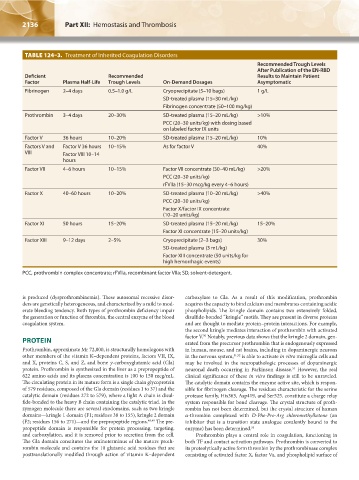
                TABLE 124–3.  Treatment of Inherited Coagulation Disorders
                                                                                              Recommended Trough Levels
                                                                                              After Publication of the EN-RBD
                Deficient                   Recommended                                       Results to Maintain Patient
                Factor       Plasma Half-Life  Trough Levels   On-Demand Dosages              Asymptomatic
                Fibrinogen   2–4 days       0.5–1.0 g/L        Cryoprecipitate (5–10 bags)    1 g/L
                                                               SD-treated plasma (15–30 mL/kg)
                                                               Fibrinogen concentrate (50–100 mg/kg)
                Prothrombin  3–4 days       20–30%             SD-treated plasma (15–20 mL/kg)  >10%
                                                               PCC (20–30 units/kg) with dosing based
                                                               on labeled factor IX units
                Factor V     36 hours       10–20%             SD-treated plasma (15–20 mL/kg)  10%
                Factors V and   Factor V 36 hours  10–15%      As for factor V                40%
                VIII         Factor VIII 10–14
                             hours
                Factor VII   4–6 hours      10–15%             Factor VII concentrate (30–40 mL/kg)  >20%
                                                               PCC (20–30 units/kg)
                                                               rFVIIa (15–30 mcg/kg every 4–6 hours)
                Factor X     40–60 hours    10–20%             SD-treated plasma (10–20 mL/kg)  >40%
                                                               PCC (20–30 units/kg)
                                                               Factor X/factor IX concentrate
                                                               (10–20 units/kg)
                Factor XI    50 hours       15–20%             SD-treated plasma (15–20 mL/kg)  15–20%
                                                               Factor XI concentrate (15–20 units/kg)
                Factor XIII  9–12 days      2–5%               Cryoprecipitate (2–3 bags)     30%
                                                               SD-treated plasma (3 mL/kg)
                                                               Factor XIII concentrate (50 units/kg for
                                                               high hemorrhagic events)

               PCC, prothrombin complex concentrate; rFVIIa, recombinant factor VIIa; SD, solvent-detergent.


               is produced (dysprothrombinemia). These autosomal recessive disor-  carboxylase to Gla. As a result of this modification, prothrombin
               ders are genetically heterogeneous, and characterized by a mild to mod-  acquires the capacity to bind calcium and membranes containing acidic
               erate bleeding tendency. Both types of prothrombin deficiency impair   phospholipids. The kringle domain contains two extensively folded,
               the generation or function of thrombin, the central enzyme of the blood   disulfide-bonded “kringle” motifs. They are present in diverse proteins
               coagulation system.                                    and are thought to mediate protein–protein interactions. For example,
                                                                      the second kringle mediates interaction of prothrombin with activated
                                                                      factor V.  Notably, previous data shows that the kringle 2 domain, gen-
                                                                            50
               PROTEIN                                                erated from the precursor prothrombin that is endogenously expressed
               Prothrombin, approximate Mr 72,000, is structurally homologous with   in human, mouse, and rat brains, including in dopaminergic neurons
               other members of the vitamin K–dependent proteins, factors VII, IX,   in the nervous system, 51,52  is able to activate in vitro microglia cells and
               and X, proteins C, S, and Z, and bone γ-carboxyglutamic acid (Gla)   may be involved in the neuropathologic processes of dopaminergic
               protein. Prothrombin is synthesized in the liver as a prepropeptide of   neuronal  death  occurring  in  Parkinson  disease.   However,  the  real
                                                                                                          52
               622 amino acids and its plasma concentration is 100 to 150 mcg/mL.   clinical significance of these in vitro findings is still to be unraveled.
               The circulating protein in its mature form is a single chain glycoprotein   The catalytic domain contains the enzyme active site, which is respon-
               of 579 residues, composed of the Gla domain (residues 1 to 37) and the   sible for fibrinogen cleavage. The residues characteristic for the serine
               catalytic domain (residues 272 to 579), where a light A chain is disul-  protease family, His363, Asp419, and Ser525, constitute a charge relay
               fide-bonded to the heavy B chain containing the catalytic triad. In the   system responsible for bond cleavage. The crystal structure of proth-
               zymogen molecule there are several exodomains, such as two kringle   rombin has not been determined, but the crystal structure of human
               domains—kringle 1 domain (F1; residues 38 to 155), kringle 2 domain   α-thrombin complexed with  D-Phe-Pro-Arg chloromethylketone (an
               (F2; residues 156 to 271)—and the prepropeptide regions. 48,49  The pre-  inhibitor that is a transition state analogue covalently bound to the
               propeptide domain is responsible for protein processing, targeting,   enzyme) has been determined. 53
               and carboxylation, and it is removed prior to secretion from the cell.   Prothrombin plays a central role in coagulation, functioning in
               The Gla domain constitutes the aminoterminus of the mature proth-  both TF and contact activation pathways. Prothrombin is converted to
               rombin molecule and contains the 10 glutamic acid residues that are   its proteolytically active form thrombin by the prothrombinase complex
               posttranslationally modified through action of vitamin K–dependent   consisting of activated factor X, factor Va, and phospholipid surface of


          Kaushansky_chapter 124_p2133-2150.indd   2136                                                                 17/09/15   3:40 pm

