


Page 2160 - Williams Hematology ( PDFDrive )
P. 2160
2134  Part XII:  Hemostasis and Thrombosis  Chapter 124:  Inherited Deficiencies of Coagulation Factors II, V, V+VIII, VII, X, XI, and XIII  2135


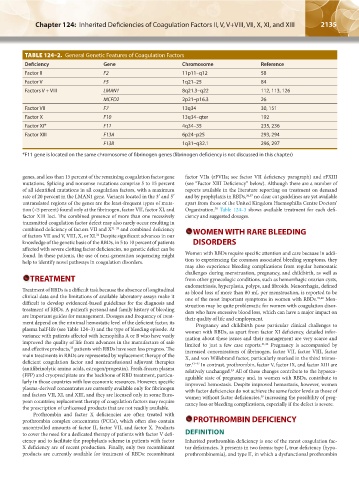
                   TABLE 124–2.  General Genetic Features of Coagulation Factors
                   Deficiency                Gene                      Chromosome                 Reference
                   Factor II                 F2                        11p11–q12                  58
                   Factor V                  F5                        1q21–25                    84
                   Factors V + VIII          LMAN1                     8q21.3–q22                 112, 113, 126
                                             MCFD2                     2p21–p16.3                 26
                   Factor VII                F7                        13q34                      30, 151
                   Factor X                  F10                       13q34–qter                 192
                   Factor XI*                F11                       4q34–35                    235, 236
                   Factor XIII               F13A                      6p24–p25                   293, 294
                                             F13B                      1q31–q32.1                 296, 297
                  *F11 gene is located on the same chromosome of fibrinogen genes (fibrinogen deficiency is not discussed in this chapter)


                  genes, and less than 15 percent of the remaining coagulation factor gene   factor VIIa (rFVIIa; see factor VII deficiency paragraph) and rFXIII
                  mutations. Splicing and nonsense mutations comprise 5 to 15 percent   (see “Factor XIII Deficiency” below). Although there are a number of
                  of all identified mutations in all coagulation factors, with a maximum   reports available in the literature reporting on treatment on demand
                  rate of 20 percent in the LMAN1 gene. Variants located in the 3′ and 5′   and by prophylaxis in RBDs, 36,37  no clear cut guidelines are yet available
                  untranslated regions of the genes are the least-frequent types of muta-  apart from those of the United Kingdom Haemophilia Centre Doctors’
                  tion (<5 percent) found only at the fibrinogen, factor VII, factor XI, and   Organization.   Table 124–3 shows available treatment for each defi-
                                                                                  38
                  factor XIII loci. The combined presence of more than one recessively   ciency and suggested dosages.
                  transmitted coagulation factor defect may also rarely occur resulting in
                  combined deficiency of factors VII and X 31–33  and combined deficiency     WOMEN WITH RARE BLEEDING
                  of factors VII and V, VIII, X, or XI.  Despite significant advances in our
                                           34
                  knowledge of the genetic basis of the RBDs, in 5 to 10 percent of patients   DISORDERS
                  affected with severe clotting factor deficiencies, no genetic defect can be
                  found. In these patients, the use of next-generation sequencing might   Women with RBDs require specific attention and care because in addi-
                  help to identify novel pathways in coagulation disorders.  tion to experiencing the common associated bleeding symptoms, they
                                                                        may also experience bleeding complications from regular hemostatic
                                                                        challenges during menstruation, pregnancy, and childbirth, as well as
                    TREATMENT                                           from other gynecologic conditions, such as hemorrhagic ovarian cysts,
                                                                        endometriosis, hyperplasia, polyps, and fibroids. Menorrhagia, defined
                  Treatment of RBDs is a difficult task because the absence of longitudinal   as blood loss of more than 80 mL per menstruation, is reported to be
                  clinical data and the limitations of available laboratory assays make it   one of the most important symptoms in women with RBDs. 39,40  Men-
                  difficult to develop evidenced-based guidelines for the diagnosis and   struation may be quite problematic for women with coagulation disor-
                  treatment of RBDs. A patient’s personal and family history of bleeding   ders who have excessive blood loss, which can have a major impact on
                  are important guides for management. Dosages and frequency of treat-  their quality of life and employment.
                  ment depend on the minimal hemostatic level of the deficient factor, its   Pregnancy and childbirth pose particular clinical challenges to
                  plasma half-life (see Table  124–3) and the type of bleeding episode. At   women with RBDs, as apart from factor XI deficiency, detailed infor-
                  variance with patients affected with hemophilia A or B who have vastly   mation about these issues and their management are very scarce and
                  improved the quality of life from advances in the manufacture of safe   limited  to  just  a  few  case  reports. 41,42   Pregnancy  is  accompanied  by
                  and effective products,  patients with RBDs have seen less progress. The   increased concentrations of fibrinogen, factor VII, factor VIII, factor
                                  35
                  main treatments in RBDs are represented by replacement therapy of the   X, and von Willebrand factor, particularly marked in the third trimes-
                  deficient coagulation factor and nontransfusional adjuvant therapies   ter. 43–47  In contrast, prothrombin, factor V, factor IX, and factor XIII are
                  (antifibrinolytic amino acids, estrogen/progestin). Fresh-frozen plasma   relatively unchanged.  All of these changes contribute to the hyperco-
                                                                                        43
                  (FFP) and cryoprecipitate are the backbone of RBD treatment, particu-  agulable state of pregnancy and, in women with RBDs, contribute to
                  larly in those countries with low economic resources. However, specific   improved hemostasis. Despite improved hemostasis, however, women
                  plasma-derived concentrates are currently available only for fibrinogen   with factor deficiencies do not achieve the same factor levels as those of
                  and factors VII, XI, and XIII, and they are licensed only in some Euro-  women without factor deficiencies,  increasing the possibility of preg-
                                                                                                  39
                  pean countries; replacement therapy of coagulation factors may require   nancy loss or bleeding complications, especially if the defect is severe.
                  the prescription of unlicensed products that are not readily available.
                     Prothrombin and factor X deficiencies are often treated with
                  prothrombin complex concentrates (PCCs), which often also contain   PROTHROMBIN DEFICIENCY
                  uncontrolled amounts of factor II, factor VII, and factor X. Products
                  to cover the need for a dedicated therapy of patients with factor V defi-  DEFINITION
                  ciency and to facilitate the prophylaxis scheme in patients with factor   Inherited prothrombin deficiency is one of the rarest coagulation fac-
                  X deficiency are of recent production. Finally, only two recombinant   tor deficiencies. It presents in two forms: type I, true deficiency (hypo-
                  products are currently available for treatment of RBDs: recombinant   prothrombinemia), and type II, in which a dysfunctional prothrombin


          Kaushansky_chapter 124_p2133-2150.indd   2135                                                                 17/09/15   3:40 pm

