


Page 2177 - Williams Hematology ( PDFDrive )
P. 2177
2152           Part XII:  Hemostasis and Thrombosis                                                                                                                  Chapter 125:  Hereditary Fibrinogen Abnormalities           2153


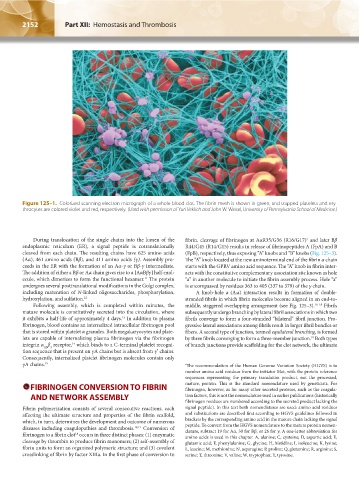
               Figure 125–1.  Colorized scanning electron micrograph of a whole blood clot. The fibrin mesh is shown in green, and trapped platelets and ery-
               throcytes are colored violet and red, respectively. (Used with permission of Yuri Veklich and John W. Weisel, University of Pennsylvania School of Medicine.)


                   During translocation of the single chains into the lumen of the   fibrin, cleavage of fibrinogen at AαR35/G36 (R16/G17)  and later Bβ
                                                                                                               *
               endoplasmic reticulum (ER), a signal peptide is cotranslationally   R44/G45 (R14/G15) results in release of fibrinopeptides A (FpA) and B
               cleaved from each chain. The resulting chains have 625 amino acids   (FpB), respectively, thus exposing “A” knobs and “B” knobs (Fig. 125–3).
               (Aα), 461 amino acids (Bβ), and 411 amino acids (γ). Assembly pro-  The “A” knob located at the new aminoterminal end of the fibrin α chain
               ceeds in the ER with the formation of an Aα-γ or Bβ-γ intermediate.   starts with the GPRV amino acid sequence. The “A” knob in fibrin inter-
               The addition of either a Bβ or Aα chain gives rise to a [AαBβγ] half-mol-  acts with the constitutive complementary association site known as hole
                                                        11
               ecule, which dimerizes to form the functional hexamer.  The protein   “a” in another molecule to initiate the fibrin assembly process. Hole “a”
               undergoes several posttranslational modifications in the Golgi complex,   is encompassed by residues 363 to 405 (337 to 379) of the γ chain.
               including maturation of  N-linked oligosaccharides, phosphorylation,   A knob-hole a (A:a) interaction results in formation of double-
               hydroxylation, and sulfation. 12                       stranded fibrils in which fibrin molecules become aligned in an end-to-
                   Following assembly, which is completed within minutes, the   middle, staggered overlapping arrangement (see Fig. 125–3). 16–18  Fibrils
               mature molecule is constitutively secreted into the circulation, where   subsequently undergo branching by lateral fibril associations in which two
                                                 13
               it exhibits a half-life of approximately 4 days.  In addition to plasma   fibrils converge to form a four-stranded “bilateral” fibril junction. Pro-
               fibrinogen, blood contains an internalized intracellular fibrinogen pool   gressive lateral associations among fibrils result in larger fibril bundles or
               that is stored within platelet α granules. Both megakaryocytes and plate-  fibers. A second type of junction, termed equilateral branching, is formed
               lets are capable of internalizing plasma fibrinogen via the fibrinogen   by three fibrils converging to form a three-member junction.  Both types
                                                                                                                19
               integrin α β  receptor,  which binds to a C-terminal platelet recogni-  of branch junctions provide scaffolding for the clot network, the ultimate
                                14
                       IIb 3
               tion sequence that is present on γA chains but is absent from γ′ chains.
               Consequently, internalized platelet fibrinogen molecules contain only
               γA chains. 15                                          * The recommendation of the Human Genome Variation Society (HGVS) is to
                                                                      number amino acid residues from the initiator Met, with the protein reference
                                                                      sequences representing the primary translation product, not the processed,
                    FIBRINOGEN CONVERSION TO FIBRIN                   mature, protein. This is the standard nomenclature used by geneticists. For
                                                                      fibrinogen, however, as for many other secreted proteins, such as the coagula-
                  AND NETWORK ASSEMBLY                                tion factors, this is not the nomenclature used in earlier publications (historically
                                                                      fibrinogen residues are numbered according to the secreted product lacking the
               Fibrin polymerization consists of several consecutive reactions, each   signal peptide). In this text both nomenclatures are used: amino acid residues
               affecting the ultimate structure and properties of the fibrin scaffold,   and substitutions are described first according to HGVS guidelines followed in
               which, in turn, determines the development and outcome of numerous   brackets by the corresponding amino acid in the mature chain lacking the signal
               diseases including coagulopathies and thrombosis. 16,17  Conversion of   peptide. To convert from the HGVS nomenclature to the mature protein nomen-
                                                                      clature, subtract 19 for Aα, 30 for Bβ, or 26 for γ. A one-letter abbreviation for
                                 18
               fibrinogen to a fibrin clot  occurs in three distinct phases: (1) enzymatic   amino acids is used in this chapter. A, alanine; C, cysteine; D, aspartic acid; E,
               cleavage by thrombin to produce fibrin monomers; (2) self-assembly of   glutamic acid; F, phenylalanine; G, glycine; H, histidine; I, isoleucine; K, lysine;
               fibrin units to form an organized polymeric structure; and (3) covalent   L, leucine; M, methionine; N, asparagine; P, proline; Q, glutamine; R, arginine; S,
               crosslinking of fibrin by factor XIIIa. In the first phase of conversion to   serine; T, threonine; V, valine; W, tryptophan; Y, tyrosine.


          Kaushansky_chapter 125_p2151-2162.indd   2152                                                                 9/18/15   5:47 PM

