


Page 2178 - Williams Hematology ( PDFDrive )
P. 2178
2152  Part XII:  Hemostasis and Thrombosis               Chapter 125:  Hereditary Fibrinogen Abnormalities           2153


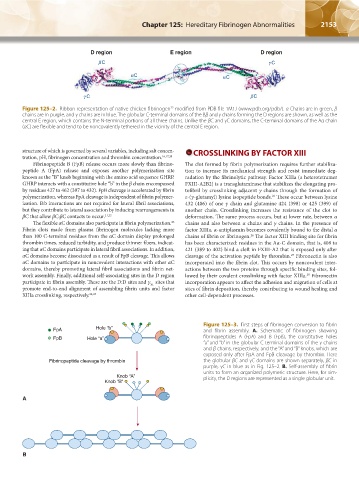
                  Figure 125–2.  Ribbon representation of native chicken fibrinogen  modified from PDB file 1M1J (www.pdb.org/pdb/). α Chains are in green, β
                                                                   22
                  chains are in purple, and γ chains are in blue. The globular C-terminal domains of the Bβ and γ chains forming the D regions are shown, as well as the
                  central E region, which contains the N-terminal portions of all three chains. Unlike the βC and γC domains, the C-terminal domains of the Aα chain
                  (αC) are flexible and tend to be noncovalently tethered in the vicinity of the central E region.


                  structure of which is governed by several variables, including salt concen-  CROSSLINKING BY FACTOR XIII
                  tration, pH, fibrinogen concentration and thrombin concentration. 16,17,20
                     Fibrinopeptide B (FpB) release occurs more slowly than fibrino-  The clot formed by fibrin polymerization requires further stabiliza-
                  peptide A (FpA) release and exposes another polymerization site   tion to increase its mechanical strength and resist immediate deg-
                  known as the “B” knob beginning with the amino acid sequence GHRP.   radation by the fibrinolytic pathway. Factor XIIIa (a heterotetramer
                  GHRP interacts with a constitutive hole “b” in the β chain encompassed   FXIII-A2B2) is a transglutaminase that stabilizes the elongating pro-
                  by residues 427 to 462 (397 to 432). FpB cleavage is accelerated by fibrin   tofibril by crosslinking adjacent γ chains through the formation of
                  polymerization, whereas FpA cleavage is independent of fibrin polymer-  ε-(γ-glutamyl) lysine isopeptide bonds.  These occur between lysine
                                                                                                      26
                  ization. B:b interactions are not required for lateral fibril associations,   432 (406) of one γ chain and glutamine 424 (398) or 425 (399) of
                  but they contribute to lateral association by inducing rearrangements in   another chain. Crosslinking increases the resistance of the clot to
                  βC that allow βC:βC contacts to occur. 21,22          deformation. The same process occurs, but at lower rate, between α
                     The flexible αC domains also participate in fibrin polymerization.    chains and also between α chains and γ chains. In the presence of
                                                                    23
                  Fibrin clots made from plasma fibrinogen molecules lacking more   factor XIIIa, α-antiplasmin becomes covalently bound to the distal α
                  than 100 C-terminal residues from the αC domain display prolonged   chains of fibrin or fibrinogen.  The factor XIII binding site for fibrin
                                                                                              26
                  thrombin times, reduced turbidity, and produce thinner fibers, indicat-  has been characterized: residues in the Aα-C domain, that is, 408 to
                  ing that αC domains participate in lateral fibril associations. In addition,   421 (389 to 402) bind a cleft in FXIII-A2 that is exposed only after
                  αC domains become dissociated as a result of FpB cleavage. This allows   cleavage of the activation peptide by thrombin.  Fibronectin is also
                                                                                                            27
                  αC domains to participate in noncovalent interactions with other αC   incorporated into the fibrin clot. This occurs by noncovalent inter-
                  domains, thereby promoting lateral fibril associations and fibrin net-  actions between the two proteins through specific binding sites, fol-
                  work assembly. Finally, additional self-associating sites in the D region   lowed by their covalent crosslinking with factor XIIIa.  Fibronectin
                                                                                                                 28
                  participate in fibrin assembly. These are the D:D sites and γ  sites that   incorporation appears to affect the adhesion and migration of cells at
                                                             XL
                  promote  end-to-end  alignment  of  assembling  fibrin  units  and  factor   sites of fibrin deposition, thereby contributing to wound healing and
                  XIIIa crosslinking, respectively. 24,25               other cell-dependent processes.


                                                                               Figure 125–3.  First steps of fibrinogen conversion to fibrin
                            FpA           Hole “b”                             and  fibrin  assembly.  A.  Schematic  of  fibrinogen  showing
                            FpB         Hole “a”                               fibrinopeptides  A (FpA) and B  (FpB), the  constitutive holes
                                                                               “a” and “b” in the globular C-terminal domains of the γ chains
                                                                               and β chains, respectively, and the “A” and “B” knobs, which are
                                                                               exposed only after FpA and FpB cleavage by thrombin. Here
                           Fibrinopeptide cleavage by thrombin                 the globular βC and γC domains are shown separately, βC in
                                                                               purple, γC in blue as in Fig. 125–2. B. Self-assembly of fibrin
                                                                               units to form an organized polymeric structure. Here, for sim-
                                                 Knob “A”                      plicity, the D regions are represented as a single globular unit.
                                             Knob “B”

                  A


                  B


          Kaushansky_chapter 125_p2151-2162.indd   2153                                                                 9/18/15   5:47 PM

