


Page 2182 - Williams Hematology ( PDFDrive )
P. 2182
2156  Part XII:  Hemostasis and Thrombosis               Chapter 125:  Hereditary Fibrinogen Abnormalities           2157


                     In addition to fibrinogen substitution, antifibrinolytic agents may   many different mutations in the three fibrinogen-encoding genes. Dys-
                  be given, particularly to treat mucosal bleeding or to prevent bleeding   fibrinogenemias and hypodysfibrinogenemias are autosomal dominant
                  following procedures such as dental extraction. Fibrin glue is useful to   disorders. Most affected patients are heterozygous for missense muta-
                  treat superficial wounds or following dental extractions. Oral contra-  tions in the coding region of one of the three fibrinogen genes. Because
                  ceptive preparations are useful in case of menorrhagia. Oral iron prep-  the secreted fibrinogen hexamer contains two copies of each of the three
                  arations can be given in cases with associated iron-deficiency anemia.   fibrinogen chains, and the resulting fibrin network contains multiple cop-
                  Routine vaccination against hepatitis, as well as a regular surveillance   ies of the molecule, heterozygosity for one mutant allele is sufficient to
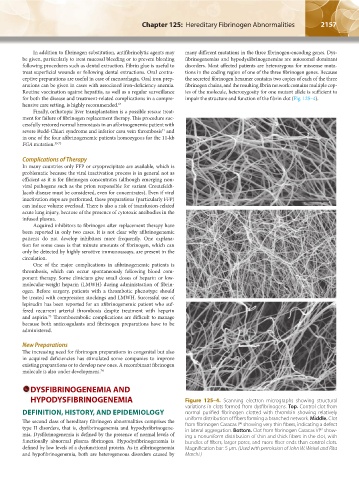
                  for both the disease and treatment-related complications in a compre-  impair the structure and function of the fibrin clot (Fig. 125–4).
                  hensive care setting, is highly recommended. 64
                     Finally, orthotopic liver transplantation is a possible rescue treat-
                  ment for failure of fibrinogen replacement therapy. This procedure suc-
                  cessfully restored normal hemostasis in an afibrinogenemic patient with
                                                                 71
                  severe Budd-Chiari syndrome and inferior cava vein thrombosis  and
                  in one of the four afibrinogenemic patients homozygous for the 11-kb
                  FGA mutation. 35,72

                  Complications of Therapy
                  In many countries only FFP or cryoprecipitate are available, which is
                  problematic because the viral inactivation process is in general not as
                  efficient as it is for fibrinogen concentrates (although emerging non-
                  viral pathogens such as the prion responsible for variant Creutzfeldt-
                  Jacob disease must be considered, even for concentrates). Even if viral
                  inactivation steps are performed, these preparations (particularly FFP)
                  can induce volume overload. There is also a risk of transfusion-related
                  acute lung injury, because of the presence of cytotoxic antibodies in the
                  infused plasma.
                     Acquired inhibitors to fibrinogen after replacement therapy have
                  been reported in only two cases. It is not clear why afibrinogenemic
                  patients do not develop inhibitors more frequently. One  explana-
                  tion for some cases is that minute amounts of fibrinogen, which can
                  only be detected by highly sensitive immunoassays, are present in the
                  circulation.
                     One of the major complications in afibrinogenemic patients is
                  thrombosis, which can occur spontaneously following blood com-
                  ponent therapy. Some clinicians give small doses of heparin or low-
                  molecular-weight heparin (LMWH) during administration of fibrin-
                  ogen. Before surgery, patients with a thrombotic phenotype should
                  be treated with compression stockings and LMWH. Successful use of
                  lepirudin has been reported for an afibrinogenemic patient who suf-
                  fered recurrent arterial thrombosis despite treatment with heparin
                  and aspirin.  Thromboembolic complications are difficult to manage
                           73
                  because both anticoagulants and fibrinogen preparations have to be
                  administered.

                  New Preparations
                  The increasing need for fibrinogen preparations in congenital but also
                  in acquired deficiencies has stimulated some companies to improve
                  existing preparations or to develop new ones. A recombinant fibrinogen
                  molecule is also under development. 74


                       DYSFIBRINOGENEMIA AND
                     HYPODYSFIBRINOGENEMIA                              Figure 125–4.  Scanning electron micrographs showing structural
                                                                        variations in clots formed from dysfibrinogens. Top. Control clot from
                  DEFINITION, HISTORY, AND EPIDEMIOLOGY                 normal purified fibrinogen clotted with thrombin showing relatively
                  The second class of hereditary fibrinogen abnormalities comprises the   uniform distribution of fibers forming a branched network. Middle. Clot
                                                                                          96
                  type II disorders, that is, dysfibrinogenemia and hypodysfibrinogene-  from fibrinogen Caracas I  showing very thin fibers, indicating a defect
                                                                                                                      97
                                                                        in lateral aggregation. Bottom. Clot from fibrinogen Caracas VI  show-
                  mia. Dysfibrinogenemia is defined by the presence of normal levels of   ing a nonuniform distribution of thin and thick fibers in the clot, with
                  functionally  abnormal  plasma  fibrinogen.  Hypodysfibrinogenemia  is   bundles of fibers, larger pores, and more fiber ends than control clots.
                  defined by low levels of a dysfunctional protein. As in afibrinogenemia   Magnification bar: 5 μm. (Used with permission of John W. Weisel and Rita
                  and  hypofibrinogenemia,  both  are  heterogeneous disorders  caused  by   Marchi.)


          Kaushansky_chapter 125_p2151-2162.indd   2157                                                                 9/18/15   5:48 PM

