


Page 2293 - Williams Hematology ( PDFDrive )
P. 2293
2268           Part XII:  Hemostasis and Thrombosis                                                                                                                                   Chapter 133:  Venous Thrombosis            2269


                   The direct ascertainment of deaths from VTE is difficult because of   TABLE 133–1.  Risk Factors for Thromboembolism*
               the low rate of autopsy in most countries, and because autopsy studies
               have consistently demonstrated that PE is often not diagnosed antemor-  Acquired  Hereditary Thrombophilias*
               tem. The strongest evidence comes from the study by Cohen and col-  Advancing age (age >40 years)  Activated protein C resistance
               leagues, who used an incidence-based model in six European countries   History of prior   Prothrombin G20210A
               to estimate that there were 534,454 deaths related to VTE across the     thromboembolic event
                                  4
               European Union in 2004.  A similar approach applied to the data from
               the United States suggested approximately 300,000 deaths from VTE   Recent surgery  Antithrombin deficiency
                       5
               each year.  The majority of deaths from VTE occur as sudden death,   Recent trauma  Protein C deficiency
               underscoring the critical role of prevention for reducing death from   Prolonged immobilization  Protein S deficiency
               VTE.
                   Effective prophylaxis against VTE is available for most high-risk   Certain forms of cancer  Dysfibrinogenemia
               patients. Use of prophylaxis is more effective for preventing death   Congestive heart failure
               and morbidity from VTE than is treatment of the established disease.     Recent myocardial infarction
                                                             6–9
               Evidence-based recommendations for prevention are available.  Mul-
               tifaceted interventions with alerts, such as computerized reminders or   Paralysis of legs
               stickers on patient charts, are effective for increasing the prescription of   Use of female hormones
               appropriate thromboprophylaxis in hospitalized adult medical or surgi-  Pregnancy or postpartum
               cal patients.  There is also evidence that inclusion of VTE risk assess-  period
                        10
               ment at the time of hospital admission and the provision of appropriate
               prophylaxis is effective for reducing VTE-related death and readmission   Varicose veins
               with nonfatal VTE. 11,12                                Obesity
                   Historically, the majority of the disease burden from VTE occurred   Antiphospholipid antibody
               in hospitalized patients. The burden of illness from VTE has shifted to   syndrome**
               the community setting such that most patients now present as outpa-
               tients to their primary care physician or to the emergency department.   Hyperhomocysteinemia
               The main reason for this shift is the greatly reduced length of hospi-  *See also Chap. 130
               tal stay for most surgical procedures or medical conditions, such that
               patients are discharged from the hospital either before the period of risk   **See also Chap. 131
               of VTE has ended or who have subclinical venous thrombi that subse-
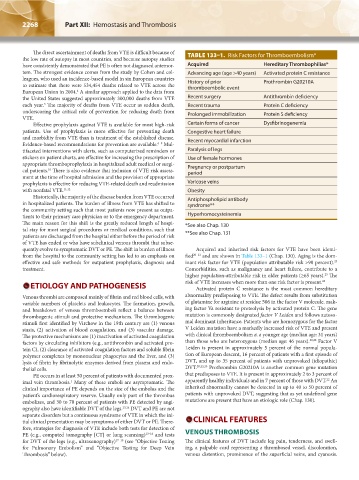
               quently evolve to symptomatic DVT or PE. The shift in burden of illness   Acquired and inherited risk factors for VTE have been identi-
               from the hospital to the community setting has led to an emphasis on   fied 20–23  and are shown in Table 133–1 (Chap. 130). Aging is the dom-
               effective and safe methods for outpatient prophylaxis, diagnosis and   inant risk factor for VTE (population attributable risk >90 percent).
                                                                                                                        23
               treatment.                                             Comorbidities, such as malignancy and heart failure, contribute to a
                                                                                                                     23
                                                                      higher population-attributable risk in older patients (≥65 years).  The
                  ETIOLOGY AND PATHOGENESIS                           risk of VTE increases when more than one risk factor is present. 24
                                                                          Activated protein C resistance is the most common  hereditary
               Venous thrombi are composed mainly of fibrin and red blood cells, with   abnormality predisposing to VTE. The defect results from substitution
               variable numbers of platelets and leukocytes. The formation, growth,   of glutamine for arginine at residue 506 in the factor V molecule, mak-
               and breakdown of venous thromboemboli reflect a balance between   ing factor Va resistant to proteolysis by activated protein C. The gene
               thrombogenic stimuli and protective mechanisms. The thrombogenic   mutation is commonly designated factor V Leiden and follows autoso-
               stimuli first identified by Virchow in the 19th century are (1) venous   mal dominant inheritance. Patients who are homozygous for the factor
               stasis, (2) activation of blood coagulation, and (3) vascular damage.   V Leiden mutation have a markedly increased risk of VTE and present
               The protective mechanisms are (1) inactivation of activated coagulation   with clinical thromboembolism at a younger age (median age: 31 years)
               factors by circulating inhibitors (e.g., antithrombin and activated pro-  than those who are heterozygous (median age: 46 years). 20,22  Factor V
               tein C), (2) clearance of activated coagulation factors and soluble fibrin   Leiden is present in approximately 5 percent of the normal popula-
               polymer complexes by mononuclear phagocytes and the liver, and (3)   tion of European descent, 16 percent of patients with a first episode of
               lysis of fibrin by fibrinolytic enzymes derived from plasma and endo-  DVT, and up to 35 percent of patients with unprovoked (idiopathic)
               thelial cells.                                         DVT. 20,22,25  Prothrombin G20210A is another common gene mutation
                   PE occurs in at least 50 percent of patients with documented prox-  that predisposes to VTE. It is present in approximately 2 to 3 percent of
                                                                                                                     22
                                1
               imal vein thrombosis.  Many of these emboli are asymptomatic. The   apparently healthy individuals and in 7 percent of those with DVT.  An
               clinical importance of PE depends on the size of the embolus and the   inherited abnormality cannot be detected in up to 40 to 50 percent of
               patient’s cardiorespiratory reserve. Usually only part of the thrombus   patients with unprovoked DVT, suggesting that as yet undefined gene
               embolizes, and 30 to 70 percent of patients with PE detected by angi-  mutations are present that have an etiologic role (Chap. 130).
               ography also have identifiable DVT of the legs. 13,14  DVT and PE are not
               separate disorders but a continuous syndrome of VTE in which the ini-
               tial clinical presentation may be symptoms of either DVT or PE. There-  CLINICAL FEATURES
               fore, strategies for diagnosis of VTE include both tests for detection of
               PE (e.g., computed tomography [CT] or lung scanning) 13–16  and tests   VENOUS THROMBOSIS
               for DVT of the legs (e.g., ultrasonography) 17–19  (see “Objective Testing     The clinical features of DVT include leg pain, tenderness, and swell-
               for Pulmonary Embolism”  and  “Objective Testing for Deep Vein   ing, a palpable cord representing a thrombosed vessel, discoloration,
               Thrombosis” below).                                    venous distention, prominence of the superficial veins, and cyanosis.


          Kaushansky_chapter 133_p2267-2280.indd   2268                                                                 9/18/15   10:52 AM

