


Page 2297 - Williams Hematology ( PDFDrive )
P. 2297
2272           Part XII:  Hemostasis and Thrombosis                                                                                                                                   Chapter 133:  Venous Thrombosis            2273


                                                             Clinically suspected PE


                                                            D-Dimer assay of plasma
                                                                   and/or
                                                                CTA/CTA-CTV
                                                                   and/or
                                                      Compression ultrasonography (CUS) of legs


                                 D-Dimer negative          D-Dimer positive or not done  D-Dimer positive or not done

                                      and                           and                           and
                           CTA/CTA-CTV negative or not done  CTA/CTA-CTV positive          CTA/CTA-CTV negative ‡
                                      and                            or                           and

                               CUS normal or not done            CUS positive                 CUS negative


                                 PE unlikely (<3%) ∗            Antithrombotic                 Repeat CUS
                                                                  therapy ∗∗                   in 5–7 days
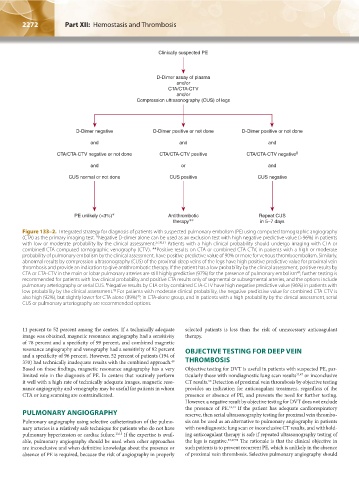
               Figure 133–2.  Integrated strategy for diagnosis of patients with suspected pulmonary embolism (PE) using computed tomographic angiography
               (CTA) as the primary imaging test. *Negative D-dimer alone can be used as an exclusion test with high negative predictive value (>96%) in patients
               with low or moderate probability by the clinical assessment. 27,30,31  Patients with a high clinical probability should undergo imaging with CTA or
               combined CTA-computed tomographic venography (CTV). **Positive results on CTA or combined CTA-CTV, in patients with a high or moderate
               probability of pulmonary embolism by the clinical assessment, have positive predictive value of 90% or more for venous thromboembolism. Similarly,
               abnormal results by compression ultrasonography (CUS) of the proximal deep veins of the legs have high positive predictive value for proximal vein
               thrombosis and provide an indication to give antithrombotic therapy. If the patient has a low probability by the clinical assessment, positive results by
                                                                                                            43
               CTA or CTA-CTV in the main or lobar pulmonary arteries are still highly predictive (97%) for the presence of pulmonary embolism ; further testing is
               recommended for patients with low clinical probability and positive CTA results only of segmental or subsegmental arteries, and the options include
                                           ‡
               pulmonary arteriography or serial CUS.  Negative results by CTA or by combined CTA-CTV have high negative predictive value (96%) in patients with
                                              43
               low probability by the clinical assessment.  For patients with moderate clinical probability, the negative predictive value for combined CTA-CTV is
                                                      43
               also high (92%), but slightly lower for CTA alone (89%) ; in CTA-alone group, and in patients with a high probability by the clinical assessment, serial
               CUS or pulmonary arteriography are recommended options.
               11 percent to 52 percent among the centers. If a technically adequate   selected patients is less than the risk of unnecessary anticoagulant
               image was obtained, magnetic resonance angiography had a sensitivity   therapy.
               of 78 percent and a specificity of 99 percent, and combined magnetic
               resonance angiography and venography had a sensitivity of 92 percent   OBJECTIVE TESTING FOR DEEP VEIN
               and a specificity of 96 percent. However, 52 percent of patients (194 of
               370) had technically inadequate results with the combined approach.    THROMBOSIS
                                                                 49
               Based on these findings, magnetic resonance angiography has a very   Objective testing for DVT is useful in patients with suspected PE, par-
               limited role in the diagnosis of PE. In centers that routinely perform   ticularly those with nondiagnostic lung scan results 33,47  or inconclusive
               it well with a high rate of technically adequate images, magnetic reso-  CT results.  Detection of proximal vein thrombosis by objective testing
                                                                              50
               nance angiography and venography may be useful for patients in whom   provides an indication for anticoagulant treatment, regardless of the
               CTA or lung scanning are contraindicated.              presence or absence of PE, and prevents the need for further testing.
                                                                      However, a negative result by objective testing for DVT does not exclude
                                                                      the presence of PE. 13,14  If the patient has adequate cardiorespiratory
               PULMONARY ANGIOGRAPHY                                  reserve, then serial ultrasonography testing for proximal vein thrombo-
               Pulmonary angiography using selective catheterization of the pulmo-  sis can be used as an alternative to pulmonary angiography in patients
               nary arteries is a relatively safe technique for patients who do not have   with nondiagnostic lung scan or inconclusive CT results, and withhold-
               pulmonary hypertension or cardiac failure. 13,15  If the expertise is avail-  ing anticoagulant therapy is safe if repeated ultrasonography testing of
               able, pulmonary angiography should be used when other approaches   the legs is negative. 33,47,50  The rationale is that the clinical objective in
               are inconclusive and when definitive knowledge about the presence or   such patients is to prevent recurrent PE, which is unlikely in the absence
               absence of PE is required, because the risk of angiography in properly   of proximal vein thrombosis. Selective pulmonary angiography should


          Kaushansky_chapter 133_p2267-2280.indd   2272                                                                 9/18/15   10:52 AM

