


Page 2383 - Williams Hematology ( PDFDrive )
P. 2383
2354           Part XIII:  Transfusion Medicine                                                                                                                   Chapter 137:  Human Leukocyte and Platelet Antigens            2355


                TABLE 137–1.  Number of Known Alleles for Each Human   acids) are accommodated. 13,14  Class II antigens have a more restricted
                                                                      tissue distribution, being found primarily on B lymphocytes and other
                Leukocyte Antigen Locus as of July 2014
                                                                      antigen-presenting cells such as dendritic cells, monocytes, and macro-
                HLA CLASS I                                           phages. They may also be expressed on activated endothelial cells and
                Gene        A       B       C     E     F     G       T lymphocytes. 12
                                                                          The  extraordinarily  polymorphic  nature  of  HLA  has  probably
                Alleles     2884    3590    2375  15    22    50
                                                                      evolved because of the need to present a very large array of different
                HLA CLASS II                                          antigenic peptides in host defense. Antigen processing and presenta-
                Gene        DRA     DRB     DQA   DQB   DPA   DPB     tion is a tightly regulated process, especially among the professional
                                                                        antigen-presenting cells such as dendritic cells. A number of alternative
                Alleles     7       1642    52    664   38    422
                                                                      mechanisms have been demonstrated in vitro, such as cross-presentation,
                NON-HLA                                               whereby dendritic cells transfer antigen derived from endocytic sources
                                                                                                         15
                Gene        MICA    MICB    TAP1  TAP2                to the class I pathway, but are poorly understood.  One promising area
                                                                      of research is the ability of HLA molecules to present antigenic peptides
                Alleles     100     40      12    12
                                                                      derived from tumors. Such peptides could arise via point mutation,
               HLA, human leukocyte antigen (HLA).                    or reactivation of a normally silent gene that produces a peptide that
               Data from Robinson J, Waller MJ, Parham P, et al: IMGT/HLA and IMGT/  can bind to HLA and induce a T-cell immune response. Several such
               MHC: Sequence databases for the study of the major histocompati-  peptides (melanoma-associated gene [MAGE] antigens) have been
               bility complex. Nucleic Acids Res  31(1):311–314, 2003.   identified for melanoma. 16
               and the light β chain (Mr 29,000) are encoded in the MHC region. Class II   NOMENCLATURE
               molecules, like class I, consist of an extracellular hydrophilic NH –     Distinguishing polymorphic variations among HLA antigens is clin-
                                                                 2
               terminal region, a hydrophobic transmembrane region, and an intracel-  ically important in  stem cell transplantation.  Terminology used to
               lular COOH– terminus region. Unlike class I antigens, the extracellular   describe accepted HLA alleles or antigens is standardized by the
               regions of each chain contain only two domains. The two domains of   World Health Organization (WHO), Nomenclature Committee for
               the α chain are designated α  and α , and the two domains of the β-chain   Factors of the HLA System, which issues biannual reports and monthly
                                        2
                                   1
               are called β  and β . The α chain of HLA-DR is constant for all HLA-DR   updates.  In addition, an HLA dictionary defining HLA antigens, their
                                                                            4
                            2
                       1
               molecules, whereas the β chain is polymorphic and determines spec-  assigned nomenclature, and serologic equivalents is published period-
               ificity of the molecule. Both α and β chains of HLA-DQ and -DP are   ically.  The nomenclature committee approved major changes to the
                                                                          5
               polymorphic, although the β chain is more so than the α chain. In all   system that were implemented in 2010.  The revisions were designed to
                                                                                                  17
               class II antigens the β  domain represents the most polymorphic region.     accommodate the unexpected number of new sequenced alleles. Under
                               1
               The structure of HLA-DR is essentially similar to the structure of class I   this system, colons are used as delimiters to separate fields. The first field
               molecules. Class II antigens present peptides from exogenous sources,   signifies the allele family that often corresponds to the serological antigen.
               such as bacterial pathogens, to CD4+ cells. The binding groove is more   The second field denotes the alleles, assigned in order of determination.
               open than that of class I, and peptides of longer length (11 to 18 amino   The third field is used for defining synonymous nucleotide substitutions.


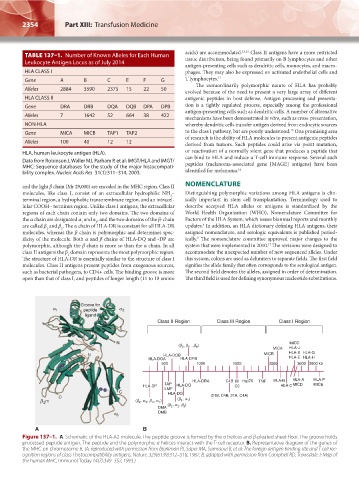
               Figure 137–1.  A. Schematic of the HLA-A2 molecule. The peptide groove is formed by the α helices and β-pleated sheet floor. The groove holds
               processed peptide antigen. The peptide and the polymorphic α helices interact with the T-cell receptor. B. Representative diagram of the genes of
               the MHC on chromosome 6. (A, reproduced with permission from Bjorkman PJ, Saper MA, Samraoui B, et al: The foreign antigen binding site and T cell rec-
               ognition regions of class I histocompatibility antigens. Nature 329(6139):512–518, 1987. B, adapted with permission from Campbell RD, Trowsdale J: Map of
               the human MHC, Immunol Today 14(7):349–352, 1993.)


          Kaushansky_chapter 137_p2353-2364.indd   2354                                                                 9/21/15   3:49 PM

