


Page 2379 - Williams Hematology ( PDFDrive )
P. 2379
2350           Part XIII:  Transfusion Medicine                                                                                                                       Chapter 136: Erythrocyte Antigens and Antibodies           2351


                                                                        3.  Cartron JP, Bailly P, Le Van Kim C, et al: Insights into the structure and function of
                TABLE 136–7.  ABO-Rh Compatibility Guidelines            membrane polypeptides carrying blood group antigens. Vox Sang 74(Suppl 2):29, 1998.
                                             Compatible Blood Groups    4.  Daniels G: Human Blood Groups, 3rd ed. Blackwell Science, Oxford, 2013.
                                                                        5.  Issitt PD, Anstee DJ: Applied Blood Group Serology, 4th ed. Montgomery Scientific,
                        Antigen on  Antibody   Donor Red   Donor         Durham, NC, 1998.
                        Red Cells  in Serum  Cells      Plasma          6.  Reid ME, Lomas-Francis C, Olsson ML:  Blood Group Antigen FactsBook, 3rd ed.
                                                                         Academic Press, San Diego, 2012.
                If recipient blood group is                             7.  Telen MJ: Erythrocyte blood group antigens: Not so simple after all. Blood 85:299, 1995.
                                                                        8.  Cartron JP, Colin Y: Structural and functional diversity of blood group antigens. Trans-
                A       A          Anti-B    A, O       A, AB            fus Clin Biol 8:163, 2001.
                                                                        9.  Bruce LJ, Ghosh S, King MJ, et al: Absence of CD47 in protein 4.2-deficient hereditary
                B       B          Anti-A    B, O       B, AB
                                                                         spherocytosis in man: An interaction between the Rh complex and the band 3 complex.
                O       O          Anti-A,   O          O, A, B, AB      Blood 100:1878, 2002.
                                   anti-B                               10.  Reid ME, Mohandas N: Red blood cell blood group antigens: Structure and function.
                                                                         Semin Hematol 41:93, 2004.
                AB      A, B       None      AB, A, B, O  AB            11.  Fung MK, Grossman BJ, Hillyer C, et al, editors: Technical Manual, 18th ed. American
                                                                         Association of Blood Banks, Bethesda, MD, 2014.
                Rh-     D          None      Rh-positive,   Rh not      12.  Storry JR, Castilho L, Daniels G, et al: International Society of Blood Transfusion
                positive                     Rh-negative  considered     Working Party on Red Cell Immunogenetics and Terminology: Cancun report (2012).
                                                                         Vox Sang 107:90, 2014.
                Rh-     None       Anti-D    Rh-negative  Rh not        13.  Daniels GL, Anstee DJ, Cartron J-P, et al: Blood group terminology 1995. ISBT working
                negative           only if              considered       party on terminology for red cell surface antigens. Vox Sang 69:265, 1995.
                                   immunized                            14.  Garratty G, Dzik WH, Issitt PD, et al: Terminology for blood group antigens and genes:
                                                                         Historical origins and guidelines in the new millennium. Transfusion 40:477, 2000.
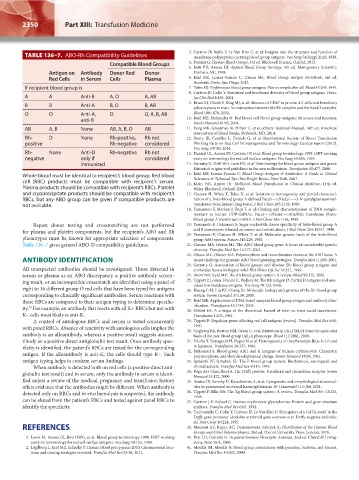
               Whole blood must be identical to recipient’s blood group. Red blood     15.  Reid ME, Lomas-Francis C: Blood Group Antigens & Antibodies: A Guide to Clinical
                                                                         Relevance & Technical Tips. Star Bright Books, New York, 2007.
               cell (RBC) products must  be compatible  with recipient’s serum.     16.  Klein HG, Anstee DJ:  Mollison’s Blood Transfusion in Clinical Medicine, 11th ed.
               Plasma products should be compatible with recipient’s RBCs. Platelet   Wiley-Blackwell, Oxford, 2006.
               and cryoprecipitate products should be compatible with recipient’s     17.  Clausen H, White T, Takio K, et al: Isolation to homogeneity and partial characteri-
               RBCs, but any ABO group can be given if compatible products are   zation of a histo-blood group A defined Fuca1—>2Gala1—>3-N-acetylglucosaminyl-
               not available.                                            transferase from human lung tissue. J Biol Chem 265:1139, 1990.
                                                                        18.  Yamamoto F, Marken J, Tsuji T, et al: Cloning and characterization of DNA comple-
                                                                         mentary to human UDP-GalNAc: Fuca1—>2Gala1—>3GalNAc transferase (histo-
                                                                         blood group A transferase) mRNA. J Biol Chem 265:1146, 1990.
                   Repeat donor testing and crossmatching are not performed     19.  Yamamoto F, Hakomori S: Sugar-nucleotide donor specificity of histo-blood group A
               for plasma and platelet components, but the recipient’s ABO and Rh   and B transferases is based on amino acid substitutions. J Biol Chem 265:19257, 1990.
               phenotypes must be known for appropriate selection of components.       20.  Yamamoto F, Clausen H, White T, et al: Molecular genetic basis of the histo-blood
                                                                         group ABO system. Nature 345:229, 1990.
               Table 136–7 gives general ABO-D compatibility guidelines.    21.  Chester MA, Olsson ML: The ABO blood group gene: A locus of considerable genetic
                                                                         diversity. Transfus Med Rev 15:177, 2001.
                                                                        22.  Olsson ML, Chester MA: Polymorphism and recombination events at the ABO locus: A
               ANTIBODY IDENTIFICATION                                   major challenge for genomic ABO blood grouping strategies. Transfus Med 11:295, 2001.
                                                                        23.  Garratty G: Association of blood groups and disease: Do blood group antigens and
               All unexpected antibodies should be investigated. Those detected in   antibodies have a biological role? Hist Philos Life Sci 18:321, 1996.
               serum or plasma as an ABO discrepancy, a positive antibody screen-    24.  Avent ND, Reid ME: The Rh blood group system: A review. Blood 95:375, 2000.
               ing result, or an incompatible crossmatch are identified using a panel of     25.  Tippett P, Lomas-Francis C, Wallace M: The Rh antigen D: Partial D antigens and asso-
                                                                         ciated low incidence antigens. Vox Sang 70:123, 1996.
               eight to 16 different group O red cells that have been typed for antigens     26.  Huang C-H, Liu PZ, Cheng JG: Molecular biology and genetics of the Rh blood group
               corresponding to clinically significant antibodies. Serum reactions with   system. Semin Hematol 37:150, 2000.
               these RBCs are compared to their antigen typing to determine specific-    27.  Reid ME: Applications of DNA-based assays in blood group antigen and antibody iden-
                                                                         tification. Transfusion 43:1748, 2003.
                  11
               ity.  For example, an antibody that reacts with all K+ RBCs but not with     28.  Giblett ER: A critique of the theoretical hazard of inter vs. intra-racial transfusion.
               K– cells most likely is anti-K.                           Transfusion 1:233, 1961.
                   A control of autologous RBCs and serum is tested concurrently     29.  Tippett P: Regulator genes affecting red cell antigens [review]. Transfus Med Rev 4:56,
               with panel RBCs. Absence of reactivity with autologous cells implies the   1990.
               antibody is an alloantibody, whereas a positive result suggests autoan-    30.  Singleton BK, Burton NM, Green C, et al: Mutations in EKLF/KLF1 form the molecular
                                                                         basis of the rare blood group In(Lu) phenotype. Blood 112:2081, 2008.
               tibody or a positive direct antiglobulin test result. Once antibody spec-    31.  Okubo Y, Yamaguchi H, Nagao N, et al: Heterogeneity of the phenotype Jk(a–b–) found
               ificity is identified, the patient’s RBCs are tested for the corresponding   in Japanese. Transfusion 26:237, 1986.
               antigen. If the alloantibody is anti-K, the cells should type K–. Such     32.  Hakomori S: Blood group ABH and Ii antigens of human erythrocytes: Chemistry,
                                                                         polymorphism, and their developmental change. Semin Hematol 18:39, 1981.
               antigen typing helps to confirm serum findings.          33.  Spitalnik PF, Spitalnik SL: The P blood group system: Biochemical, serological, and
                   When antibody is detected both on red cells (a positive direct anti-  clinical aspects. Transfus Med Rev 9:110, 1995.
               globulin test result) and in serum, only the antibody in serum is identi-    34.  Pogo AO, Chaudhuri A: The Duffy protein: A malarial and chemokine receptor. Semin
                                                                         Hematol 37:122, 2000.
               fied unless a review of the medical, pregnancy and transfusion history     35.  Araten DJ, Swirsky D, Karadimitris A, et al: Cytogenetic and morphological abnormal-
               offers evidence that the antibodies might be different. When antibody is   ities in paroxysmal nocturnal haemoglobinuria. Br J Haematol 115:360, 2001.
               detected only on RBCs and in vivo hemolysis is suspected, the antibody     36.  Tippett P, Ellis NA: The Xg blood group system: A review. Transfus Med Rev 12:233,
                                                                         1998.
               can be eluted from the patient’s RBCs and tested against panel RBCs to     37.  Cartron J-P, Rahuel C: Human erythrocyte glycophorins: Protein and gene structure
               identify the specificity.                                 analyses. Transfus Med Rev 6:63, 1992.
                                                                        38.  Tournamille C, Colin Y, Cartron JP, Le Van Kim C: Disruption of a GATA motif in the
                                                                         Duffy gene promoter abolishes erythroid gene expression in Duffy-negative individu-
                                                                         als. Nat Genet 10:224, 1995.
               REFERENCES                                               39.  Mourant AE, Kopec AC, Domaniewska-Sobczak K: Distribution of the Human Blood
                                                                         Groups and Other Polymorphisms, 2nd ed. Oxford University Press, London, 1976.
                 1.  Lewis M, Anstee DJ, Bird GWG, et al: Blood group terminology 1990. ISBT working     40.  Petz LD, Garratty G: Acquired Immune Hemolytic Anemias, 2nd ed. Churchill Living-
                  party on terminology for red cell surface antigens. Vox Sang 58:152, 1990.  stone, New York, 2003.
                 2.  Lögdberg L, Reid ME, Zelinsky T: Human blood group genes 2010: Chromosomal loca-    41.  Moulds JM, Moulds JJ: Blood group associations with parasites, bacteria, and viruses.
                  tions and cloning strategies revisited. Transfus Med Rev 25:36, 2011.  Transfus Med Rev 14:302, 2000.


          Kaushansky_chapter 136_p2327-2352.indd   2350                                                                 9/21/15   4:32 PM

