


Page 2390 - Williams Hematology ( PDFDrive )
P. 2390
2360  Part XIII:  Transfusion Medicine               Chapter 137:  Human Leukocyte and Platelet Antigens             2361


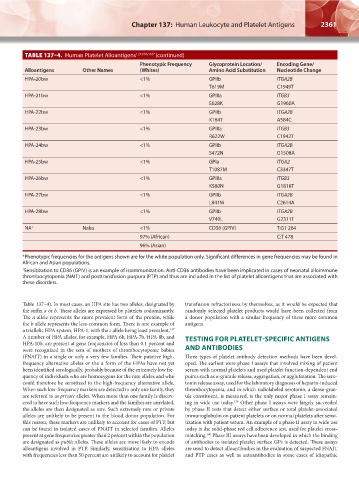
                   TABLE 137–4.  Human Platelet Alloantigens 127,136,163*     (continued)
                                                         Phenotypic Frequency   Glycoprotein Location/  Encoding Gene/
                   Alloantigens       Other Names        (Whites)               Amino Acid Substitution  Nucleotide Change
                   HPA-20bw                              <1%                    GPIIb                  ITGA2B
                                                                                T619M                  C1949T
                   HPA-21bw                              <1%                    GPIIIa                 ITGB3
                                                                                E628K                  G1960A
                   HPA-22bw                              <1%                    GPIIb                  ITGA2B
                                                                                K164T                  A584C
                   HPA-23bw                              <1%                    GPIIIa                 ITGB3
                                                                                R622W                  C1942T
                   HPA-24bw                              <1%                    GPIIb                  ITGA2B
                                                                                S472N                  G1508A
                   HPA-25bw                              <1%                    GPIa                   ITGA2
                                                                                T1087M                 C3347T
                   HPA-26bw                              <1%                    GPIIIa                 ITGB3
                                                                                K580N                  G1818T
                   HPA-27bw                              <1%                    GPIIb                  ITGA2B
                                                                                L841M                  C2614A
                   HPA-28bw                              <1%                    GPIIb                  ITGA2B
                                                                                V740L                  G2311T
                   NA †               Naka               <1%                    CD36 (GPIV)            T:G1 264
                                                         97% (African)                                 C:T 478
                                                         96% (Asian)
                  *Phenotypic frequencies for the antigens shown are for the white population only. Significant differences in gene frequencies may be found in
                  African and Asian populations.
                  † Sensitization to CD36 (GPIV) is an example of isoimmunization. Anti-CD36 antibodies have been implicated in cases of neonatal alloimmune
                  thrombocytopenia (NAIT) and posttransfusion purpura (PTP) and thus are included in the list of platelet alloantigens that are associated with
                  these disorders.


                  Table  137–4). In most cases, an HPA site has two alleles, designated by   transfusion refractoriness by themselves, as it would be expected that
                  the suffix a or b. These alleles are expressed by platelets codominantly.   randomly selected platelet products would have been collected from
                  The a allele represents the more prevalent form of the protein, while   a donor population with a similar frequency of these more common
                  the b allele represents the less-common form. There is one example of   antigens.
                  a triallelic HPA system, HPA-1, with the c allele being least prevalent.
                                                                   137
                  A number of HPA alleles, for example, HPA-6b, HPA-7b, HPA-8b, and   TESTING FOR PLATELET-SPECIFIC ANTIGENS
                  HPA-10b, are present at gene frequencies of less than 0.1 percent and
                  were recognized in the sera of mothers of thrombocytopenic babies   AND ANTIBODIES
                  (FNAIT) in a single or only a very few families. Their putative high-  Three types of platelet antibody detection methods have been devel-
                  frequency alternative alleles or the a form of the HPAs have not yet   oped. The earliest were phase I assays that involved mixing of patient
                  been identified serologically, probably because of the extremely low fre-  serum with normal platelets and used platelet function-dependent end
                  quency of individuals who are homozygous for the rare alleles and who   points such as α-granule release, aggregation, or agglutination. The sero-
                  could therefore be sensitized to the high-frequency alternative allele.   tonin release assay, used for the laboratory diagnosis of heparin-induced
                  When such low-frequency markers are detected in only one family, they   thrombocytopenia, and in which radiolabeled serotonin, a dense-gran-
                  are referred to as private alleles. When more than one family is discov-  ule constituent, is measured, is the only major phase I assay remain-
                  ered to have such low-frequency markers and the families are unrelated,   ing in wide use today.  Other phase I assays were largely succeeded
                                                                                         139
                  the alleles are then designated as rare. Such extremely rare or private   by phase II tests that detect either surface or total platelet-associated
                  alleles are unlikely to be present in the blood donor population. For   immunoglobulin on patient platelets or on normal platelets after sensi-
                  this reason, these markers are unlikely to account for cases of PTP, but   tization with patient serum. An example of a phase II assay in wide use
                  can be found in isolated cases of FNAIT in selected families. Alleles   today is the solid-phase red cell adherence test, used for platelet cross-
                  present at gene frequencies greater than 2 percent within the population   matching.  Phase III assays have been developed in which the binding
                                                                                140
                  are designated as public alleles. These alleles are more likely to encode   of antibodies to isolated platelet surface GPs is detected. These assays
                  alloantigens  involved  in  PTP.  Similarly,  sensitization  to  HPA  alleles   are used to detect alloantibodies in the evaluation of suspected FNAIT
                  with frequencies less than 50 percent are unlikely to account for platelet   and PTP cases as well as autoantibodies in some cases of idiopathic


          Kaushansky_chapter 137_p2353-2364.indd   2361                                                                 9/21/15   3:50 PM

