


Page 2395 - Williams Hematology ( PDFDrive )
P. 2395
2366           Part XIII:  Transfusion Medicine                                                                                                               Chapter 138:  Blood Procurement and Red Cell Transfusion           2367


               population in the least-developed countries.  Thus, industrialized coun-  and uncertain safety to sophisticated supply systems and component
                                               3
               tries utilize transfused blood products far more commonly. In developed   availability equal to or surpassing those of the United States.
               countries, especially Western Europe and parts of Asia, a governmental
               agency usually oversees the blood collection activities, although the     PROCUREMENT OF PLASMA
               extent  to  which the  government  sets  requirements  and  monitors  or
               inspects the blood collection system varies. In developed countries, the   DERIVATIVES
               basic processes of donor medical screening, blood collection, laboratory
               testing, and preparation of blood components are similar to the system   The plasma industry is separate from the blood banking system
               found in the United States. In virtually all developed countries, blood is   described above. Plasma can be subjected to a fractionation process
               donated by volunteers because paid donors are associated with a higher   to produce several medically valuable products referred to as plasma
                                    4
               risk of disease transmission.  The basic blood components—red cells,   derivatives. Plasma fractionation is performed in manufacturing plants
               platelets, and plasma—usually are available and apheresis instruments   in batches of up to 10,000 L involving the pooling of plasma from a
               are used to collect platelets. Plasma derivatives such as albumin, coag-  large number of donors. Plasma for manufacture or fractionation into
               ulation factor VIII, other plasma protein concentrates (coagulation   derivatives can be obtained from units of whole blood, but this amount
               factors or inhibitors, or complement factor-1 inhibitor) and immune   of plasma is inadequate to meet the needs for plasma derivatives. Con-
               globulins are available.                               sequently, large amounts of plasma are obtained by plasmapheresis in
                   However, in the developing world the blood supply is very lim-  which only the plasma and not red cells or platelets are retained from
               ited and components are often not available. Patients may be required   the donor. Individuals can donate plasma up to two times per week and
               to arrange for the blood they need so donors may be friends or fam-  usually are paid because of the more extensive time commitment. This
               ily members of patients or even individuals who have been paid by the   plasma collection system usually is operated by for-profit organizations
               patient’s family to donate the blood needed. Donor screening may not   and functions separately from the system for whole-blood donation.
               be as extensive, transmissible disease testing may be lacking, and equip-  Approximately 29 million liters of plasma were collected in the
               ment may be reused. These difficulties may be compounded by the pres-  United States in 2013. Twenty-six plasma derivatives are approved for
               ence of endemic transfusion-transmissible diseases for which screening   licensure by the FDA. Disruption in the sources of plasma or in one
               is difficult or expensive and thus not performed as extensively as in   manufacturer’s plant can have serious consequences and create short-
               more developed countries. Great strides have been made during the last   ages of certain derivatives.
               decade primarily from the U.S.-funded President’s Emergency Plan for   The remainder of this chapter describes the blood collection sys-
               AIDS Relief (PEPFAR) program.  Thus, the availability of blood and its   tem operated by voluntary community organizations to provide cellular
                                       5
               components around the world varies widely, from inadequate supplies   and whole-blood–derived components.
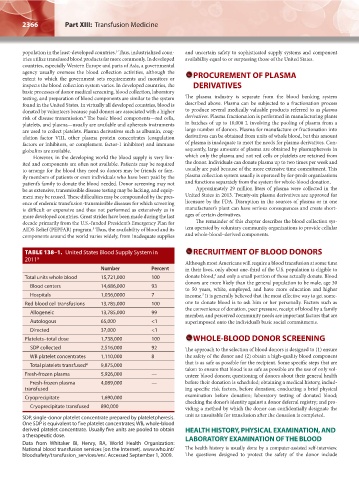
                TABLE 138–1.  United States Blood Supply System in       RECRUITMENT OF BLOOD DONORS
                2011*
                                                                      Although most Americans will require a blood transfusion at some time
                                          Number           Percent    in their lives, only about one-third of the U.S. population is eligible to
                                                                                6
                Total units whole blood   15,721,000       100        donate blood,  and only a small portion of those actually donate. Blood
                                                                      donors are more likely than the general population to be male, age 30
                  Blood centers           14,686,000       93
                                                                      to  50 years, white, employed, and have  more education and  higher
                  Hospitals               1,036,0000       7          income.  It is generally believed that the most effective way to get some-
                                                                            7
                Red blood cell transfusions  13,785,000    100        one to donate blood is to ask him or her personally. Factors such as
                                                                      the convenience of donation, peer pressure, receipt of blood by a family
                  Allogeneic              13,785,000       99
                                                                      member, and perceived community needs are important factors that are
                  Autologous              65,000           <1         superimposed onto the individual’s basic social commitments.
                  Directed                37,000           <1
                Platelets–total dose      1,738,000        100           WHOLE-BLOOD DONOR SCREENING
                  SDP collected           2,516,000        92         The approach to the selection of blood donors is designed to (1) ensure
                  WB platelet concentrates  1,110,000      8          the safety of the donor and (2) obtain a high-quality blood component
                  Total platelets transfused*  9,875,000              that is as safe as possible for the recipient. Some specific steps that are
                                                                      taken to ensure that blood is as safe as possible are the use of only vol-
                Fresh-frozen plasma       5,926,000        —          unteer blood donors; questioning of donors about their general health
                  Fresh-frozen plasma     4,089,000        —          before their donation is scheduled; obtaining a medical history, includ-
                transfused                                            ing specific risk factors, before donation; conducting a brief physical
                Cryoprecipitate           1,690,000                   examination before donation; laboratory testing of donated blood;
                                                                      checking the donor’s identity against a donor deferral registry; and pro-
                  Cryoprecipitate transfused  890,000                 viding a method by which the donor can confidentially designate the
               SDP, single-donor platelet concentrate prepared by plateletpheresis.   unit as unsuitable for transfusion after the donation is completed.
               One SDP is equivalent to five platelet concentrates; WB, whole-blood
               derived platelet concentrate. Usually five units are pooled to obtain   HEALTH HISTORY, PHYSICAL EXAMINATION, AND
               a therapeutic dose.                                    LABORATORY EXAMINATION OF THE BLOOD
               Data from  Whitaker BI, Henry, RA,  World Health Organization:
               National blood transfusion services [on the Internet]. www.who.int/  The health history is usually done by a computer-assisted self-interview.
               bloodsafety/transfusion_services/en/. Accessed September 1, 2009.  The questions designed to protect the safety of the donor include


          Kaushansky_chapter 138_p2365-2380.indd   2366                                                                 9/18/15   11:11 AM

