


Page 341 - Williams Hematology ( PDFDrive )
P. 341
316            Part V:  Therapeutic Principles                                                                                                          Chapter 22:  Pharmacology and  Toxicity of  Antineoplastic Drugs           317


                                                                      drug interactions of the various agents. Antineoplastic chemotherapy
                   Inherited genetic variations in drug-metabolizing enzymes may lead to an   is a complex undertaking, with the potential for serious or fatal side
                 increased risk of drug toxicity and may alter the antitumor response. The most   effects. Patients are best served if their treatment is based on evidence
                 important of these familial syndromes affecting treatment of leukemia is the   from clinical trials, which define optimal doses, schedules, and drug
                 deficiency of thiopurine methyltransferase, which slows the elimination of   combinations. The specific protocol chosen for treatment should be
                 6-mercaptopurine (6-MP) and leads to unanticipated toxicity during mainte-  appropriate not only for the stage and histology of the tumor but should
                 nance chemotherapy for acute lymphocytic leukemia. Pharmacokinetic moni-  consider individual patient comorbidities, age, and susceptibility to
                 toring has a standard role in the use of certain therapies, particularly high-dose   specific potential toxicities. Thus, bleomycin is not a safe choice for a
                 methotrexate, and in the evaluation of new drugs or new drug combinations.  patient with serious underlying renal or lung disease, nor is doxorubicin
                                                                      an appropriate drug for use in a patient with a history of congestive
                 To ensure appropriate dosing, and management of toxicity, there is no substi-  heart failure; even in patients with normal cardiac or pulmonary func-
                 tute for therapy based on standard protocols and peer-reviewed clinical trials.   tion, total dose limits should be respected for these agents. Even though
                 Adherence to protocols ensures that the pharmacologic variables affecting   clinical trials define the benefits and risks of a cohort of patients of a
                 drug disposition can be taken into account early in the course of treatment   defined age range and physiology, these results may not be easily extrap-
                 and that serious untoward events can be avoided while maintaining effective   olated to patients at the extreme ends of the spectrum.
                 therapy.                                                 Depending on the major route of drug clearance, doses should be
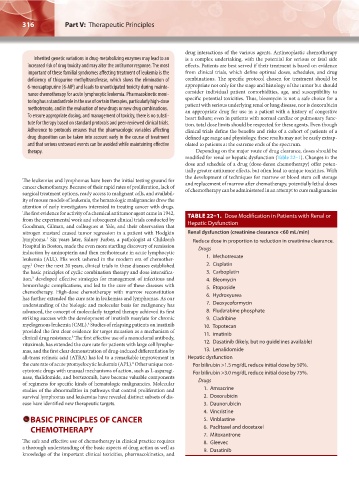
                                                                      modified for renal or hepatic dysfunction (Table 22–1). Changes in the
                                                                      dose and schedule of a drug (dose-dense chemotherapy) offer poten-
                                                                      tially greater antitumor effects, but often lead to unique toxicities. With
                                                                      the development of techniques for marrow or blood stem cell storage
               The leukemias and lymphomas have been the initial testing ground for
               cancer chemotherapy. Because of their rapid rates of proliferation, lack of   and replacement of marrow after chemotherapy, potentially lethal doses
               surgical treatment options, ready access to malignant cells, and availabil-  of chemotherapy can be administered in an attempt to cure malignancies
               ity of mouse models of leukemia, the hematologic malignancies drew the
               attention of early investigators interested in treating cancer with drugs.
               The first evidence for activity of a chemical antitumor agent came in 1942,   TABLE 22–1.  Dose Modification in Patients with Renal or
               from the experimental work and subsequent clinical trials conducted by
               Goodman, Gilman, and colleagues at Yale, and their observation that   Hepatic Dysfunction
               nitrogen mustard caused tumor regression in a patient with Hodgkin   Renal dysfunction (creatinine clearance <60 mL/min)
               lymphoma.   Six  years later,  Sidney  Farber,  a pathologist at  Children’s     Reduce dose in proportion to reduction in creatinine clearance.
                       1
               Hospital in Boston, made the even more startling discovery of remission      Drugs
               induction by aminopterin and then methotrexate in acute lymphocytic
               leukemia (ALL). His work ushered in the modern era of chemother-       1.   Methotrexate
               apy.  Over the next 20 years, clinical trials in these diseases established        2.  Cisplatin
                  2
               the basic principles of cyclic combination therapy and dose intensifica-       3.   Carboplatin
               tion,  developed effective strategies for management of infectious and        4.  Bleomycin
                   3
               hemorrhagic complications, and led to the cure of these diseases with        5.  Etoposide
               chemotherapy. High-dose chemotherapy with marrow reconstitution
               has further extended the cure rate in leukemias and lymphomas. As our        6.  Hydroxyurea
               understanding of the biologic and molecular basis for malignancy has        7.  Deoxycoformycin
               advanced, the concept of molecularly targeted therapy achieved its first        8.  Fludarabine phosphate
               striking success with the development of imatinib mesylate for chronic        9.  Cladribine
               myelogenous leukemia (CML).  Studies of relapsing patients on imatinib       10.  Topotecan
                                     4
               provided the first clear evidence for target mutation as a mechanism of       11.  imatinib
               clinical drug resistance.  The first effective use of a monoclonal antibody,
                                5
               rituximab, has extended the cure rate for patients with large cell lympho-        12.  Dasatinib (likely, but no guidelines available)
               mas, and the first clear demonstration of drug-induced differentiation by       13.  Lenalidomide
               all-trans retinoic acid (ATRA) has led to a remarkable improvement in   Hepatic dysfunction
               the cure rate of acute promyelocytic leukemia (APL).  Other unique non-    For bilirubin >1.5 mg/dL reduce initial dose by 50%.
                                                    6
               cytotoxic drugs with unusual mechanisms of action, such as L-asparagi-    For bilirubin >3.0 mg/dL reduce initial dose by 75%.
               nase, thalidomide, and bortezomib, have become valuable components
               of regimens for specific kinds of hematologic malignancies. Molecular      Drugs
               studies of the abnormalities in pathways that control proliferation and       1.  Amsacrine
               survival lymphomas and leukemias have revealed distinct subsets of dis-      2.  Doxorubicin
               ease have identified new therapeutic targets.               3.  Daunorubicin
                                                                           4.  Vincristine
                    BASIC PRINCIPLES OF CANCER                             5.  Vinblastine
                  CHEMOTHERAPY                                             6.  Paclitaxel and docetaxel
                                                                           7.  Mitoxantrone
               The safe and effective use of chemotherapy in clinical practice requires       8.  Gleevec
               a thorough understanding of the basic aspects of drug action as well as       9.  Dasatinib
               knowledge of the important clinical toxicities, pharmacokinetics, and


          Kaushansky_chapter 22_p0313-0352.indd   316                                                                   9/18/15   10:24 PM

