


Page 348 - Williams Hematology ( PDFDrive )
P. 348
322  Part V:  Therapeutic Principles        Chapter 22:  Pharmacology and  Toxicity of  Antineoplastic Drugs          323


                                                                                O
                                                                                C     N
                                                                              N
                                S                        S                             N
                                C     N                  C     N          NH 2  N
                              N                       N
                                      N                        N
                                N                  NH 2  N                          O
                                                                          HO  CH 2
                                                                                    OH
                                                                                 OH
                            6-Mercapturine            6-Thioguanine           Nelarabine


                                                                                                   H    OH
                                  NH 2                     NH 2                NH 2
                                       N                         N                   N                     N
                               N                        N                   N
                                                                                               H—N
                                        N                        N                   N                     N
                             Cl   N                   F    N              Cl   N                      N
                                                     O
                              HOCH 2  O          HO P   OCH 2  O           HOCH 2  O            HO—H C   O
                                                                                                     2
                                                     OH       OH                   F

                                    OH                       OH                  OH                    OH
                                Cladribine              Fludarabine          Clofarabine          Deoxycoformycin

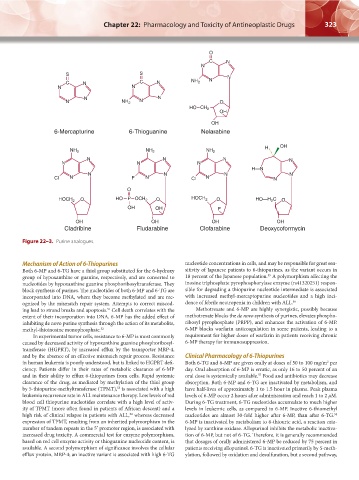
                  Figure 22–3.  Purine analogues.


                  Mechanism of Action of 6-Thiopurines                  nucleotide concentrations in cells, and may be responsible for great sen-
                  Both 6-MP and 6-TG have a thiol group substituted for the 6-hydroxy   sitivity of Japanese patients to 6-thiopurines, as the variant occurs in
                                                                                                    55
                  group of hypoxanthine or guanine, respectively, and are converted to   18 percent of the Japanese population.  A polymorphism affecting the
                  nucleotides by hypoxanthine guanine phosphoribosyltransferase. They   inosine triphosphate pyrophosphorylase enzyme (rs41320251) respon-
                  block synthesis of purines. The nucleotides of both 6-MP and 6-TG are   sible for degrading a thiopurine nucleotide intermediate is associated
                  incorporated into DNA, where they become methylated and are rec-  with increased methyl-mercaptopurine nucleotides and a high inci-
                  ognized by the mismatch repair system. Attempts to correct miscod-  dence of febrile neutropenia in children with ALL. 56
                                              51
                  ing lead to strand breaks and apoptosis.  Cell death correlates with the   Methotrexate and 6-MP are highly synergistic, possibly because
                  extent of their incorporation into DNA. 6-MP has the added effect of   methotrexate blocks the de novo synthesis of purines, elevates phospho-
                  inhibiting de novo purine synthesis through the action of its metabolite,   ribosyl pyrophosphate (PRPP), and enhances the activation of 6-MP.
                  methyl-thioinosine monophosphate. 52                  6-MP blocks warfarin anticoagulation in some patients, leading to a
                     In experimental tumor cells, resistance to 6-MP is most commonly   requirement for higher doses of warfarin in patients receiving chronic
                  caused by decreased activity of hypoxanthine guanine phosphoribosyl-  6-MP therapy for immunosuppression.
                  transferase (HGPRT), by increased efflux by the transporter MRP-4,
                  and by the absence of an effective mismatch repair process. Resistance   Clinical Pharmacology of 6-Thiopurines
                  in human leukemia is poorly understood, but is linked to HGPRT defi-  Both 6-TG and 6-MP are given orally at doses of 50 to 100 mg/m  per
                                                                                                                        2
                  ciency.  Patients  differ  in  their  rates  of  metabolic  clearance  of  6-MP   day. Oral absorption of 6-MP is erratic, as only 16 to 50 percent of an
                  and in their ability to efflux 6-thiopurines from cells. Rapid systemic   oral dose is systemically available.  Food and antibiotics may decrease
                                                                                                 57
                  clearance of the drug, as mediated by methylation of the thiol group   absorption. Both 6-MP and 6-TG are inactivated by metabolism, and
                  by 5-thiopurine-methyltransferase (TPMT),  is associated with a high   have half-lives of approximately 1 to 1.5 hour in plasma. Peak plasma
                                                  53
                  leukemia recurrence rate in ALL maintenance therapy. Low levels of red   levels of 6-MP occur 2 hours after administration and reach 1 to 2 μM.
                  blood cell thiopurine nucleotides correlate with a high level of activ-  During 6-TG treatment, 6-TG nucleotides accumulate to much higher
                  ity of TPMT (more often found in patients of African descent) and a   levels in leukemic cells, as compared to 6-MP. Inactive 6-thiomethyl
                  high risk of clinical relapse in patients with ALL,  whereas decreased   nucleotides are almost 30-fold higher after 6-MP, than after 6-TG.
                                                      54
                                                                                                                          58
                  expression of TPMT, resulting from an inherited polymorphism in the   6-MP is inactivated by metabolism to 6-thiouric acid, a reaction cata-
                  number of tandem repeats in the 5′ promoter region, is associated with   lyzed by xanthine oxidase. Allopurinol inhibits the metabolic inactiva-
                  increased drug toxicity. A commercial test for enzyme polymorphism,   tion of 6-MP, but not of 6-TG. Therefore, it is generally recommended
                  based on red cell enzyme activity or thioguanine nucleotide content, is   that dosages of orally administered 6-MP be reduced by 75 percent in
                  available. A second polymorphism of significance involves the cellular   patients receiving allopurinol. 6-TG is inactivated primarily by S-meth-
                  efflux protein, MRP-4; an inactive variant is associated with high 6-TG   ylation, followed by oxidation and desulfuration, but a second pathway,


          Kaushansky_chapter 22_p0313-0352.indd   323                                                                   9/18/15   10:24 PM

