


Page 35 - Williams Hematology ( PDFDrive )
P. 35
12             Part I:  Clinical Evaluation of the Patient                                                                                                                        Chapter 2:  Examination of Blood Cells            13


               analytical challenges are the frequency of the different cell types, which   as basophils and immature granulocytic cells, from the major normal
               vary over many orders of magnitude, from red cells (millions per μL) to   blood cell types. In addition, nucleic-acid-binding fluorescent dyes incor-
               basophils (dozens per μL), and the complexity of the structure of normal   porated into the lysis buffer measure total RNA plus DNA in the cells and
               and abnormal blood cells. Over the past several decades, instruments   are used in some analyzers to help differentiate leukocyte types. Fluores-
               have become increasingly sophisticated with the use of multiple param-  cence measurements after staining with RNA binding dyes are commonly
               eters to produce more precise results in the great majority of patient   used to detect and subclassify reticulocytes and platelets. Light absorp-
               samples. In a typical automated hematology analyzer, the blood sample   tion is the principle used for hemoglobin measurement and in some
               is  aspirated  and separated into different  fluidic  streams.  The  streams   instruments for identifying peroxidase-positive granulocytes. Instru-
               are mixed with various buffers that accomplish specific purposes in   ments rely on a combination of techniques for accuracy and precision
                                                                                                                        11
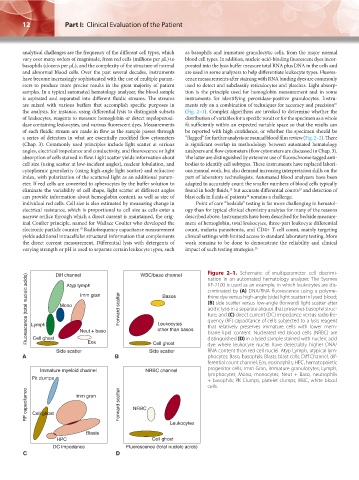
               the analysis, for instance, using differential lysis to distinguish subsets   (Fig. 2–1). Complex algorithms are invoked to determine whether the
               of leukocytes, reagents to measure hemoglobin or detect myeloperoxi-  distribution of variables for a specific result or for the specimen as a whole
               dase containing leukocytes, and various fluorescent dyes. Measurements   fit sufficiently within an expected variable space so that the results can
               of each fluidic stream are made in flow as the sample passes through   be reported with high confidence, or whether the specimen should be
               a series of detectors in what are essentially modified flow cytometers   “flagged” for further analysis or manual blood film review (Fig. 2–2). There
               (Chap. 3). Commonly used principles include light scatter at various   is significant overlap in methodology between automated hematology
               angles, electrical impedance and conductivity, and fluorescence or light   analyzers and flow cytometers (flow cytometers are discussed in Chap. 3).
               absorption of cells stained in flow. Light scatter yields information about   The latter are distinguished by extensive use of fluorochrome tagged anti-
               cell size (using scatter at low-incident angles), nuclear lobulation, and   bodies to identify cell subtypes. These instruments have replaced labori-
               cytoplasmic granularity (using high-angle light scatter) and refractive   ous manual work, but also demand increasing interpretation skills on the
               index, with polarization of the scattered light as an additional param-  part of laboratory technologists. Automated blood analyzers have been
               eter. If red cells are converted to spherocytes by the buffer solution to   adapted to accurately count the smaller numbers of blood cells typically
                                                                                                            13
                                                                                     12
               eliminate the variability of cell shape, light scatter at different angles   found in body fluids,  but accurate differential counts  and detection of
                                                                                           14
               can provide information about hemoglobin content, as well as size of   blast cells in fluids of patients  remains a challenge.
               individual red cells. Cell size is also estimated by measuring change in   Point of care “bedside” testing is far more challenging in hematol-
               electrical resistance, which is proportional to cell size as cells enter a   ogy than for typical clinical chemistry analytes for many of the reasons
               narrow orifice through which a direct current is maintained, the orig-  described above. Instruments have been described for bedside measure-
               inal Coulter principle, named for Wallace Coulter who developed the   ment of hemoglobin, total leukocytes, three-part leukocyte differential
                                   10
               electronic particle counter.  Radiofrequency capacitance measurement   count, malaria parasitemia, and CD4+ T-cell count, mainly targeting
               yields additional intracellular structural information that complements   clinical settings with limited access to standard laboratory testing. More
               the direct current measurement. Differential lysis with detergents of   work  remains  to  be  done  to  demonstrate  the  reliability  and  clinical
               varying strength or pH is used to separate certain leukocyte types, such   impact of such testing strategies. 15


                                                                              Figure 2–1.  Schematic of multiparameter cell discrimi-
                           Diff channel
                                                       WBC/baso channel
                 Fluorescence (total nucleic acids)  Lymph  Mono  Imm gran  Forward scatter  Leukocytes  XE-2100 is used as an example, in which leukocytes are dis-
                                                                              nation in an automated hematology analyzer. The Sysmex
                              Atyp lymph
                                                                              criminated by (A) DNA/RNA fluorescence using a polyme-
                                                              Basos
                                                                              thine dye versus high-angle (side) light scatter in lysed blood;
                                                                              (B) side scatter versus low-angle (forward) light scatter after
                                                                              acidic lysis in a separate aliquot that preserves basophil struc-
                                                                              ture; and (C) direct current (DC) impedance versus radio fre-
                                                                              quency (RF) capacitance of cells subjected to a lysis reagent
                                                                              that  relatively preserves immature cells  with  lower mem-
                                                             other than basos
                   Cell ghost
                                                                              distinguished (D) in a lysed sample stained with nucleic acid
                                     Eos
                                                           Cell ghost
                                                                              dye where leukocyte nuclei have detectably higher DNA/
                                                                              RNA content than red cell nuclei. Atyp Lymph, atypical lym-
                           Side scatter Neut + baso       Side scatter        brane lipid content. Nucleated red blood cells (NRBC) are
               A                              B                               phocytes; Baso, basophils; Blasts, blast cells; Diff Channel, dif-
                                                                              ferential count channel; Eos, eosinophils; HPC, hematopoietic
                     Immature myeloid channel            NRBC channel         progenitor cells; Imm Gran, immature granulocytes; Lymph,
                                                                              lymphocytes; Mono, monocytes; Neut + Baso, neutrophils
                   Pit clumps                                                 + basophils; Plt Clumps, platelet clumps; WBC, white blood
                                                                              cells.
                 RF capacitance  Cell ghost  Imm gran  Forward scatter  NRBC

                                                                 Leukocytes
                                     Blasts
                           HPC                             Cell ghost
                          DC impedance            Fluorescence (total nucleic acids)
                C                              D


          Kaushansky_chapter 02_p0011-0026.indd   12                                                                    17/09/15   5:34 pm

