


Page 379 - Williams Hematology ( PDFDrive )
P. 379
354            Part V:  Therapeutic Principles                                                                                                                          Chapter 23:  Hematopoietic Cell Transplantation            355


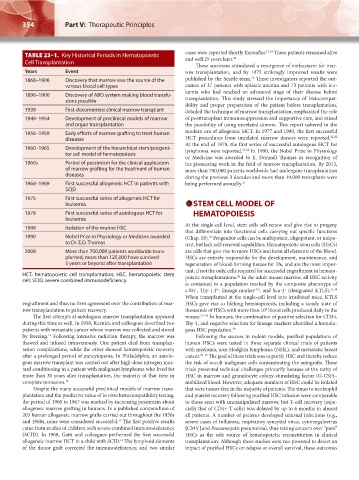
                TABLE 23–1.  Key Historical Periods in Hematopoietic    cases were reported shortly thereafter. 17,18  These patients remained alive
                                                                      and well 25 years later.
                                                                                      19
                Cell Transplantation
                                                                          These successes stimulated a resurgence of enthusiasm for mar-
                Years         Event                                   row transplantation, and by 1975 strikingly improved results were
                                                                                            20
                1868–1906     Discovery that marrow was the source of the   published by the Seattle team.  These investigators reported the out-
                              various blood cell types                comes of 37 patients with aplastic anemia and 73 patients with leu-
                                                                      kemia who had reached an advanced stage of their disease before
                1896–1900     Discovery of ABO system making blood transfu-
                              sions possible                          transplantation. This study stressed the importance of histocompat-
                                                                      ibility and proper preparation of the patient before transplantation,
                1939          First documented clinical marrow transplant  detailed the technique of marrow transplantation, emphasized the role
                1949–1954     Development of preclinical models of marrow   of posttransplant immunosuppression and supportive care, and raised
                              and organ transplantation               the possibility of using unrelated donors. This report ushered in the
                1956–1959     Early efforts of marrow grafting to treat human   modern era of allogeneic HCT. In 1977 and 1980, the first successful
                              diseases                                HCT procedures from unrelated marrow donors were reported. 21,22
                                                                      At the end of 1978, the first series of successful autologous HCT for
                1960–1965     Development of the hierarchical stem/progeni-  lymphoma were reported. 23,24  In 1990, the Nobel Prize in Physiology
                              tor cell model of hematopoiesis
                                                                      or Medicine was awarded to E. Donnall Thomas in recognition of
                1960s         Period of pessimism for the clinical application   his pioneering work in the field of marrow transplantation. By 2013,
                              of marrow grafting for the treatment of human   more than 700,000 patients worldwide had undergone transplantation
                              diseases                                during the previous 3 decades and more than 19,000 transplants were
                1968–1969     First successful allogeneic HCT in patients with   being performed annually. 25
                              SCID
                1975          First successful series of allogeneic HCT for
                              leukemia                                     STEM CELL MODEL OF
                1978          First successful series of autologous HCT for   HEMATOPOIESIS
                              leukemia
                                                                      At the single-cell level, stem cells self-renew and give rise to progeny
                1988          Isolation of the murine HSC
                                                                      that differentiate into functional cells carrying out specific functions
                1990          Nobel Prize in Physiology or Medicine awarded   (Chap. 18).  Progenitor cells can be multipotent, oligopotent, or unipo-
                                                                              26
                              to Dr. E.D. Thomas                      tent, but lack self-renewal capabilities. Hematopoietic stem cells (HSCs)
                2008          More than 700,000 patients worldwide trans-  are cells that give rise to more HSCs and form all elements of the blood.
                              planted, more than 125,000 have survived    HSCs are entirely responsible for the development, maintenance, and
                              5 years or beyond after transplantation  regeneration of blood-forming tissues for life, and are the most impor-
                                                                      tant, if not the only, cells required for successful engraftment in hemato-
               HCT, hematopoietic cell transplantation; HSC, hematopoietic stem   poietic transplantations.  In the adult mouse marrow, all HSC activity
                                                                                       26
               cell; SCID, severe combined immunodeficiency.
                                                                      is contained in a population marked by the composite phenotype of
                                                                                lo
                                                                                             –/lo
                                                                                                       +
                                                                         +
                                                                      c-kit , Thy-1.1 , lineage marker , and Sca-1  (designated KTLS). 27,28
                                                                      When transplanted at the single-cell level into irradiated mice, KTLS
               engraftment and thus no firm agreement over the contribution of mar-  HSCs gave rise to lifelong hematopoiesis, including a steady state of
               row transplantation to patient recovery.               thousands of HSCs with more than 10  blood cells produced daily in the
                                                                                                 9
                   The first attempts at autologous marrow transplantation appeared   mouse. 27–29  In humans, the combination of positive selection for CD34,
               during this time as well. In 1958, Kurnick and colleagues described two   Thy-1, and negative selection for lineage markers identified a homolo-
               patients with metastatic cancer whose marrow was collected and stored   gous HSC population. 30
               by freezing.  Following intensive radiation therapy, the marrow was   Following the success in rodent models, purified populations of
                        13
               thawed and infused intravenously. One patient died from transplan-  human HSCs were tested in three separate clinical trials of patients
               tation complications, while the other showed hematopoietic recovery   with myeloma, non-Hodgkin lymphoma (NHL), and metastatic breast
               after a prolonged period of pancytopenia. In Philadelphia, an autolo-  cancer. 31–33  The goal of these trials was to purify HSC and thereby reduce
               gous marrow transplant was carried out after high-dose nitrogen mus-  the risk of occult malignant cells contaminating the autografts. These
               tard conditioning in a patient with malignant lymphoma who lived for   trials presented technical challenges primarily because of the rarity of
               more than 30 years after transplantation, the majority of that time in   HSC in marrow and granulocyte colony-stimulating factor (G-CSF)–
               complete remission. 14                                 mobilized blood. However, adequate numbers of HSC could be isolated
                   Despite the many successful preclinical models of marrow trans-  that were tumor-free in the majority of patients. The times to neutrophil
               plantation and the predictive value of in vitro histocompatibility testing,   and platelet recovery following purified HSC infusion were comparable
               the period of 1960 to 1967 was marked by increasing pessimism about   to those seen with unmanipulated marrow, but T-cell recovery (espe-
               allogeneic marrow grafting in humans. In a published compendium of   cially that of CD4+ T cells) was delayed by up to 6 months in almost
               203 human allogeneic marrow grafts carried out throughout the 1950s   all patients. A number of patients developed unusual infections (e.g.,
               and 1960s, none were considered successful.  The first positive results   severe cases of influenza, respiratory syncytial virus, cytomegalovirus
                                                15
               came from studies of children with severe combined immunodeficiency   [CMV] and Pneumocystis pneumonia), thus raising concern over “pure”
               (SCID). In 1968, Gatti and colleagues performed the first successful   HSCs as the sole source of hematopoietic reconstitution in clinical
               allogeneic marrow HCT in a child with SCID.  The lymphoid elements   transplantation. Although these studies were not powered to detect an
                                                16
               of the donor graft corrected the immunodeficiency, and two similar   impact of purified HSCs on relapse or overall survival, these outcomes


          Kaushansky_chapter 23_p0353-0382.indd   354                                                                   9/19/15   12:45 AM

